
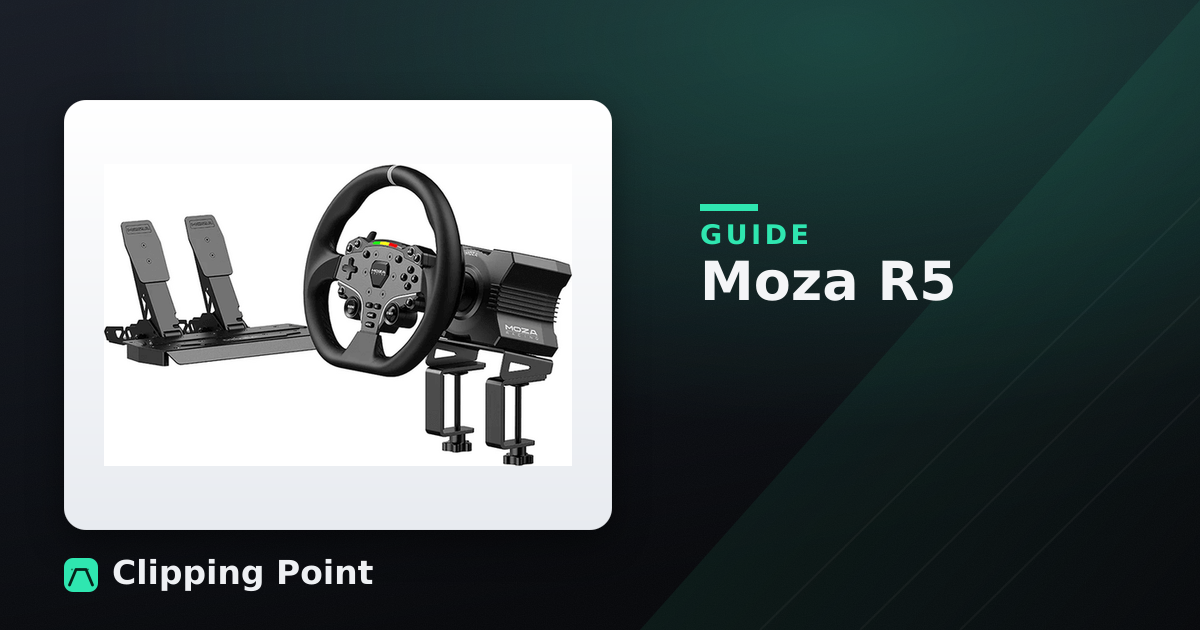
If you have a desk, a budget somewhere under $700, and you want direct drive, buy the Moza R5 bundle. Base, wheel, pedals, clamp, done. It’s 5.5 Nm, it mounts to a desk without you buying a bracket you didn’t know you needed, and the software is good enough that you’ll spend one evening in it and then forget it exists. That’s the whole recommendation. Everything below is me showing my work.
The Fanatec CSL DD is still a fine motor. It was the base that broke direct drive out of the enthusiast bracket back in 2021, and it deserves the reputation it earned. But in 2026 you’re paying more for the same 5 Nm, the table clamp is a separate purchase, and you’re buying into a support pipeline that has spent three years making people angry. If you already own Fanatec pedals or a Fanatec wheel, keep the family. If you’re starting fresh, I’d need a specific reason to point you there.
Torque matters less than you’ve been told, up to a point
Every forum thread about desk direct drive turns into a torque measuring contest. Somebody who owns a 12 Nm base will tell you 5 Nm is a toy. He’s wrong, and here’s why: he’s not running his 12 Nm base at 12 Nm. Nobody is. Go read the settings threads. People with 15 and 16 Nm hardware run 60 to 70 percent gain because full torque on a modern GT3 car snaps your wrists on a curb strike and makes stints unpleasant after twenty minutes. What they’re actually enjoying is headroom and the way a big motor holds detail while it’s loaded, not the peak number on the box. Our best sim racing wheels guide breaks the tiers down if you’re still choosing a base.
At 5.5 Nm you feel front tire load, you feel the rear step out, you feel kerbs. What you don’t get is the sheer physical weight of a heavy GT3 car under braking, and you’ll run out of torque in a Formula car with high downforce loading through a fast corner. That’s it. That’s the compromise. It’s a real one, but it isn’t the difference between “sim racing” and “not sim racing,” and anyone telling you it is has never done a 90-minute endurance stint on a 5 Nm base and come away with sore forearms anyway.
The thing that actually limits you on a desk is not the motor. It’s the desk.
Desk flex will ruin this before torque does
Here is the part the listicles skip. A direct drive base pushes back against whatever it’s bolted to. If that thing moves, the base moves, and the forces you feel are a blurry sum of tire slip and furniture wobble. It feels vague. You’ll tune it, and tune it again, and never work out why your car feels like it’s on stilts.
Most IKEA-tier desks are 22 to 25 mm of particleboard on a hollow core. Clamp a 5.5 Nm base to the middle of that span and the surface will visibly bow under a hard countersteer. Real fix, in order of how much I like them:
Clamp as close to a leg as the wheel position allows, not in the geometric center of the desk. This one costs nothing and does more than any tuning filter.
Bolt through the desk instead of clamping, if you own the desk and don’t mind four holes. Our how to mount a direct drive wheel to a desk guide walks through this step by step. Both the Moza clamp and the Fanatec table clamp are surface-friction devices, and friction against laminate is not your friend.
Put a length of steel angle or a plank under the desk edge, spanning to a leg, and clamp through both. Ugly. Works.
If your desk still flexes after that, you don’t need a bigger base. You need a rig, and you should stop reading buyer’s guides and go price a Playseat Challenge and a wheel stand, which is a genuinely fine sub-$400 answer for a small room.
Also: pedals. Under a desk, on carpet, a pedal set that isn’t braced against something will slide forward until it’s under your monitor. The R5 bundle’s SR-P Lite pedals ship with a load cell on the brake, and a load cell brake is the single biggest improvement most people make to their lap times, bigger than the wheelbase, because you start braking by pressure instead of by distance and your muscle memory finally has something to hold on to. It took me about two weeks to stop overbraking into Turn 1 at Sebring and another month before I trusted it. Then I went back and drove a potentiometer pedal set and it felt like pressing a wet sponge.
Moza R5: what a month with it actually looks like
Unboxing is uneventful, which is a compliment. The base has the clamp built into its underside, so there’s no accessory hunt. USB, barrel jack power brick, done. Pit House (Moza’s software) wants a firmware update on day one, it will ask you to update the base, the wheel, and the pedals separately, and one of those three will fail the first time and need a retry. This is normal. Nobody at Moza has fixed it. Just run it again.
First hour, put max torque at 100 percent in Pit House and do your limiting in the sim, not in the base. Reason: cut torque at the base and you lose resolution across the whole range. Set the base to give you everything and let the sim’s gain slider do the shaping. Road sensitivity around 8 out of 10 gives you kerb texture without turning the wheel into a paint mixer over concrete seams. Damping at 5, natural inertia at whatever it defaults to. Speed-dependent damping off, it’s a band-aid.
iRacing: tell it your wheel is 5.5 Nm, tick linear mode, and let the auto force button set your per-car max force. In a Porsche 992 Cup around Monza that landed me somewhere in the mid-30s Nm, which sounds absurd until you understand the number is a clipping threshold for the simulated force, not the force you’ll feel. Then drop damping and friction to near zero and never touch them. ACC: gain around 75, minimum force 0, dynamic damping 40, road effects 20. Minimum force above zero on a direct drive base is a hangover from gear-driven wheels and it adds an oily notchiness to center. Leave it at zero.
Rotation: 900 degrees at the base, and let every sim override per car. Don’t hard-set 540 because someone on YouTube did.
What surfaces after a week: the R5 has a faint electrical whine under load. Not a fault, it’s the motor, and you’ll hear it through a headset only when the room is dead silent. The wheel-side quick release has a small amount of rotational play out of the box that settles once the taper seats; if yours turns into a persistent knock, see direct drive wheel rattle at center. Pit House occasionally loses the base after a Windows sleep cycle and you replug the USB. That’s my complete gripe list, and it’s shorter than I expected.
The feel. In the McLaren 720S GT3 at Zandvoort, through the banked Turn 3, you get a clear rise in weight as the car loads and a distinct, readable moment where the front washes out. That’s the whole reason you buy direct drive. Belt bases smear that transition. In Le Mans Ultimate, the LMDh cars at Sebring over the bumps are where 5.5 Nm shows its limit, because the sim is asking for more force than the motor can give and it clips, and you feel the detail flatten out under the big hits. Doesn’t stop me from driving it. Does make me understand why people buy 9 Nm, which is the base I put under the microscope in the Moza R9 review.
Moza R3: the base I recommend more often than I expected to
3.9 Nm. Around $400 with a wheel and pedals in the bundle, sometimes less on sale. It is Xbox-licensed, which is the actual reason most people buy it.
The Moza R3 is not a slightly worse R5. It’s a different proposition. If you’re coming off a Logitech G29 or a Thrustmaster T300, the R3 will feel like a revelation for about three weeks, and then you will start hitting the torque ceiling in exactly one place: heavy braking with the car rotating. It just runs out of muscle. But the detail resolution, the thing direct drive is actually for, is all there. Same motor technology, less of it.
Buy the R3 if you play on Xbox, or if $400 is genuinely your number and $600 isn’t. Don’t buy the R3 as a stepping stone to the R5, because the delta is small enough that you’ll resent having spent twice. Skip to the R5 or wait.
| Moza R3 | Moza R5 | Fanatec CSL DD (5 Nm) | |
|---|---|---|---|
| Torque | 3.9 Nm | 5.5 Nm | 5 Nm (8 Nm with Boost Kit) |
| Desk clamp | Included | Included | Sold separately, around $60 |
| Base price, roughly | ~$260 base, ~$400 bundle | ~$400 base, ~$600 bundle | ~$350 base and up |
| Console | Xbox | PC | Xbox (PS via GT DD Pro variant) |
The Fanatec problem
I owned a CSL DD for two years and liked it. The motor is smooth, the Boost Kit 180 taking it to 8 Nm is the cheapest real torque upgrade in the category, and Fanatec’s wheel selection is deeper than anyone’s. The tuning menu on the wheel itself, where you can change FFB strength without alt-tabbing, is a small thing I still miss.
Then there’s everything else. The company’s shipping and RMA reputation over the last few years is not a rumor, it’s a wall of receipts on r/simracing: weeks-long ticket silence, parts backorders, orders sitting unfulfilled through a whole season. The Corsair acquisition was supposed to fix the operations side and it has, unevenly. Some people report clean, fast orders. Some are still waiting. Buying hardware where “will support answer” is an open question is a tax I stopped being willing to pay.
Two technical notes if you buy anyway. The older plastic-sided QR1 quick release has real play in it and it will annoy you within a month, so budget for a QR2. And the CSL DD has mild cogging at very low speed, most noticeable rolling out of the pits, which some people never notice and some people cannot unfeel once pointed out. It doesn’t affect driving. It does affect the vibe.
FAQ
Is 5 Nm enough for a direct drive wheel? For GT3, touring cars, road cars, and rally, yes, comfortably. For open-wheel with heavy downforce, you’ll notice clipping in fast corners. Nobody who owns 5 Nm regrets moving up from a belt wheel. Some regret not stretching to 9 Nm.
Do I need a rig, or will my desk work? Your desk will work if it doesn’t flex. Test it: bolt or clamp the base down, grab the wheel rim, and try to twist the base off center with your body weight. If the desk surface visibly bows, fix the mounting before you spend anything else.
Moza or Fanatec for a first direct drive base in 2026? Moza, unless you own Fanatec pedals or wheels already. Newer brand, shorter track record, and yes that’s a real risk, but the current product is better value and the support experience is currently the less frightening of the two.
Before you order
Go measure the depth of your desk from the front edge to where you’d want the wheel center, and check that a clamp jaw of about 55 mm can actually reach a flat, unobstructed underside there. Desks with a front rail, a drawer, or a rounded edge profile will not take a clamp, and you’ll find out the day the box arrives.
Buy the Moza R5 bundle if that check passes and $600 is your budget. Buy the Moza R3 if it’s $400 and you’re on Xbox. Buy the Fanatec CSL DD with the Boost Kit if you already have Fanatec wheels and pedals in a cupboard and you’ve made peace with the support lottery.
And whatever you buy, if the money only stretches to one upgrade, put it in the brake pedal.