
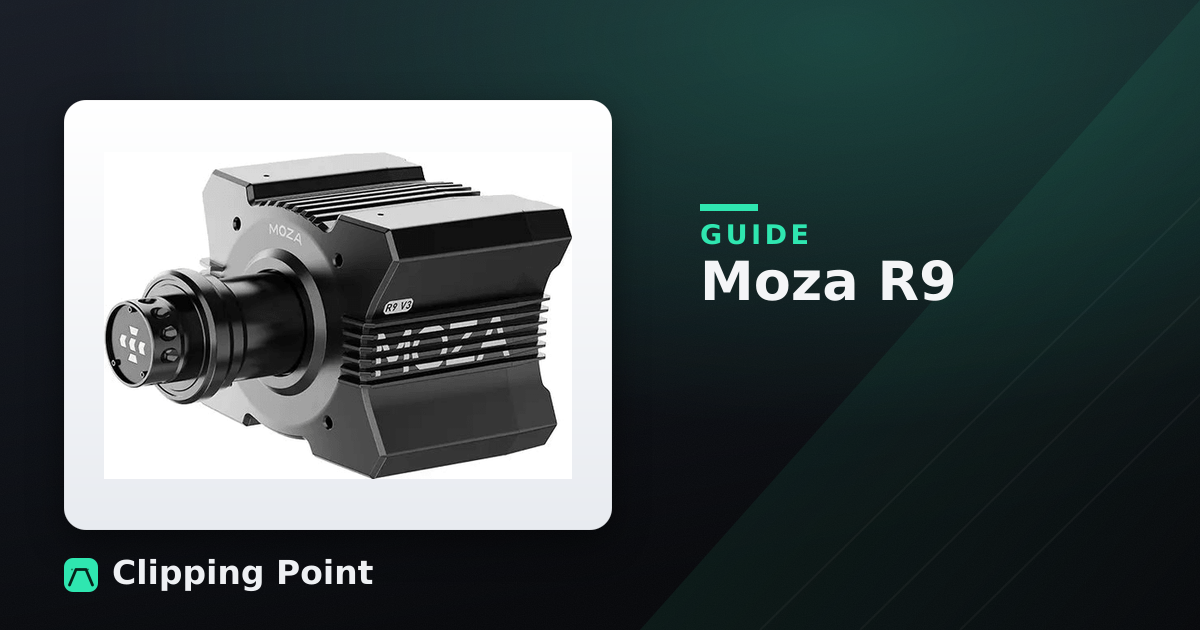
If you have a thousand dollars and you want a wheel and pedals that you won’t be itching to replace in eight months, buy a Moza R9 V2 bundle with the Moza CS V2 wheel and put the rest into Moza SR-P Lite pedals with the load cell brake. That lands you around $900 depending on what’s on sale, leaves you a bit of headroom, and gives you 9Nm of direct drive torque that is genuinely more than most people can use on a desk. If Moza’s newness bothers you, the Fanatec CSL DD (8Nm Boost Kit) with the CSL Elite V2 pedals is the other correct answer, at a similar price and with a support experience I’d describe as character-building.
The reason those two beat the alternatives is not torque. It’s that both are the bottom rung of a ladder that goes somewhere. Buy a Logitech G Pro or a Thrustmaster T598 and you are on an island: the wheel rim is the base, the pedals aren’t really upgradeable, and when you want more, you’re selling the whole thing at a loss on r/simracing for 60% of retail. Moza and Fanatec both use QR systems that let you keep the base and swap rims, and both sell pedal sets that plug into the same wiring. That’s what your thousand dollars is actually buying. Optionality.
What the money splits into, and why most people get it wrong
The instinct is to spend 80% on the wheel and grab whatever pedals come in the box. This is backwards and I say that as someone who did exactly that for two years.
Here’s the rough split I’d defend: about 55-60% wheelbase and rim, 30-35% pedals, and whatever’s left on mounting. If you’re at $1000 total and you don’t already have a rig, mounting is not optional and it’s the thing nobody budgets for. More on that below because it will ruin your purchase if you ignore it.
Direct drive is the headline, and it deserves to be, but the actual lap-time improvement most people get comes from the brake. A potentiometer brake pedal measures how far you pushed it. A load cell measures how hard. Your foot has no positional memory but it has excellent pressure memory, which is why you can hop into a road car you’ve never driven and stop it smoothly. First week on a load cell, your trail braking gets noticeably more consistent and you stop locking the fronts into T1 at Watkins Glen because you’re now modulating pressure instead of guessing at travel. It’s the single biggest jump in the whole hobby and it costs less than the wheelbase.
The Moza R9 V2 case
9Nm, around $500 for the base. The V2 revision fixed the thing people complained about with the original: the older R9 had a slightly hollow feel at low torque settings, a kind of numbness around center that showed up in slower corners. V2 tightened that up.
Setup is genuinely quick. Pi Hub (Moza’s software) is not beautiful but it works, and unlike some competitors it doesn’t require you to make an account and log in to change your FFB gain. Firmware updates happen in the app and take about two minutes. I’d budget an hour for first-time assembly if you’re also bolting to a rig, less if you’re clamping to a desk.
Settings worth trying, because the defaults are conservative: base FFB strength at 70-80%, in-game gain in iRacing set with the auto function then backed off 5%, damping at 5-10 (not zero, despite what the forum absolutists say), and rotation left on “by game” so ACC and iRacing handle it themselves. If you’re in Gran Turismo 7 on a compatible setup, run lower. GT7’s FFB is a different animal and full strength there just makes your arms tired.
The quirks show up after a week. The R9’s fan is audible when you’ve been hammering an oval for an hour, a low whir rather than anything obnoxious, but you’ll hear it in a quiet room. The QR is aluminum and solid, though it takes a firm hand the first dozen times before it loosens into an easy click. And the CS V2 wheel, which is the round rim that usually comes in the bundle, has a leather wrap that’s fine but not lovely. It’s a $150-ish rim and it feels like one.
The Fanatec counterargument
CSL DD at 8Nm with the Boost Kit is the more mature product. Fanatec has been at this longer, the driver software is deeply configurable, and the FFB has a texture to it that some people (me, on some days) prefer. Kerb detail at Spa’s Eau Rouge exit comes through with a specificity that I find slightly better than Moza’s.
Then there’s the other side. Fanatec’s shipping and RMA reputation is not internet exaggeration. Orders that sit in “processing” for three weeks, support tickets that take a fortnight, the CSL DD’s known QR1 Lite wobble on the base-model quick release (buy the metal QR2 if you can stretch, or accept a small amount of play at the hub). The company went through a rough patch and while things have stabilized under new ownership, the community memory is long and mostly earned. If you order and something’s wrong in the box, you’re going to spend some evenings on this.
The CSL Elite V2 pedals are strong for the money and the load cell brake is well judged out of the box. Fanatec’s pedal firmware lets you set the brake force curve properly, which matters more than people think.
| Moza R9 V2 + CS V2 + SR-P Lite | Fanatec CSL DD 8Nm + CSL Elite V2 | |
|---|---|---|
| Torque | 9Nm | 8Nm (Boost Kit required) |
| Rough total | ~$900 | ~$950-1000 |
| Software | Pi Hub, simple, works | Fanalab/driver, deeper, fussier |
| Support | Fast, small team | Slow, well documented complaints |
| Rim options | Growing, good value | Enormous, expensive |
Desk flex will eat your direct drive
This is the part the listicles skip. Direct drive puts real reactive force into whatever it’s bolted to. A 9Nm base clamped to a hollow-core IKEA desk does not deliver 9Nm to your hands. It delivers maybe 5Nm and converts the rest into your desk rocking back and forth, which feels like mush and makes you think the wheel is bad.
If your desk is solid wood or has a steel frame, a clamp is fine. If it’s particleboard with a laminate top, you have two options: a wheel stand (the Next Level Racing Wheel Stand 2.0 runs around $150 and is genuinely stiff enough for 9Nm) or a proper cockpit if space allows. I’d rather see someone buy an R5 (5.5Nm, around $370) on a real stand than an R9 clamped to furniture that flexes. The torque number on the box is a ceiling, not a promise.
Same for pedals. Load cell brakes need something to push against. If your pedal tray slides forward under braking, you’ll never build the muscle memory that makes a load cell worth having. The SR-P Lite has decent grip pads but on carpet, put something behind it.
What you’re giving up under $1000
No hydraulic brake. No 15Nm base. No formula rim with a carbon shell and thirty buttons. No motion, obviously.
You’re also giving up the third pedal, sort of. Both bundles usually come as two-pedal sets with the clutch as an add-on around $60-100. Skip it unless you’re doing vintage cars in rF2 or you specifically want heel-toe practice. In iRacing GT3 and ACC, you will never touch it.
What you’re not giving up is pace. A 9Nm base with a load cell brake is not the thing standing between you and your target lap time. I’ve watched people on 8Nm setups put in times that embarrass folks on 21Nm rigs, because the last two tenths come from knowing where the apex is, not from feeling the tire carcass squirm at 0.3g more fidelity.
First-hour reality check
Open the box, and you’ll find the base is heavier than you expected. The R9 is about 6kg with mount. Bolt it down before you attach the rim; doing it the other way means wrestling a wheel-shaped lever while trying to line up M8 bolts.
Install the software before plugging anything in. Both brands’ Windows drivers behave better that way. Then, and this is the step people skip, calibrate the pedals. Out of the box the load cell brake is set for a maximum force that may not suit you. Set it so full pressure with a comfortable hard push registers 100%. If you have to stand on it, you’ll be inconsistent and tired. If it maxes out with a light press, you’ll lock up constantly.
Then drive something slow. Not a GT3. Take a Mazda MX-5 around Okayama in iRacing or a Cup car around Brands Hatch, something with enough grip loss to teach you what the wheel is telling you. Direct drive on a fast car with high downforce initially feels weirdly light and you’ll misread it.
What breaks and what just annoys
In two-ish years of these bases being on the market, the failures that come up repeatedly are: USB cable seating (both brands, cheap fix, wiggle it), load cell drift on cheaper pedals after heavy use (recalibrate, takes 30 seconds), and the odd firmware update that bricks a base until you do a hard reset with the button combo in the manual. Nothing structural. These are not fragile products.
The annoyances are more predictable. Moza’s Pi Hub occasionally forgets a profile after a Windows update. Fanatec’s driver sometimes wants a specific version to work with a specific game and the community maintains an informal list of which combinations are cursed. Both have small quality-of-life papercuts that you learn to route around in a month.
One genuine gripe with the budget rims on both sides: the buttons are mushy and the shifter paddles on entry-level rims have a soft engagement that you’ll notice against a magnetic paddle setup. You’ll want to upgrade the rim before the base. That’s normal and it’s the whole point of buying into a system.
FAQ
Is 8Nm enough, or should I save for 12Nm+? It’s enough. Above roughly 10Nm you’re into territory where the constraint becomes your rig, not the base. On a desk or a folding stand, anything past 8-9Nm just makes the mount flex more. Save the money and buy better pedals or a real cockpit. When you eventually do want 15Nm, both brands sell one and your rims carry over.
Can I use these on PlayStation or Xbox? Partly, and this is the actual reason to think hard before buying. Moza’s console support is limited and depends on specific rim and base combinations, mostly Xbox-oriented on the newer stuff. Fanatec has a longer console story but PlayStation licensing lives in specific rims, not the base. If you’re on PS5 and playing GT7, check the current compatibility chart for the exact rim before ordering, because buying the wrong rim means it works fine on PC and does nothing on console.
Should I buy last-gen used instead? A used Fanatec CSL DD or first-gen Moza R9 at 60-70% of retail is decent value if the seller can show it working. Belt-driven stuff (T300, G29 era) is not worth buying now even cheap, because you’ll want to replace it within a year and the resale is worse than the direct drive gear.
Before you click buy
Measure your desk or check your stand. Push down hard on the front edge of where the wheel will mount. If it moves more than a few millimeters, buy the stand first and the base second, even if that means dropping from a 9Nm to a 5.5Nm this month.
Then check two things on the product page: whether the bundle includes the QR (some listings show a rim that needs a separate quick release) and whether the pedal set in the bundle is the load cell version or the base potentiometer version. Manufacturers list both under similar names and the price difference is small enough that people order the wrong one constantly. The load cell is the whole reason you’re buying that pedal set. Confirm it’s the one in your cart.