
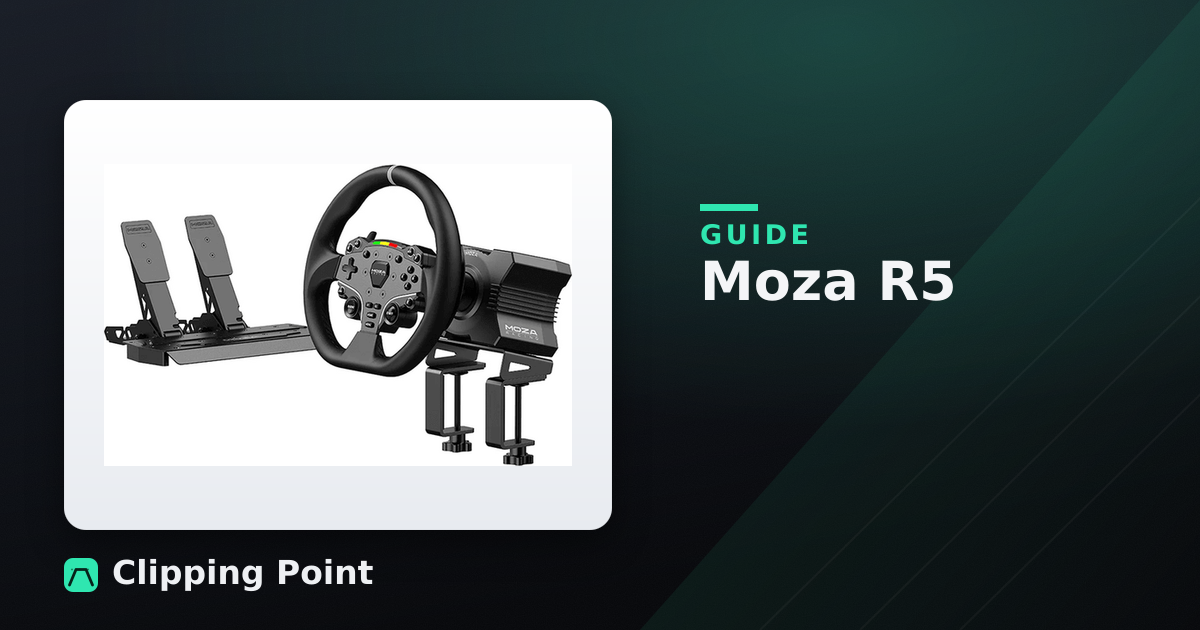
Buy the Moza R5 bundle. If you can get the R5 base, the ES wheel, and the SR-P Lite pedals landed for somewhere around $500, that is the answer for most people reading this at one in the morning, and you can close the other seventeen tabs. Direct drive, a load-cell brake included, software that mostly works. Nothing in that box will embarrass you in a year.
The one situation where I’d tell you otherwise: if you’re on Xbox, or if Corsair is running one of their periodic Fanatec CSL DD Ready2Race discounts, the CSL DD 5Nm with CSL Pedals plus the Load Cell Kit is the better long-game buy. It’s slightly worse value at list price and Fanatec’s shipping reputation still makes people twitchy. But the upgrade path is real, and the used market for their wheel rims is enormous.
Everything below is me defending those two picks and telling you what nobody puts in the spec table.
The base is the part you photograph. The pedals are the part you drive with.
This is the single thing beginners get backwards, and it’s the reason half the “under $500” listicles are useless. They rank by torque. Torque is the easiest number to compare and one of the least important at this price.
The jump from a gear-driven Logitech to any 5Nm direct drive is genuinely large. You feel the front tires load up and let go instead of feeling a notchy approximation of it. Fine. But the jump from a potentiometer brake pedal to a load-cell brake is bigger, and it’s the one that actually makes your lap times drop. A potentiometer measures how far you pushed the pedal. A load cell measures how hard. Your right leg has no idea how many millimetres it just travelled. It has an extremely good idea of how many kilograms it’s pushing, because that’s how the pedal box in a real car works and how your brain has been calibrated since you learned to drive.
Give it two weeks. You’ll start braking by feel instead of by looking at the brake bar, and threshold braking into Turn 1 at Road Atlanta stops being a coin flip.
So: a 5Nm base with a load cell beats an 8Nm base with a pot brake, every time, at this budget. If a bundle forces you to choose, choose the pedals.
Moza R5 bundle: the one I’d actually order
The R5 is a 5.5Nm direct drive base. Small, heavy for its size, and it runs cool enough that you won’t hit thermal throttling in a two-hour endurance stint, which is more than I can say for some belt-drive units I’ve cooked.
Unboxing is about twenty minutes if you’re not fussy. The base bolts to a table clamp (verify the clamp is in the bundle you’re buying, because Moza’s SKUs shift around and some regions ship it separately). The ES wheel is a plastic-rimmed round wheel with a slightly cheap-feeling suede-ish grip and a magnetic paddle setup that’s better than it has any right to be at this price. The paddles are the standout part. Crisp, short throw, a proper click. Moza’s quick release is a threaded collar, not a snap-on, so wheel swaps take fifteen seconds rather than one.
Then you install Pit House, Moza’s config software, and this is where the first-hour experience gets less charming. It wants a firmware update on basically every component, immediately, before it’ll do anything useful. Do them one at a time, don’t unplug anything mid-flash, and don’t panic when the base clicks and re-enumerates. The r/simracing threads about “bricked” Mozas are almost entirely people who yanked USB during a firmware write. Recovery mode exists and usually works.
Out of the box the FFB is over-seasoned. Moza ships with Road Sensitivity cranked high (around 8 on a 1–10 scale, depending on firmware) and it makes every surface texture feel like gravel. Drop it to 4 or 5. Set Force Feedback Strength to 100% in Pit House and do your actual strength adjustment inside the sim, because that’s the only way to keep a consistent reference across titles. Leave Natural Inertia low. The Wheel Speed limiter should be at max unless you’re getting oscillation on a flexy mount, in which case fix the mount instead.
The SR-P Lite pedals are the weak-strong point. The brake is a load cell, which is the whole reason to buy this bundle, but it’s a light load cell with a lot less maximum force than Moza’s full SR-P set. If you’re a heavy braker you will bottom it out inside a week. The fix is the stiffer elastomer stack, which is a few dollars and ten minutes with an Allen key, and it transforms the pedal. The throttle is hall-effect, smooth, no complaints. There’s no clutch in the two-pedal set, and for 95% of people driving GT3 and prototypes that’s irrelevant.
What it feels like: in iRacing, the Porsche 992 GT3 Cup at Road Atlanta, the R5 gives you a clear, unmistakable signal when the rear steps out over the crest at the top of the esses. Detail level is honest. It’s not going to give you the fine-grain texture of a 9Nm+ base, and heavy kerbs at Sebring in Le Mans Ultimate will clip the motor and go momentarily numb, but you learn where that ceiling is and drive around it.
The gripe you’ll see on the Moza Discord: firmware releases occasionally change FFB behaviour without warning, and people get annoyed that a setup they’d dialled in feels different after an update. It’s real, it’s not frequent, and Moza has been reasonably quick to roll back. They’re a younger company than Fanatec or Thrustmaster and it shows in the polish, not the hardware.
Fanatec CSL DD: the better platform, the worse purchase experience
Fanatec’s CSL DD base is 5Nm out of the box, roughly $350 on its own, with an optional Boost Kit power supply that takes it to 8Nm for about $150 more. Skip the Boost Kit at this budget. It’s a bigger power brick, it’s a real improvement, and it’s also $150 you should spend on pedals or a mount first.
Where Fanatec wins is the platform. The QR1 Lite quick release means you can move to a proper GT3-style rim later, the used market is deep, and the tuning menu on the base itself lets you adjust FFB without alt-tabbing. Their pedal upgrade path is also the cleanest: the base CSL Pedals ship with potentiometers on all three, and the Load Cell Kit swaps the brake for a proper one at around $100. Buy the kit at the same time. Don’t tell yourself you’ll add it later. You won’t, and you’ll spend six months braking badly.
CSL DD tuning menu starting point, and this is close to what I actually run: SEN Auto, FF 100, FFS Peak, NDP 15, NFR Off, NIN Off, INT 2, FEI 100. Then set your strength in-sim. In ACC, Gain around 70, Min Force 0 (direct drive doesn’t need deadzone compensation, and adding it just makes the centre feel greasy), Dynamic Damping 60, Road Effects 20. In iRacing, use linear mode, then set max force so the FFB meter lives under 100% except over kerbs. For a 5Nm base that usually lands somewhere in the low-to-mid teens depending on the car.
The awkward part. Fanatec’s shipping and RMA record between roughly 2022 and 2024 was genuinely bad, with people waiting months on warranty claims and getting nothing useful from support. Corsair bought the company out of that mess and things have improved noticeably. Order fulfilment is faster, support tickets get answered. But the institutional memory in the community is long and people are still wary, and there are still periodic reports of long waits during Black Friday crush. Factor that in if you need a working wheel by a specific date.
Console note, because it trips people constantly: platform compatibility on Fanatec lives in the wheel rim, not the base. An Xbox-licensed rim makes the base work on Xbox. A PlayStation setup needs the Gran Turismo DD Pro variant. Moza’s R5 is PC-only; if you need Xbox, look at the Moza R3 instead, which is 3.9Nm and Xbox-licensed but a meaningful step down in feel. Read the product page twice before you click buy.
The third option worth a look
The Thrustmaster T598 sits right around $500 with pedals included, uses an axial-flux motor, and is about 5Nm. It’s a competent wheel and the included T3NP pedals have a load cell brake, which is more than Fanatec gives you at list price. Thrustmaster’s build quality is fine and their support has always been the least dramatic of the three.
I don’t pick it because the wheel rim is mediocre, the upgrade path is narrow, and the FFB has a slightly soft, filtered character next to the R5. If it’s $150 cheaper than the alternatives on a given week, buy it and don’t feel bad.
| Moza R5 bundle | Fanatec CSL DD + LC kit | Thrustmaster T598 | |
|---|---|---|---|
| Torque | 5.5 Nm | 5 Nm (8 with Boost Kit) | ~5 Nm |
| Load-cell brake | Yes (light, upgrade elastomers) | Only with the $100 kit | Yes, included |
| Realistic all-in | ~$500 | ~$530+ at list, less on sale | ~$500 |
| Upgrade path | Good | Best | Limited |
| Platforms | PC | PC/Xbox/PS via rim choice | PC/Xbox or PC/PS variants |
What I’d talk you out of
The Logitech G29 and G923 still show up on every “best of” list because the affiliate payouts are reliable and the stock is everywhere. In 2026 they’re a bad use of $300. Gear-driven force feedback has a mechanical deadzone at centre that no software setting fixes, and you will feel it every corner exit for as long as you own it. The Thrustmaster T248 is the same story with slightly better hardware.
If your total budget is genuinely $300 and can’t stretch, buy used. A second-hand CSL DD or a T300RS is a better wheel than a new G923, and the sim racing used market is unusually honest because everyone’s upgrading in the same direction.
Your desk is probably the problem
Nobody tells you this before you order and everyone discovers it in the first hour. Direct drive puts real torque through the clamp, and a hollow-core IKEA-style desk will flex, boom, and transmit every kerb strike into your monitor stand. The wheel feels vague and you’ll blame the base.
Test it before you spend more: clamp the wheel, hold the rim at 9 and 3, and shove hard. If the desktop visibly moves, that movement is coming out of your force feedback budget.
Cheapest real fix is a wheel stand (Next Level Racing’s Wheel Stand 2.0 runs about $150) or a folding cockpit like the GT Lite at roughly $250. Pedals are the other half of it. On carpet, an unmounted pedal set will walk away from you under braking within three laps, and a load cell makes that much worse because you’re now pushing 30-plus kilograms into a plastic tray. A strip of grip tape and a wall behind the pedals will do in a pinch. It looks stupid. It works.
Budget for the mount before you budget for torque. This is the advice people ignore and then post about a month later.
FAQ
Is 5Nm enough, or should I save for a 9Nm base? It’s enough. The difference between 5Nm and 9Nm is real but it’s about headroom on kerbs and heavy-steering cars, not about whether you can feel the car. Plenty of fast people race 5Nm bases in leagues. Spend the delta on a load cell and a rigid mount and you’ll gain more time.
Do I need three pedals? Only if you’re driving H-pattern cars in rF2 or Assetto Corsa, or you want to do proper heel-toe. GT3, LMP, Cup cars and almost all of iRacing’s popular series are paddle-shift with an auto-clutch. Two pedals is fine, and a clutch you never use is $60 of decoration.
How much should the pedals cost as a share of the budget? Roughly a third, minimum. If you’re spending $500 and less than $150 of it is pedals, you’ve built the setup wrong. A $350 base with $150 pedals will beat a $450 base with $50 pedals in every measurable way.
Before you click buy
Check three things on the product page, in this order. One: does the bundle include a table clamp or mounting hardware, or is that a separate line item. Two: is the brake pedal a load cell or a potentiometer, and if it’s a pot, add the load-cell kit to the same order right now. Three: does the rim support your platform, not just the base.
Then buy the R5 bundle if you’re on PC and want the least friction, or the CSL DD with the Load Cell Kit if you’re on console or you know you’ll be upgrading within eighteen months. Order the stiffer brake elastomers at the same time if you go Moza. Set Road Sensitivity to 4, leave everything else alone for a week, and drive the MX-5 at Okayama in iRacing until the wheel stops being a novelty and starts being information.