
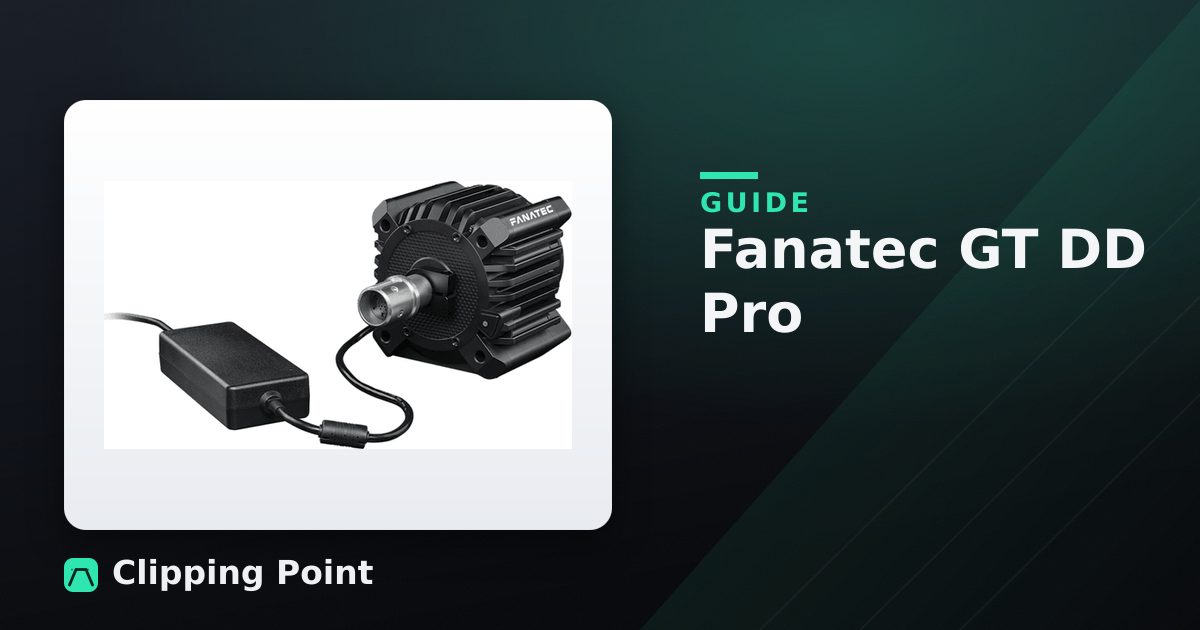
If you want the answer and not the tour: buy the Fanatec GT DD Pro in its base 5Nm form, skip the Boost Kit, and put the money you saved into a load cell brake. That is the wheel that fits Gran Turismo 7 better than anything else officially licensed for PS5, and it has been true for a few years now despite a steady drip of newer, shinier bases that mostly aren’t allowed on the console anyway.
If $700-ish is not happening, the Thrustmaster T598 at around $500 is a genuinely good direct drive base and the only real competition. And if you’re at the $250 tier, the Logitech G29 is still fine, still ugly, still notchy, and still a better first wheel than most people admit. What I’d steer you away from is the thousand-dollar end. GT7 does not give you a thousand dollars of information through the wheel. More on that below, because it’s the part everybody gets wrong.
GT7’s force feedback is quieter than you think
Here’s the thing that reframes this whole buying decision. Gran Turismo 7’s FFB model is largely self-aligning torque plus suspension load. It tells you where the front axle is pointed and roughly how hard it’s working. What it does not do, at least not with the fidelity of iRacing or Assetto Corsa Competizione, is stream you the fine-grained tire slip texture that makes a high-torque direct drive base worth owning. When the front end lets go in a Gr.3 car at Suzuka’s first Degner, the wheel goes light and stays light. It doesn’t chatter. It doesn’t scrub. It just goes quiet.
That’s not a knock on the game. GT7’s tire model has improved a lot since launch and the driving is excellent. But it changes the math on hardware. On a 15Nm base in ACC you can feel the difference between the front tire being at 6 degrees of slip and 9 degrees. In GT7 you feel “loaded” and “not loaded,” and 5Nm communicates that just as clearly as 15Nm does, only with less arm fatigue and less need for a steel rig bolted to the floor.
People on r/simracing argue about this constantly and it usually ends with someone insisting their ClubSport DD “transformed” GT7. What actually transformed is that they went from a gear-driven wheel with a dead spot to a direct drive with none. That jump is enormous. The jump from 5Nm to 12Nm inside GT7 is not.
The Fanatec GT DD Pro, after living with one
The bundle arrives in two boxes and the first hour is less plug-and-play than the marketing implies. You get the base, the CSL Steering Wheel P1 V2 (a hollow plastic rim with paddles), the two-pedal CSL Pedals, a table clamp, and a power brick. Assembly is a QR1 quick release and about six screws.
Then you plug it into the PS5 and nothing works properly until you do the firmware dance. Fanatec ships bases with whatever firmware was current when the unit was built, which on a unit that sat in a warehouse can be two years old. You will need a Windows PC and Fanatec Control Panel to update base, wheel, and motor firmware separately. Budget twenty minutes and don’t unplug anything mid-flash. This trips up an alarming number of first-time buyers who then post that their wheel is broken.
The clamp is the weakest physical part of the package. It holds, but on a normal 18mm particleboard desk you will see the desktop itself bow under a hard steering input. Not a little. You’ll watch your monitor wobble at the Nordschleife’s Fuchsröhre compression. Anything above about 60% strength on a desk mount is you fighting the furniture rather than the car. Get a rig, or at minimum a thick, solid-top desk.
The fan is real and it’s audible. Once the base has been working for fifteen or twenty minutes it spins up to something like a laptop rendering video in the next room. Over headphones you’ll never notice. On speakers in a quiet room at 1am, you will.
The P1 V2 rim is the compromise that funds the good base. It creaks if you squeeze it hard, the rubber grip attracts every particle of dust in the county, and the paddles are decent but not magnetic. It’s fine. It’s also the first thing most owners replace within a year, usually with a ClubSport rim or one of the round leather ones off the used market.
Settings that actually work in GT7
Ignore anyone handing you a 20-line tuning menu. GT7 responds to a short list.
On the base tuning menu: SEN to AUTO (GT7 sets rotation per car, and it’s one of the few games that does this properly, so a Gr.4 car gets its own lock-to-lock and the Vision GT cars get theirs), FFB 100, FFS to PEAK, NDP around 25 to 35, NFR at 0 to 5, NIN 0, INT 4, FEI 100.
NDP is the one to fiddle with. It’s damping, and GT7 sends a fairly raw signal that can feel loose and oscillatory around center on a light car. Push NDP to 35 and the wheel settles down and feels like it has real steering rack friction. Drop it to 10 and you get more detail with a wheel that hunts at high speed. I sit at 30.
In game, under Force Feedback: Max Torque around 5 to 7, Sensitivity at 1 or 2. Max Torque is your gain. Above 7 on this base you’ll clip on kerbs, meaning the wheel maxes out and every detail on top of that peak vanishes. Sensitivity is the misleading one. Turning it up doesn’t add information, it amplifies the road surface and rumble layer, so at 8 or 10 you get a wheel that buzzes constantly and drowns out the thing you actually need to feel, which is the front axle loading up. Most fast GT7 drivers I know run Sensitivity at 1.
Take a Gr.3 car to Suzuka with those numbers. The moment the wheel earns its money is Turn 1 into Turn 2, where you can feel the front bite, then the weight transfer as you release brake pressure. On a G29 that whole sequence is one undifferentiated heaviness. On the GT DD Pro there are three distinct events in it.
Skip the Boost Kit
The 8Nm Boost Kit is a bigger power supply, roughly $150, and it takes about thirty seconds to swap. That’s the whole upgrade. You can add it any time, so there is zero reason to pay for it up front, and in GT7 specifically I’ve never found a car where 8Nm told me something 5Nm didn’t. Buy it later if you move to ACC on PC and find yourself wanting more. Which you probably won’t.
The upgrade nobody puts on the box
The CSL Pedals in the bundle are two potentiometer pedals. The brake is a spring, and your foot learns to modulate it by position rather than pressure, which is not how a real brake works and not how your muscle memory should be trained.
The CSL Pedals Load Cell Kit costs somewhere around $100 to $130 and replaces the brake spring with a load cell that measures force. It is the single largest improvement available to a GT7 setup at any price, including replacing your wheel base. The first week is awkward because you’ll be locking the fronts constantly. Then something clicks and you start trail braking with actual pressure control, and lap times drop in a way no amount of torque delivers. Anyone who has done this upgrade will tell you the same story. It’s one of the few pieces of universal agreement in this hobby.
Set it up so full pedal travel takes real effort. Most people run it far too soft at first.
The one I’d talk you out of
The Logitech G Pro Racing Wheel is 11Nm, PS5 licensed, well built, and costs around $1,000 for the base with pedals pushing the package well past that. Logitech’s TrueForce implementation is clever and their PS5 support is solid.
I still wouldn’t buy it for GT7. You’re paying roughly $400 more than the GT DD Pro for torque headroom the game doesn’t use, on a platform where you can’t take that base to iRacing anyway unless you also own a gaming PC. If you do own a PC and split your time, the calculus changes and the Fanatec still probably wins on price-to-parts. The G Pro’s real audience is someone who wants one very good box, doesn’t want to think about firmware managers, and has the budget. That’s a legitimate person. It just isn’t the person searching for a GT7 wheel at midnight.
| Wheel | Price (approx) | Type | Worth it for GT7? |
|---|---|---|---|
| Logitech G29 | $250 | Gear driven | Yes, as a first wheel |
| Logitech G923 | $375 | Gear + TrueForce | Only on deep sale |
| Thrustmaster T598 | $500 | Direct drive, 5Nm | Yes, strong value |
| Fanatec GT DD Pro | $700 | Direct drive, 5Nm | Best overall |
| Logitech G Pro | $1,000+ | Direct drive, 11Nm | Overkill here |
Thrustmaster T598, the value play
Direct drive, around 5Nm, roughly $500 with pedals, and it undercuts Fanatec by a couple hundred. The wheel rim is a decent GT-style unit and the magnetic paddles are better than the P1 V2’s. Thrustmaster’s software is simpler than Fanatec’s, which is both a compliment and a limitation.
Where it loses: the included pedals have no load cell path as clean as Fanatec’s, the upgrade ladder above it is thin, and Thrustmaster’s build feel is a step down on the base housing. Where it wins: it’s $200 cheaper and it’s direct drive, which is the jump that matters. If your budget stops hard at $500, buy it without agonising.
Logitech G29 and G923: still defensible
The Logitech G29 has been on sale for a decade and it’s frequently under $200 on Amazon during a sale. It’s gear driven, which means a small notch at center, a mechanical clatter over kerbs, and a ceiling on detail that you will hit eventually. The pedals are mediocre. The build is plastic and it clamps to a desk without drama.
None of that stops it being the correct purchase for someone who isn’t sure they’ll stick with this. You can flip a used G29 for close to what you paid. You cannot say that about most sim gear.
The Logitech G923 adds TrueForce, a vibration layer driven by game audio, and it does work in GT7. It’s also the same gear-driven base underneath with the same center notch. At full price it’s poor value against the T598. On a heavy discount it’s fine.
Before you order
Check three things. First, that your desk or rig can take a direct drive base without visibly flexing, because a 5Nm wheel bolted to a wobbly surface feels worse than a G29 on a solid one. Second, that you have access to a Windows PC for Fanatec firmware, because there is no console-side updater and this catches people out. Third, Fanatec’s shipping estimates. The Corsair acquisition improved stock levels a lot compared to the backorder era that made the brand infamous, but “in stock” and “on your doorstep this week” are still occasionally different claims, so order before you clear your calendar for a weekend of racing.
FAQ
Does the Fanatec GT DD Pro work on PC too? Yes, fully, over USB, with the same tuning menu and no licensing restrictions. It’s a normal Fanatec base that happens to carry the PlayStation handshake chip. That’s a real argument in its favour if a PC is anywhere in your future.
Can I use a Moza or Simagic wheel on GT7? Almost certainly not. PS5 requires officially licensed hardware, and the PC-first brands mostly don’t have that licensing. This is why the GT7 wheel list is so much shorter than the PC one, and it’s a running complaint on every sim racing forum. Verify current compatibility on the manufacturer’s own PS5 page before you spend anything.
Is a wheel actually faster than a controller in GT7? Not immediately. Expect to be several seconds a lap slower for the first week, and controller aces routinely beat wheel users in Sport mode. What you gain is consistency over a race distance and the ability to catch a slide you’d have lost on a stick. Give it a month before you judge.