
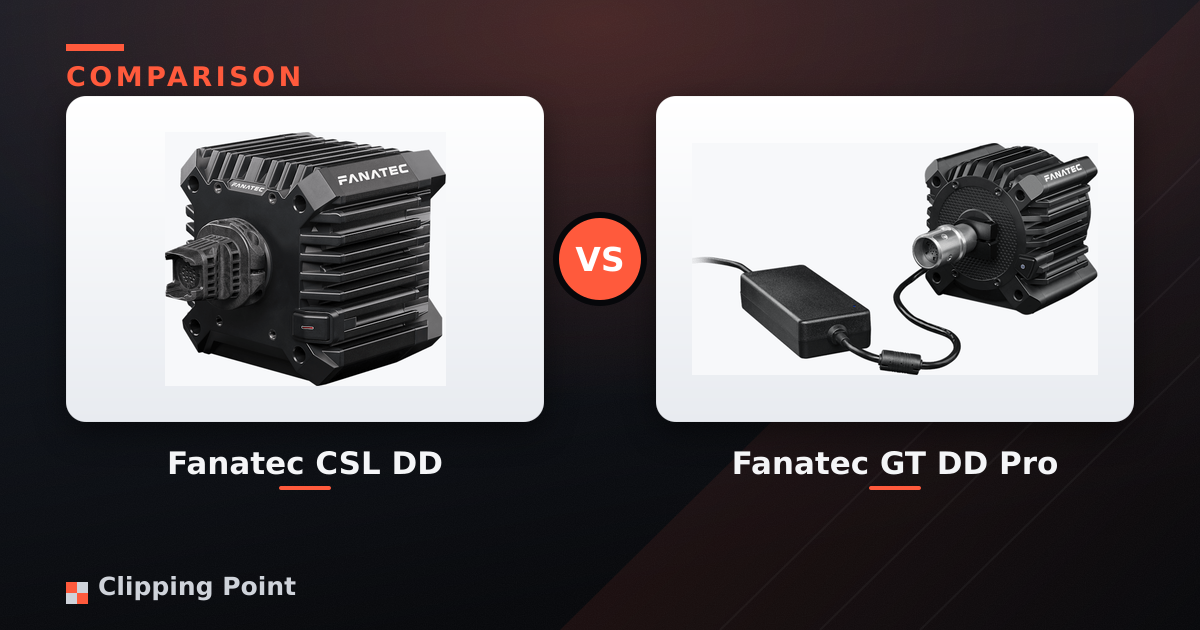
| Fanatec CSL DD | Fanatec GT DD Pro | |
|---|---|---|
| Peak torque | 5 Nm (8 Nm with Boost Kit) | 5 Nm (8 Nm with Boost Kit) |
| Drive type | Direct drive | Direct drive |
| Platforms | PC · Xbox | PC · PS5/PS4 |
| In the box | Base only | Bundle: wheel + pedals |
| Best for | An upgrade path into the Fanatec ecosystem | The go-to direct-drive base for PlayStation |
Specs from each manufacturer's current listings. Prices move constantly — hit the price buttons above for today's numbers.
Here’s the answer you came for at 1am: the Fanatec CSL DD and the Fanatec GT DD Pro are the same wheelbase inside the same plastic shell, running the same motor and the same firmware. The difference that matters is a licensing chip and a sticker. The GT DD Pro is the PlayStation-blessed version, so it works on PS4 and PS5 (and PC). The CSL DD is the Xbox-blessed version, so it works on Xbox (and PC). Pick the one that matches the console you actually own. If you only play on PC, buy whichever is cheaper on the day.
That’s genuinely it for the big decision. Everything else people argue about (the 5Nm versus 8Nm thing, the wheel it ships with, the pedals) applies to both boxes equally, because it’s the same hardware wearing a different jacket. So the rest of this is about the stuff Fanatec’s product page won’t tell you: what these bases are like to live with, where they annoy you after a month, and the one upgrade that’s actually worth your money versus the two that aren’t.
Same motor, two badges
Both bases ship at 5Nm of torque out of the box with the standard power brick. Both can be pushed to 8Nm if you buy the Boost Kit 180, which is really just a beefier power supply plus the firmware headroom to use it. There is no secret “better” motor hiding in one version. I’ve had the guts of both apart on my desk and the only physical difference you’d ever notice is which console it talks to. If you want the base judged on its own merits, that’s the full Fanatec CSL DD review.
The GT DD Pro exists because Sony wanted a direct-drive wheel that works with Gran Turismo 7 on PS5, and Fanatec had the CSL DD sitting right there. So they added the PlayStation handshake, co-branded it with the Gran Turismo logo, and bundled it with a wheel and a set of pedals. The CSL DD, by contrast, is more often sold as a bare base so you build your own kit around it.
Which brings up the one real gotcha nobody mentions until you’ve already paid: neither base works on both consoles. If you buy the GT DD Pro and switch to Xbox in two years, that base becomes a PC-only paperweight for your Xbox. Same the other direction. Cross-platform is the one thing direct drive still can’t do, and it’s a Microsoft/Sony licensing fight, not a Fanatec limitation.
The first hour
Setup is not the frictionless experience the marketing implies. You bolt the base down, plug in the power brick, and then you go to Fanatec’s site to download the driver and, almost certainly, flash new firmware to the base, the wheel, and the pedals separately. The Control Panel software looks like it was designed in 2013 and it kind of was. It works. It’s just ugly and occasionally throws a “motor not detected” error that a reboot fixes.
The base itself is small. Smaller than people expect. It’s a chunky little cube, and that’s the first place you run into trouble, because a small base with real torque behind it wants to twist your desk instead of the wheel. On an IKEA-tier table with a single front clamp, 5Nm will flex the tabletop and you’ll feel a mushy, slightly delayed response that people mistake for the base being weak. The base is fine. Your desk is the problem. More on that below, because it’s the single most common reason someone thinks direct drive was overhyped.
Wheel attachment is via Fanatec’s quick release. The older plastic QR1 has a well-earned reputation for developing a tiny bit of play over time, a faint knock you feel at the exact moment you transition from left lock to right. If your bundle comes with the metal QR2, you’re set. If it comes with the plastic one, budget for the upgrade eventually. It’s not urgent on day one. You will notice it by month three.
What 5Nm actually feels like, and whether you need 8
Five newton-metres does not sound like much on paper. It’s plenty. On a desk, in a GT3 car, 5Nm will give you a beefier arm workout than you’d guess after a 40-minute stint at Spa in ACC. You feel the front tyres load up under braking into Eau Rouge, you feel the rear step out, you feel the kerbs at the top of the hill try to rip the wheel flat. It’s a night-and-day jump from any belt or gear-driven wheel like the old G29 or a Thrustmaster T300, the kind of gap our best sim racing wheels guide maps tier by tier.
So do you need the Boost Kit 180 for 8Nm? My honest position, and it’s not the popular one: most people buying their first direct-drive base do not. Here’s the reasoning. If your desk already flexes at 5Nm, adding 3Nm makes the flex worse, not the feel better. The extra torque is only useful once you’ve got a rock-solid mount, and by the time you’ve built that, you’re probably eyeing a bigger base anyway. Where the Boost Kit does earn its keep is on a proper aluminium rig running heavier cars, or if you specifically love the extra weight in formula stuff. If you’re on a desk, spend that money on a load cell instead. Every time.
The upgrade that’s actually worth it
The pedals are where these bundles quietly cheap out. The standard two-pedal set that ships with a lot of GT DD Pro packages uses a potentiometer brake, which means you’re braking by pedal position, like pressing a spring. It’s fine. It’s also the thing holding your lap times back more than any amount of wheel torque.
Add the CSL Pedals Load Cell Kit and the whole experience changes. A load cell measures pressure, not travel, so you brake with your leg the way you would in a real car, pushing against a firm stop to a target force. Threshold braking suddenly becomes learnable. Trail braking into a slow corner at, say, the final chicane at Monza stops being a guessing game. People who spend $300 upgrading from 5Nm to 8Nm and skip the load cell have their priorities exactly backwards, and I’ll happily die on that hill. If you buy one accessory this year, buy the brake.
Living with it: the quirks nobody lists
After a few weeks a few things surface. The cooling fan spins up under sustained high force and it’s audible, a soft whir you’ll hear in a quiet room during a long stint. Not loud. Present. Some units have a faint coil whine at certain wheel angles when the base is holding torque but not moving; it’s normal and not a fault, though it drives a certain kind of person insane.
The base runs warm, which is expected, and it has a thermal system that will quietly reduce torque if you cook it during a two-hour endurance race. You’ll feel the FFB go slightly limp and think something broke. It didn’t. It’s protecting the motor and it comes back once it cools. Worth knowing before you file a support ticket.
Speaking of which. Fanatec’s support and shipping reputation is the elephant in the room and I’m not going to pretend otherwise. For years the running joke on r/simracing was that ordering from Fanatec meant your gear might arrive in a week or in two months, and if something broke, the RMA process could eat your soul. The company hit serious financial trouble and was bought by Corsair in 2024, and things have reportedly steadied since, but the trust deficit is real and earned. Buy from a stocked regional warehouse if you can, keep your box, and don’t expect miracles from the ticket queue. This is the actual risk of buying Fanatec, far more than any spec.
Settings worth trying
Don’t leave the base on defaults. A starting point that works for most people: set the base FFB (FF on the wheel or in the tuning menu) to 100, then control the actual strength inside each sim so you’re not double-clipping the signal.
In ACC, drop the in-game gain to around 60 to 70 percent and set minimum force to zero; the CSL DD doesn’t need artificial minimum force the way a gear wheel does. In iRacing, use the auto button to set the wheel force per car, then nudge it so you’re just not clipping on the fastest corner. Rotation at 900 degrees for GT3 and road cars, and drop it via the tuning menu for formula stuff where you want less lock. Turn the damping way down or off once you’re used to it; the stock damping hides detail that’s the whole reason you bought direct drive. In Gran Turismo 7 on the GT DD Pro, the in-game FFB sliders are coarse, so set torque around 5 or 6 and sensitivity low, and accept that GT7’s force feedback is just less detailed than a PC sim no matter what base you hang off it.
The desk problem, spelled out
If you take one practical thing from this, take this. A direct-drive base is only as good as what it’s bolted to. On a flexing desk you are feeling the desk, not the tyres. Before you spend a cent on the Boost Kit, get the base clamped or bolted to something that does not move: a thick tabletop with a proper clamp at both front corners, or better, a dedicated wheel stand or 80/20 aluminium rig. A $60 rock-solid mount does more for the feel than $150 of extra torque. I’ve watched people return a CSL DD as “disappointing” when the base was fine and their card table was the culprit.
Quick FAQ
Is the GT DD Pro better than the CSL DD? No. Same base. The GT DD Pro just adds PlayStation compatibility and usually comes bundled with a wheel and pedals. If you’re on PC or Xbox, the CSL DD gives you the identical motor without paying for PlayStation licensing you won’t use.
Can I use the GT DD Pro on Xbox, or the CSL DD on PlayStation? No. That’s the whole reason two versions exist. GT DD Pro does PlayStation and PC; CSL DD does Xbox and PC. Match it to your console and don’t assume you can switch later.
Should I get the 8Nm Boost Kit? Only if you have a stiff rig and want more torque for heavier cars. On a desk, or as a first direct-drive setup, skip it and put the money toward the CSL Pedals Load Cell Kit. The brake upgrade improves your driving; the torque bump mostly just fights your table.
So, which do you order
Buy the Fanatec GT DD Pro if you play on PlayStation, full stop, because it’s your entry point into direct drive there and the Gran Turismo 7 support is the reason it exists. Buy the Fanatec CSL DD if you’re on PC or Xbox, and buy it as a bare base so you can pick your own wheel rather than paying for a bundled one you’ll replace. If you’re still cross-shopping brands at this price, our Moza R5 vs Fanatec CSL DD comparison is the next stop. Either way, before you check out, price in a load cell brake and a mount that doesn’t flex, and think hard before adding the Boost Kit 180 unless your rig is already solid.
One last thing to check before you click order: confirm the base is shipping from a warehouse in your region, not backordered from overseas. With Fanatec, that single detail decides whether your gear shows up next week or sometime after you’ve forgotten you bought it.