
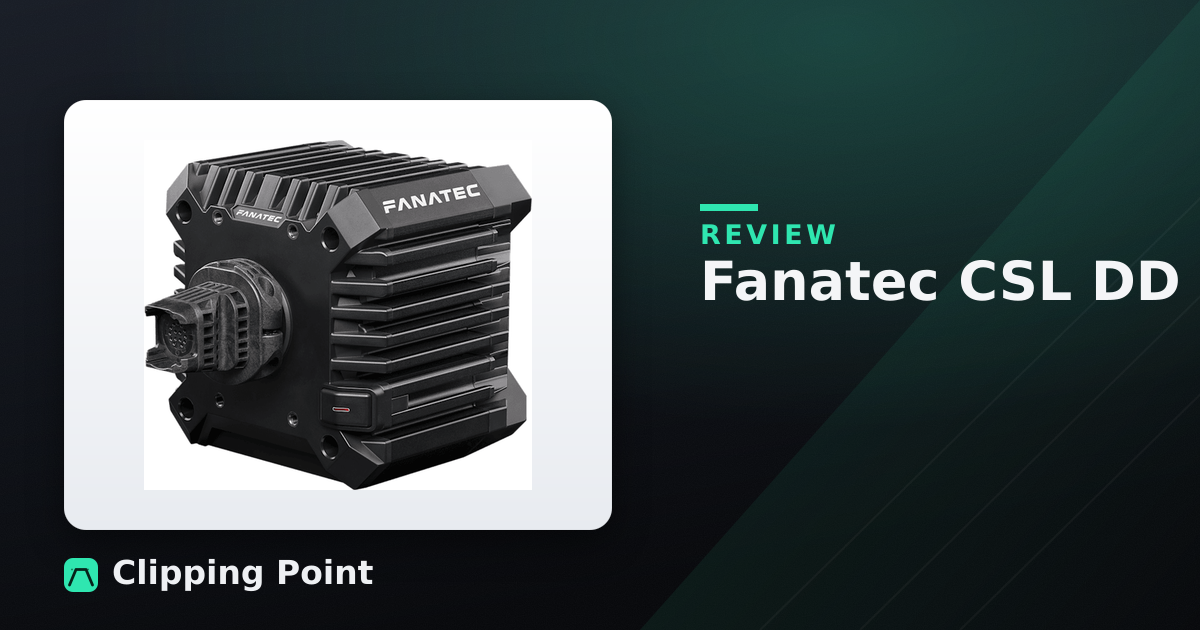
The Fanatec CSL DD is still the entry direct-drive base I’d point most PC and Xbox players toward, and it’s still the one nearly every rival gets measured against three years after launch. But I’ll say the uncomfortable part in the first breath: the price on the box is a down payment, not the bill. This is a genuinely excellent little wheelbase hiding behind a headline number that quietly leaves out the two things you can’t race without.
So this review isn’t going to tell you the motor is good. It is. You already knew that. It’s going to tell you what the CSL DD is actually like to own, where it annoyed me, and the one honest question that decides whether it’s the right buy for you: what does it cost once it’s a setup you can actually drive?
| Fanatec CSL DD | Moza R5 | |
|---|---|---|
| Peak torque | 5 Nm (8 Nm with Boost Kit) | 5.5 Nm |
| Drive type | Direct drive | Direct drive |
| Platforms | PC · Xbox | PC |
| In the box | Base only | Base (bundle adds ES wheel + SR-P Lite pedals) |
| Best for | An upgrade path into the Fanatec ecosystem | A first direct-drive base without overspending |
Specs from each manufacturer's current listings. Prices move constantly — hit the price buttons above for today's numbers.
Who the CSL DD is actually for
Buy this base if one of two things is true. Either you’re on PC or Xbox and you want the deepest hardware ecosystem in sim racing to grow into, or you already own a Fanatec wheel from an older CSL Elite or CSU setup and you want to jump to direct drive without re-buying everything. Those two buyers get the most out of it, and the second one gets a genuine bargain, because they skip the single biggest hidden cost.
Everyone else needs to walk in with eyes open. If this is your very first wheel and you own nothing Fanatec, you’re not buying a cheap direct drive. You’re buying the start of a setup, and the finished setup costs a lot more than the base alone. That’s not a knock, it’s just the reality the “cheapest direct drive!” videos skate right past. I go deeper on the value math against the obvious alternative in the Moza R5 vs Fanatec CSL DD head-to-head, and if you’re still shortlisting bases in general, the best sim racing wheels hub lays them out side by side.
What it feels like to drive
Five newton-metres does not read like much. On a desk, in a GT3 car, it’s plenty. After a 40-minute stint at Spa in ACC your forearms know they did something. You feel the front tyres load under braking into Les Combes, you feel the rear rotate and let go, you feel the kerbs try to slap the wheel out of your hands. Compared to any belt or gear wheel you might be upgrading from, a G29 or an old T300, it’s not an improvement, it’s a different category of thing.
The motor itself is clean. There’s a faint notchiness at very low forces before you’ve dialled the settings, the kind of thing you notice for one evening and never again once the base is tuned. This is a properly good wheelbase. Nobody serious argues otherwise, which is exactly why the interesting questions are all about torque, cost, and the company selling it.
The 5 Nm vs 8 Nm question, and the Boost Kit
Here’s the debate you came for. The CSL DD ships at 5 Nm on its standard power supply. Buy the Boost Kit 180 and you unlock 8 Nm. That kit is, stripped of the marketing, a beefier 180-watt power brick plus the firmware headroom to actually use it. There is no secret stronger motor in the 8 Nm version. It’s the same base fed more electricity.
My honest position, and it’s not the popular one: most first-time direct-drive buyers do not need it. The reasoning is about physics, not brand loyalty. If your desk flexes under 5 Nm, and a lot of desks do, then adding 3 Nm makes the flex worse, not the feel better. The extra torque only pays off once the base is bolted to something that genuinely does not move, and by then you understand what you want and can add the Boost Kit later as a cheap upgrade.
Where 8 Nm earns its money: a rigid aluminium rig, heavier cars, or formula stuff where you actually enjoy the extra arm weight. There the headroom means less clipping, which is when the force feedback maxes out and detail flattens into a wall of nothing. If that’s your situation, and especially if you’re already committed to Fanatec, get the 8 Nm version from the start rather than paying twice.
But if you’re on a desk buying your first direct drive, put that Boost Kit money toward a load-cell brake instead. Every single time. A load cell changes how you drive; three extra newton-metres mostly just fights your table.
Base only: the price nobody quotes you
This is the whole review, really. The CSL DD is sold as a wheelbase only. No wheel. No pedals. You cannot drive a wheelbase. So the real cost of a working CSL DD setup is the base, plus a wheel rim, plus a set of pedals, and the pedals question has its own trap.
The standard CSL Pedals use a potentiometer brake, which means you brake by pedal position, like pressing against a spring. It works, technically. It’s also the single thing holding your lap times back more than any amount of wheel torque. The fix is the CSL Pedals Load Cell Kit, which measures pressure instead of travel, so you brake with your leg against a firm stop the way you would in a real car. Threshold braking becomes learnable. Trail braking into the final chicane at Monza stops being a guess. On a Fanatec setup the load cell isn’t really optional, which means it’s another line item stacked on top of the base you thought was cheap.
Add it up honestly. Base, then a rim, then load-cell pedals, and you’re well past double the headline number before anything ships. That’s not me quoting a figure at you, because prices drift and the buttons above will always be more current than I am. It’s me telling you the shape of the bill so you’re not blindsided at checkout. This is precisely why a complete bundle from a rival can undercut a “cheaper” Fanatec base once both carts are actually full.
The ecosystem: lock-in that cuts both ways
The reason people put up with all of this is the ecosystem, and it’s real. Fanatec’s quick release lets you pop rims on and off in seconds, and the range of wheels that fit the CSL DD is enormous, from a plain round CSL rim up to Podium formula and GT wheels that cost more than the base. Same story with pedals and shifters. You buy into a platform you can grow inside for years without changing the wheelbase. That’s the genuine pro, and it’s a strong one.
The flip side is that lock-in is a wall in both directions. Fanatec wheels only fit Fanatec bases. If you ever want to switch to Moza or Simucube down the line, your wheel collection does not come with you, and neither does the resale logic. The deeper you invest, the more expensive it is to ever leave. That’s fine if you’re confident Fanatec is your long-term home. It’s a trap if you’re not sure yet, and given the next section, “not sure yet” is a defensible place to be.
One practical ecosystem gotcha worth budgeting for: the older plastic QR1 quick release develops a faint knock over time, a tiny bit of play you feel right at the transition from left lock to right. If your setup comes with the metal QR2, you’re set. If it’s the plastic one, you’ll want the upgrade eventually. Not urgent on day one. Very noticeable by month three.
Xbox compatibility, and the catch nobody mentions
The CSL DD is the Xbox-licensed version of this wheelbase, which is the entire reason it exists as a separate product from the otherwise-identical PlayStation model. If you want the full breakdown of why there are two near-identical bases, I wrote the CSL DD vs GT DD Pro explainer, but the short version is: CSL DD does Xbox and PC, the GT DD Pro does PlayStation and PC, and neither crosses over. Match it to the console you own and don’t assume you can switch later.
Here’s the catch that catches people. On Xbox, the console requires the attached wheel to carry the license, so you can’t just bolt any rim on and expect it to work on console. You need an Xbox-compatible Fanatec wheel in the quick release for the base to function on Xbox at all. On PC, anything goes. On Xbox, the wheel is part of the licensing handshake, and buying the wrong rim means a base that works on your PC and does nothing on your console. Check the wheel’s compatibility, not just the base’s, before you order.
Software: Fanalab is deep, the drivers are a lottery
Fanatec’s software is two things. There’s the driver and Control Panel, which looks like it was designed in 2013 because it roughly was, and there’s Fanalab, the tuning layer with per-game profiles, LED and display control, and genuinely deep force-feedback adjustment. Power users love Fanalab. It’s more capable than anything a newcomer needs and more fiddly than a newcomer wants.
The recurring annoyance is driver roulette. The newest driver is not always the most stable one, and the community keeps informal “known good” version lists for a reason. When you land on a good combo it’s flawless. When you land on a bad one you’re reading forum threads at 1am instead of driving. This has been a Fanatec tax for years, and while it’s improved, it hasn’t vanished. Budget an evening for the first setup, and don’t assume the latest download is the safe one.
For starting settings, don’t leave the base on defaults. Set the base FFB to 100 and control the actual strength inside each sim so you’re not double-clipping the signal. In ACC, drop the in-game gain to around 60 to 70 percent with minimum force at zero; a direct-drive base doesn’t need the artificial minimum force a gear wheel does. In iRacing, use the auto button per car, then nudge it up until you’re just not clipping through the fastest corner. Run 900 degrees of rotation for GT3 and road cars and let each sim request less for formula. Turn the stock damping right down once you’re comfortable, because it hides the exact low-level detail you paid direct-drive money to feel.
The honest cons: price creep and the Fanatec question
Two real downsides, and neither is about the hardware.
The first is price creep. Fanatec has nudged prices upward over the years, and the base you remember being a screaming deal at launch is not the same value it was, especially once the mandatory add-ons are in the cart. The headline number stays attractive precisely because it excludes the wheel and the load-cell pedals you cannot skip. Judge the CSL DD on its all-in cost, not its sticker, and it looks less like a budget hero and more like a fair mid-tier setup.
The second is the elephant in every r/simracing thread, and I won’t pretend around it. Fanatec’s shipping and support reputation went through a genuinely rough stretch. For years the running joke was that a Fanatec order might arrive in a week or in two months, and an RMA could eat your soul. The company hit serious financial trouble and was bought by Corsair in 2024. Things have reportedly steadied since, and the hardware was never the problem, but the trust deficit is real and earned. Buy from a stocked regional warehouse when you can, keep the box, and keep your expectations of the support queue modest. This is the actual risk of buying Fanatec, far more than any spec on the page.
Verdict: still the base to beat, with an asterisk
The Fanatec CSL DD earns its reputation. The motor is excellent, the ecosystem is the deepest in the hobby, and on PC or Xbox it’s still the entry direct drive everything else gets compared to. That’s why it’s a 4.5 and not lower despite everything I just aired.
Buy it if you’re on PC or Xbox and you want a platform to grow into, and buy it in 8 Nm form only if you’re pairing it with a rigid rig rather than a flexing desk. Buy it without hesitation if you already own a compatible Fanatec wheel, because that’s the one scenario where the base-only pricing becomes a real steal instead of a hidden tax. If you’re a first-timer who owns no Fanatec gear and just wants to be racing out of one box tonight, price a complete bundle against it first, because “cheapest direct drive” stops being true the moment you fill the cart.
Whatever you decide, do two boring things before you click order. Confirm the base is shipping from a warehouse in your region and not backordered from overseas, because with Fanatec that single detail decides whether your gear shows up next week or after you’ve forgotten you bought it. And put a load-cell brake in the cart no matter what, because that’s the upgrade you’ll feel every lap, long after you’ve stopped caring who won the torque argument.