
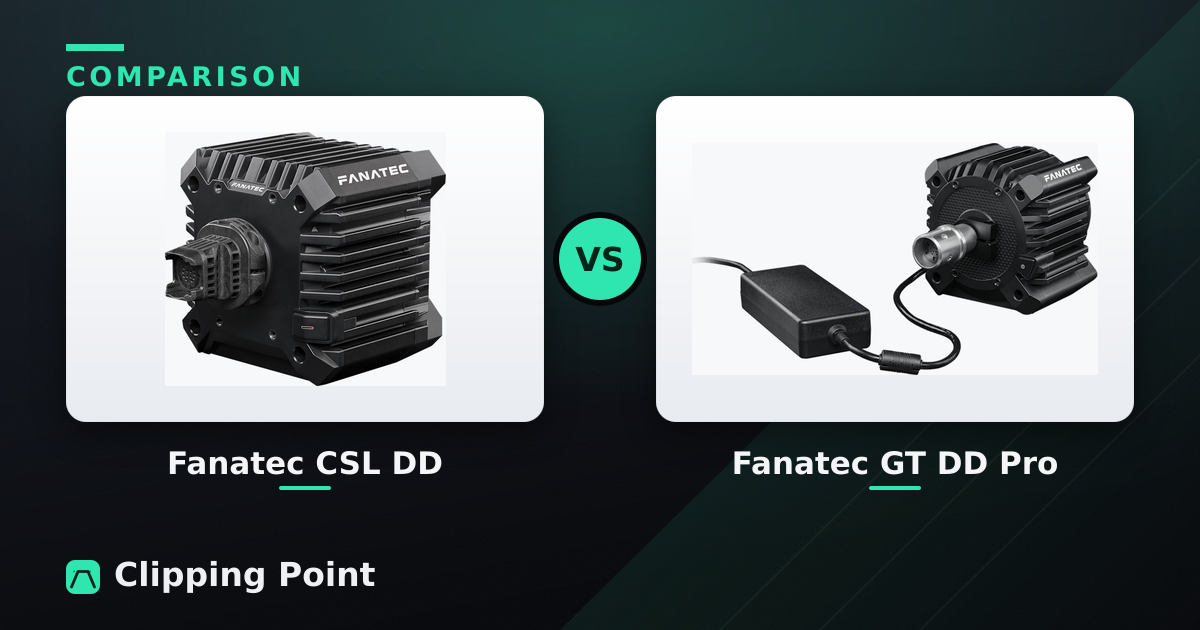
| Fanatec CSL DD | Fanatec GT DD Pro | |
|---|---|---|
| Peak torque | 5 Nm (8 Nm with Boost Kit) | 5 Nm (8 Nm with Boost Kit) |
| Drive type | Direct drive | Direct drive |
| Platforms | PC · Xbox | PC · PS5/PS4 |
| In the box | Base only | Bundle: wheel + pedals |
| Best for | An upgrade path into the Fanatec ecosystem | The go-to direct-drive base for PlayStation |
Specs from each manufacturer's current listings. Prices move constantly — hit the price buttons above for today's numbers.
They’re the same wheel base. Same motor, same electronics, same firmware, same feel through your hands. The Fanatec GT DD Pro is a CSL DD with a PlayStation license chip inside and Gran Turismo branding on the outside, sold as a bundle instead of a bare base.
So the decision is stupidly simple once you know that. Race on PS5 and you buy the GT DD Pro, because the CSL DD physically will not talk to a PlayStation. Race on PC or Xbox and you buy the CSL DD, because the GT DD Pro won’t talk to an Xbox and you’d be paying a licensing tax for a console you don’t own. That’s the whole comparison. Everything below is the stuff you actually need to know before you put money down, because the base isn’t where people get burned. The bundle math is.
Why Fanatec named them like this
Console licensing at Fanatec works in two different directions, which is the source of roughly ninety percent of the confusion on this topic.
PlayStation licensing lives in the base. Sony requires the authentication chip to sit in the wheel base itself, so Fanatec had to build a physically separate SKU, get it certified, and market it. Polyphony was launching Gran Turismo 7 at the time, so Fanatec slapped the GT name on it and shipped it as a bundle with a wheel and pedals, aimed at a console player who has never owned sim gear and doesn’t want to assemble a shopping list.
Xbox licensing lives in the wheel rim. So the plain CSL DD can run on an Xbox as long as you bolt on an Xbox-licensed Fanatec rim, and it runs on PC with anything. Same base, opposite arrangement.
Which means neither one covers all three platforms. If you own a PS5 and an Xbox and want one wheel for both, Fanatec cannot sell you that, and nobody else can either. Pick the console you actually race on.
| CSL DD | GT DD Pro | |
|---|---|---|
| Motor / torque | 5Nm, 8Nm with Boost Kit | Identical |
| PC | Yes | Yes |
| PlayStation 5 / 4 | No | Yes |
| Xbox | Yes, with an Xbox rim | No |
| Sold as | Base only, or base + rim | Bundle with rim and pedals |
| Rough price | ~$350 base only, ~$500 for 8Nm | ~$600 for the 5Nm bundle, ~$800 for 8Nm |
Prices drift constantly and Fanatec discounts hard around Black Friday and whenever GT7 gets a big update, so treat those as ballpark. I’ve seen the 8Nm GT bundle land near $650 on sale.
The Boost Kit is a power supply. That’s it.
This is the single most useful thing in this article, so I’m putting it in its own section.
The 5Nm CSL DD and the 8Nm CSL DD are the same base with different power bricks. The stock unit is a 90W supply. The Boost Kit 180 is a 180W supply plus a firmware flag, and it costs somewhere around $150. Nothing inside the base changes. The motor was always capable of 8Nm; it was just being starved.
Two consequences. First, you can start at 5Nm and upgrade later without selling anything, which is genuinely the right move if money is tight. Second, do not let anyone tell you the 8Nm version is a “better wheel.” It’s the same wheel with more electricity.
Buy the 8Nm version up front if you can swing it, though. Not because 5Nm is unusable (it isn’t) but because buying the kit separately later costs more than the bundle price difference, and you’ll want it. Everyone wants it eventually.
What 5Nm versus 8Nm actually feels like
Torque numbers get treated like horsepower on this hobby’s forums, and it’s mostly nonsense above about 8Nm. Below it, though, the difference is real.
At 5Nm in the Porsche 992 GT3 Cup at Watkins Glen on iRacing, you feel the front axle load up through the Esses and you feel it let go, but the peaks clip. The kerb at the exit of turn 1 arrives as a soft thud rather than a hit. You’ll drive fine. You’ll set decent laps. You just won’t get the last ten percent of information about what the front tires are doing right at the limit, because the base runs out of headroom and flattens everything above it into the same sensation.
At 8Nm the same lap has texture in the peaks. The Ferrari 296 GT3 at Kyalami in ACC is where it shows up hardest for me: that long uphill right at turn 1 has a specific moment where the front unloads over the crest, and on 5Nm it’s a hint, on 8Nm it’s a message.
For GT7 on a PS5, the difference matters less than you’d think, because the game’s force feedback is fairly gentle and heavily filtered compared to iRacing or Le Mans Ultimate. The Gr.3 cars at Deep Forest feel good on either. GT7 has never sent much detail; it sends weight and direction, and it does that well. If you’re a pure GT7 player, the 5Nm bundle is a defensible buy and you can add the Boost Kit the day you install Assetto Corsa on a PC.
Setting it up, and the first week
Unboxing is fine. The base is small, denser than it looks, and the included table clamp is a single plastic-and-metal affair that threads up against your desk from underneath.
That clamp is adequate at 5Nm on a solid desk. At 8Nm on an IKEA tabletop it’s a comedy act. Your desk will flex, the whole base will rock a few millimeters under load, and every detail you paid for gets smeared into desk wobble. This is the number one reason people say direct drive “didn’t feel that different.” Their desk was eating it. If you’re desk-mounted, use the front-mount bolt holes into a proper wheel deck or a stiff plate, or accept that you’re leaving performance on the table.
The tuning menu lives on the wheel rim’s display, or in Fanatec Control Panel on PC. Reasonable starting point for iRacing on the 8Nm:
- SEN: AUTO
- FF: 100
- FFS: PEAK
- NDP: 20
- NFR: 0
- NIN: 0
- INT: 2
- FEI: 100
Then in iRacing, run the auto-configure force, and back the max force number off until the strongest corner of your fastest car stops clipping. Around 20 to 24 is a normal landing zone on 8Nm, higher on 5Nm because you’re clipping anyway. In ACC, gain 70 to 80, minimum force 0, dynamic damping around 100, road effects 20 to 30 if you like feeling kerbs and 0 if you find it noisy.
NDP is the one people over-crank. It’s a damper. Turn it up and the wheel feels heavier and calmer and you feel less. Fanatec ships some profiles with it high because it makes the base feel expensive in the first five minutes.
Firmware updates go through Fanatec Control Panel and are occasionally a bad time. The base drops off USB mid-flash, Windows shows it as an unknown device, and you get to reinstall the driver package and power-cycle the base twice. It always comes back. It’s still annoying at 11pm.
There’s also a fan. It’s audible when the base has been working, and it will spin up during a long stint. Nobody mentions this in reviews and everybody notices it in week one.
The bundle math, which is where the money actually goes
The GT DD Pro ships with a rim and a set of CSL Pedals. Those pedals are two-pedal, potentiometer-based, and the brake is a spring. It measures how far you push, not how hard.
Every real brake pedal measures pressure. Your right foot in a real car doesn’t know inches of travel; it knows force. Switching to a load cell is the single biggest jump in lap time consistency most people ever get from hardware, bigger than going from 5Nm to 8Nm, bigger than any wheel rim. The CSL Pedals Load Cell Kit runs around $100 and bolts onto the pedals you already have. Budget for it from day one. If you have more room, the CSL Elite Pedals V2 are the better answer and worth the jump.
The quick release is the other line item. Depending on when your unit was built you’ll get QR1 Lite or QR2 Lite, both of which are plastic-heavy and both of which will develop a small amount of rotational play after a few months of hard use. It shows up as a tick when you reverse direction. The metal QR2 Pro fixes it permanently for about $100. Not urgent, but if your wheel starts clicking, that’s what it is, and no amount of tightening the retaining ring will fix it for good.
So a realistic GT DD Pro build is the bundle plus a load cell kit, and eventually a quick release. Price it that way before you compare it to anything else.
What people actually argue about
Fanatec’s support and shipping reputation is the recurring topic, and it isn’t invented. Endor AG (Fanatec’s parent) went through a genuinely rough financial stretch before Corsair took over in 2024, and during the worst of it people waited months on backorders and weeks on RMA replies. It’s better now. It is not Amazon. Order with the assumption that if something arrives dead, sorting it out will take real effort, and buy from a retailer with a sane return policy where you can.
The other argument is whether Fanatec is still the right call at all on PC. Moza’s R5 and R9 undercut Fanatec on price with better metal quality and a much cleaner software suite, and Simagic’s Alpha Mini is a stronger base for similar money. On PC, Fanatec’s advantage now is mostly the breadth of the rim and pedal catalog and the fact that half your friends already own the stuff. On PS5 the argument evaporates, because your options are the GT DD Pro, the Logitech G Pro Racing Wheel, or a belt-driven Thrustmaster T598, and the GT DD Pro is the best value of those by a comfortable margin.
The thing nobody argues about, oddly, is the base itself. Nearly four years in and the CSL DD is still the quiet consensus starter direct drive. It just works, it doesn’t overheat, and it doesn’t do anything embarrassing.
FAQ
Can I convert a CSL DD into a GT DD Pro, or the other way? No. The PlayStation authentication is baked into the base hardware and Fanatec doesn’t sell a conversion. People ask this weekly. The answer has never changed.
Does the GT DD Pro work on PC? Yes, fully, with the same driver and the same tuning menu. It’s a PS5 and PC base. You lose Xbox and nothing else.
Is 5Nm enough for a beginner? Yes, and it’s more than enough to make a bad desk mount obvious. Fix the mounting before you spend on the Boost Kit. A properly bolted 5Nm base feels better than a wobbling 8Nm one.
Before you order
Buy the CSL DD if you’re on PC or Xbox. Get the 8Nm version if the extra ~$150 doesn’t hurt, and buy the base on its own rather than a bundle so you can pick your own rim.
Buy the GT DD Pro if there’s a PS5 under your TV. Get the 8Nm bundle if you can, add the CSL Pedals Load Cell Kit to the same order, and stop reading comparison articles.
Two things to check before you click buy. Measure your desk or rig for the front-mount bolt pattern and confirm you have a way to bolt the base down properly, because the clamp is a compromise. And if you’re going Xbox with a CSL DD, verify the specific rim you’re adding to the cart is Xbox-licensed, not just Fanatec-branded. That mistake is expensive, and Fanatec’s product pages do not go out of their way to stop you making it.