
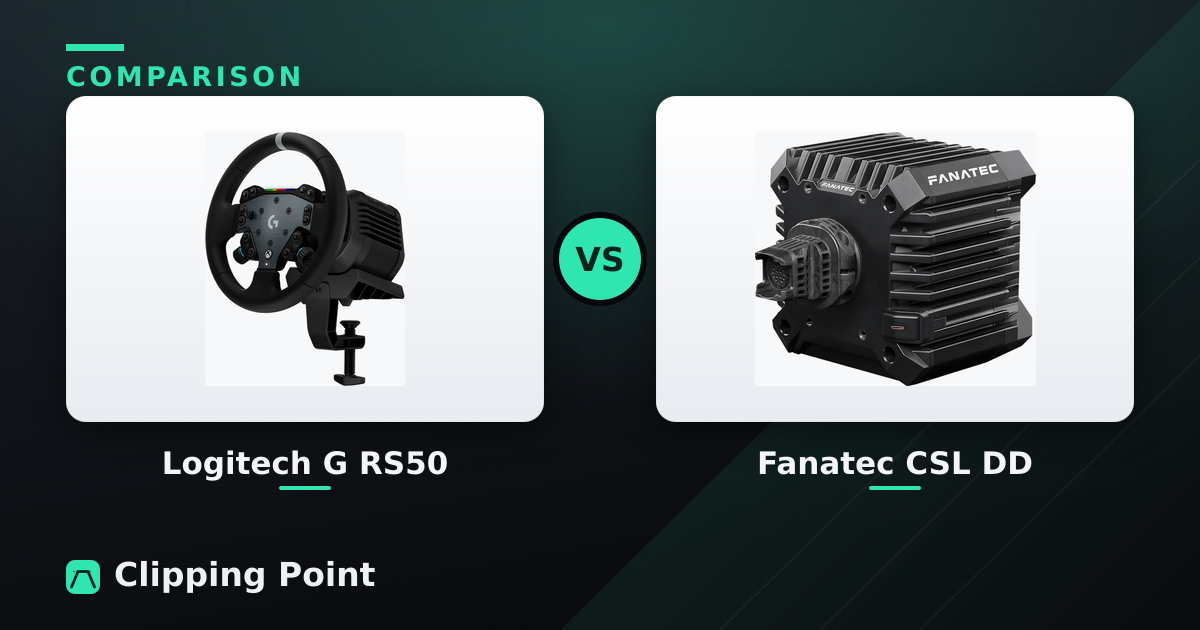
| Logitech G RS50 | Fanatec CSL DD | |
|---|---|---|
| Peak torque | 8 Nm | 5 Nm (8 Nm with Boost Kit) |
| Drive type | Direct drive | Direct drive |
| Platforms | PC · PS5 · Xbox | PC · Xbox |
| In the box | Base (system bundle adds wheel + pedals) | Base only |
| Best for | One base that just works on every platform | An upgrade path into the Fanatec ecosystem |
Specs from each manufacturer's current listings. Prices move constantly — hit the price buttons above for today's numbers.
If you already run Logitech gear and you’re trying to decide whether your first direct drive base should be the Logitech G RS50 or the Fanatec CSL DD, here’s where I land after time with both: most PC racers should still buy the CSL DD, pocket the difference, and spend it on a load-cell brake. The RS50 wins in exactly two situations. You race on console, especially if you split time between PlayStation and Xbox, or you want one box that works out of the crate with zero firmware rituals. Brand loyalty is not a reason. Your G923 rim won’t bolt to the RS50 anyway, so you’re starting over either way.
I say this as someone who came up through the Logitech pipeline like everyone else: Driving Force GT, G27, G29, years of that gear-driven rattle. So when Logitech finally shipped a proper direct drive base, I wanted it to be the obvious answer. It’s a good product. It’s just entering a fight Fanatec has been winning on price and accessories for four years, and the gap hasn’t closed as much as the launch coverage suggested.
What you’ll actually spend, all-in
Sticker prices lie in this hobby because nobody races a bare wheelbase. Rough numbers, and I mean rough, because Fanatec runs sales so often that paying list price is basically a rookie tax:
| Fanatec route | Logitech route | |
|---|---|---|
| Base | CSL DD ~$350 (5 Nm) + Boost Kit ~$150 for 8 Nm | Logitech G RS50 ~$700 (8 Nm) |
| Rim | CSL Steering Wheel P1 V2, ~$130 | RS Track Wheel, ~$200 |
| Pedals | CSL Pedals with load-cell kit, ~$200 | RS Pedals, ~$300 |
| Ballpark total | ~$830 | ~$1,200 |
That $350-ish difference is real money, and it’s before you learn that Fanatec discounts the CSL DD bundle hard every Black Friday, sometimes to the point where r/simracing spends a week telling everyone to stop asking and just wait for November. The counterargument is that the Fanatec number hides two asterisks. The table clamp is a separate $40 purchase if you’re on a desk, and the included QR1 Lite quick release deserves its own section below. Logitech ships the RS50 with desk clamping sorted and a metal quick release standard. Fanatec nickel-and-dimes you toward the same place.
Still. Even with the asterisks priced in, the CSL DD setup lands meaningfully cheaper at the same 8 Nm.
How they feel, since that’s the whole point
Both bases put out 8 Nm, the CSL DD only after you add the Boost Kit 180 (the 5 Nm base version is fine for smaller wheels but feels thin with a 300 mm rim, don’t cheap out here). On paper, tie. In the hands, they’re different characters.
The CSL DD has that slightly granular, information-dense delivery Fanatec bases are known for. In the iRacing MX-5 at Okayama you can feel the exact moment the front tires load up into the downhill right at turn 2, and the rear stepping out arrives as a distinct lightening in the wheel rather than a vague wobble. Some people call this texture “raw.” A few call it grainy, and they’re not wrong at low force settings, where you can sense a faint notchiness off-center that the more expensive bases don’t have.
The RS50 is smoother. Noticeably. Off-center it feels closer to a Moza R9 than to the CSL DD, and curb strikes in ACC (992 GT3 R, the exit curb at Raidillon is my test) come through as a clean thud instead of a gravelly buzz. Then there’s TRUEFORCE, Logitech’s system that drives high-frequency vibration from game audio and physics. In Gran Turismo 7 it’s genuinely additive; engine harmonics and surface changes come alive in a way the Fanatec can’t match there. In iRacing it does nothing, because iRacing doesn’t support it. The supported list is short and you should check whether your main sim is on it before you let TRUEFORCE sway you at all.
Settings that took me a while to settle on, so you don’t have to guess. CSL DD: FF 100, NDP 25, NFR 3, NIN off, INT 3, then set strength in-game (around 55-65% gain in ACC, and in iRacing use the auto button and nudge from there). Out of the box the damping is too low and the wheel feels nervous; NDP at 25 fixes most complaints I see from new owners. RS50: run G HUB strength around 80%, TRUEFORCE at 40-50% rather than the default, which rattles the rim on curbs like a coin in a dryer, and 900 degrees globally with per-car rotation handled by the sim.
Verdict on feel: the RS50 is more refined, the CSL DD tells you more. For learning car control, I’d take the information.
The quick release, or why Fanatec makes you pay twice
The CSL DD ships with the QR1 Lite, a plastic quick release that develops a small but perceptible wobble under hard cornering load. It’s fine in the way a shopping-cart wheel is fine. Every CSL DD owner eventually has the same conversation with themselves and buys the metal QR2 upgrade for around $100, which is why you should just budget it from the start or clamp the QR1 Lite’s screws down and live with it.
Logitech got this right. The RS50’s quick release is metal, tight, and included. No upsell, no wobble, no forum threads about it. Credit where due.
Where Fanatec claws it back is what you can attach. The Fanatec catalog is the deepest in sim racing: the McLaren GT3 V2 rim for around $200, formula rims, round rims, the BMW GT3 wheel, plus Podium-grade stuff when you upgrade the base later and keep everything else. That accessory depth is the single best argument for buying into Fanatec. Logitech’s RS lineup at the moment is a couple of rims and a hub. It will grow, presumably, but you’re betting on a roadmap instead of browsing a store page.
Pedals decide more races than wheelbases
Nobody wants to hear this when they’re comparing torque figures, but braking consistency is where lap time lives. The stock CSL Pedals brake is a spring on a potentiometer and it teaches bad habits. Add the load-cell kit. The difference is not subtle: you go from braking by pedal position to braking by pressure, your reference points stop drifting, and trail braking becomes something you can actually repeat. It’s the single most commonly reported “oh, that’s what everyone meant” moment in this hobby.
Logitech’s RS Pedals come with a load-cell brake in the box, which is why they cost around $300 and why that price is fairer than it looks. They’re solid, the brake stiffness is adjustable, and there’s nothing to upgrade on day one. If you compare pedal-to-pedal at equivalent spec, Logitech’s bundle logic holds up better than its wheelbase pricing does.
Living with them: software and the quirks that show up in week two
G HUB is the weak link on the Logitech side. It’s the same app that manages gaming mice, it occasionally fails to see the base after the PC wakes from sleep (unplug, replug, sigh), and profile switching is clumsier than it should be. When it works, it works. When it doesn’t, you’re restarting it before a league race.
Fanatec’s situation is the opposite shape. The driver and firmware updater feel like industrial software, the update process is a small ceremony with a progress bar you’re warned not to interrupt, and FanaLab, the tuning app, looks like it was designed by an engineer who lost a bet. But the depth is real: per-car profiles, telemetry-driven LED control on supported rims, every FFB parameter exposed. New owners find it intimidating for a week, then never want to give it up. My CSL DD has also, maybe twice a year, booted into firmware-recovery mode for no stated reason. A reflash fixes it in five minutes. It’s still a five-minute problem the Logitech has never given me.
One more thing that surfaces after a week on either base: your desk. 8 Nm through a clamp on a flexy Ikea top means the whole surface shimmies in fast direction changes, and it partially cancels the detail you paid for. Both bases have proper bolt patterns underneath. A Wheel Stand Pro or a cheap 8020-style rig upgrades the feel of either base more than any settings change will.
Consoles, briefly, because this is where the RS50 actually wins
The RS50 works on PC, PlayStation 5, and Xbox. One base, both consoles. Nothing else in this price class does that, and if you play GT7 and Forza in the same household the comparison is over, buy the Logitech. The CSL DD does PC and Xbox (with an Xbox-licensed rim), and for PlayStation Fanatec sells you a different product entirely, the GT DD Pro, which is the same hardware wearing a Sony license. It’s a confusing product split and people buy the wrong one constantly.
The Fanatec problem
You can’t recommend Fanatec without this paragraph. Through 2023 and early 2024 the company earned a genuinely bad reputation: weeks-long support silences, the Black Friday order meltdown, RMAs that aged like open milk. Then Corsair bought them in mid-2024, and by most accounts on the forums and Discord, shipping and support have recovered to normal-company levels. I believe the improvement is real. I also understand anyone who got burned and refuses to go back, and if that’s you, the RS50 exists partly because Logitech smelled that blood in the water. Logitech’s support apparatus is boring and functional, which is exactly what you want from a support apparatus.
FAQ
Do I need the Boost Kit 180 for the CSL DD? If you’re comparing against the RS50, yes, otherwise it’s not a fair fight. 5 Nm is livable with a small rim, but 8 Nm gives you headroom so you’re running the motor at 70% instead of maxed, and detail survives better with headroom. Buy the 8 Nm bundle up front; it’s cheaper than adding the kit later.
Does the CSL DD work on PS5? No. Fanatec’s PlayStation answer is the Gran Turismo DD Pro, which is a CSL DD with a Sony license and a GT7-branded rim. Same motor, same feel. If you’re PlayStation-first, compare the RS50 against that instead, and note the RS50 covers Xbox too while the GT DD Pro doesn’t.
Is 8 Nm enough, or should I save for a 12-15 Nm base? It’s enough. Peak torque numbers are the most oversold spec in sim racing. 8 Nm run at sane strength is more than most people can hold precisely for a 40-minute stint, and slew rate and detail matter more than the ceiling. Spend the difference on pedals or a rigid mount before you spend it on torque.
Buy this if
Get the Fanatec CSL DD (8 Nm bundle) if you race on PC, you want the widest choice of rims and a cheap path to better ones, and you can stomach one firmware ceremony per quarter. Budget for the QR2 and the load-cell pedal kit in your initial number, not as someday-upgrades, and check whether a sale is running before you pay list, because one usually is.
Get the Logitech G RS50 if you’re on console, or on both consoles, or you’re the person in your house who gets called when the printer breaks and you’d rather this hobby not add to that pile. Pair it with the Logitech RS Pedals and you’re done shopping for years.
Before you order either: measure your desk thickness against the clamp specs, confirm your main sim supports the base natively (Le Mans Ultimate and rF2 both do, for both, but check the current compatibility pages anyway), and if any part of you is planning to “upgrade the rim later,” price that rim now. Later has a way of costing $200.