
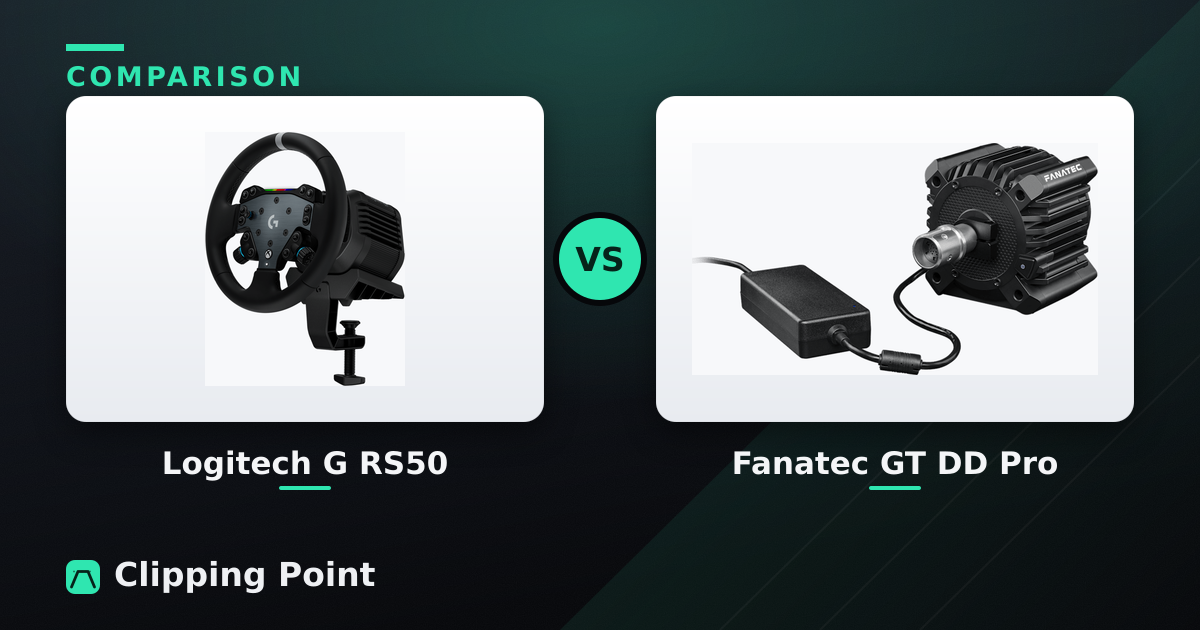
| Logitech G RS50 | Fanatec GT DD Pro | |
|---|---|---|
| Peak torque | 8 Nm | 5 Nm (8 Nm with Boost Kit) |
| Drive type | Direct drive | Direct drive |
| Platforms | PC · PS5 · Xbox | PC · PS5/PS4 |
| In the box | Base (system bundle adds wheel + pedals) | Bundle: wheel + pedals |
| Best for | One base that just works on every platform | The go-to direct-drive base for PlayStation |
Specs from each manufacturer's current listings. Prices move constantly — hit the price buttons above for today's numbers.
If you want the one-line answer: buy the Logitech G RS50 if you’re on Xbox, or if you’re on PlayStation and can stretch your budget past a grand for the full setup. Buy the Fanatec GT DD Pro if you’re a PS5-and-GT7 person who wants a complete direct drive rig, wheel and pedals included, for the least money that isn’t a mistake. Those are different buyers, and most of the “which is better” arguing online comes from people pretending they’re the same buyer.
The longer answer is about what each company doesn’t put on the box. Fanatec’s bundle price looks great until you add the two upgrades almost everyone ends up buying, at which point it’s within shouting distance of the Logitech. Logitech’s base looks reasonable until you remember it ships with no wheel and no pedals. Neither company is lying to you, exactly. They’re just both very quiet about the total.
What you’re actually comparing
The Fanatec GT DD Pro has been the default console direct drive answer since 2021 because Sony basically blessed it. It’s the Gran Turismo branded version of the CSL DD: 5 Nm out of the box, 8 Nm if you buy the Boost Kit 180 power supply for around $150 extra. The standard bundle runs about $600 and includes the base, a round CSL P1 V2 rim, the two-pedal CSL Pedals set, and a table clamp. That’s a complete rig. You plug it into a PS5 and GT7 recognizes everything.
The Logitech G RS50 is much newer, launched in 2025 as the start of Logitech’s modular RS lineup, and it’s the more interesting piece of hardware. It’s an 8 Nm direct drive base with a proper quick release, TRUEFORCE (Logitech’s audio-driven FFB layer), and the thing that actually matters for this comparison: one base covers PC, PS5, and Xbox. Not two SKUs. One base. For around $700 you get the base and nothing else. Add a rim (the Logitech RS Track Wheel or the RS hub with your own wheel) and the Logitech RS Pedals, and you’re realistically at $1,000 to $1,100 before you’ve turned a lap.
So the sticker comparison of $600 versus $700 is fiction. The real comparison is a complete ~$600 Fanatec rig at 5 Nm versus a complete ~$1,050 Logitech rig at 8 Nm. Or, if you spec the Fanatec the way most owners eventually do (Boost Kit plus the load cell brake upgrade), roughly $810 versus $1,050. That gap is real but it’s not the chasm the base prices suggest.
The console question decides more than the hardware does
Here’s the part that ends the debate for a lot of people. The GT DD Pro is PlayStation licensed. On Xbox, a Fanatec base only works if the rim attached to it carries the Xbox license chip, which means buying a specific (and not cheap) Fanatec Xbox wheel on top of everything else. If you’re on Series X and you’re pricing out a GT DD Pro, stop. You’re building the wrong rig.
The RS50 works on both consoles with the same base and the same rims. If there’s any chance you’ll switch platforms, or you’ve got a household with both boxes under the TV, Logitech wins this on walkover. Fanatec’s platform licensing model made sense in 2019. In 2026 it reads like a tax.
PS5-only? Then it’s a genuine contest, and the rest of this article is for you.
Force feedback: 5 Nm, 8 Nm, and what the numbers hide
The spec sheet fight is 8 Nm versus 5 Nm (or 8 versus 8 with the Boost Kit), and I’d encourage you not to care as much as the forums do. Torque numbers past 5 Nm are mostly about headroom and fidelity, not about arm strength. A 5 Nm GT DD Pro running at 100% is already more wheel than any Logitech G29 owner has ever felt, and the jump from belt drive to any direct drive is the revelation. The jump from 5 to 8 is a refinement.
Where it does matter: running a base near its ceiling clips the fine detail. At 5 Nm in GT7 with in-game torque at 5, big curb strikes and heavy Group 3 cars will occasionally flatten out, and you lose the small stuff underneath the big loads. The Boost Kit fixes that, which is why “just budget for the Boost Kit” is repeated on r/simracing like a liturgy. It’s annoying that Fanatec gates the base’s real performance behind a power brick, but the advice is correct.
Character-wise they’re different animals. The Fanatec, with the usual community tuning menu settings (FFB 100, NDP around 25, NFR and NIN off or near it, INT 3), is sharp and slightly raw. Kick the rear out in a Porsche 911 GT3 at Suzuka’s Dunlop curve and the countersteer cue arrives fast and unfiltered. The RS50 out of the box is smoother, almost damped, and some early owners called it numb until they turned the filtering down and the strength up in G HUB. Get it dialed and it’s detailed and quiet, with none of the drivetrain grain cheaper bases have.
Then there’s TRUEFORCE, which layers engine and road audio data into the FFB in supported games (GT7 supports it properly). Half the community calls it a gimmick. I mostly disagree, with a caveat: at high settings it’s a rumble motor cosplaying as force feedback, but at 30 to 50 percent in GT7 it adds engine texture through the rim that genuinely helps you feel revs in cars you can’t hear well. Try it low before you write it off.
Build, mounting, and the stuff you find out in week two
Both clamp to a desk. Neither should, forever. An 8 Nm base on a flexy IKEA desk turns fast direction changes at Brands Hatch into a wobbling mess, and desk flex is the single most common reason people think their direct drive base is disappointing. If a wheel stand or rig isn’t in your eventual plan, you should reconsider the whole direct drive idea and pocket the difference. Both bases have standard bottom mounting patterns for stands; the Fanatec’s included table clamp is fine, the Logitech’s clamping is solid and tool-friendly.
The Fanatec’s known weak point is the QR1 Lite, the plastic quick release on the bundle rim. It develops a small rotational wobble under hard use, and the fix is Fanatec’s metal QR1, which is another purchase and another line in the “true cost” spreadsheet. The CSL Pedals’ brake in the base bundle is a spring, and it’s the first thing you’ll hate. The load cell kit is around $60 and it is the single highest value-per-dollar upgrade in sim racing. A load cell brake retrains you to brake by pressure instead of position, and your consistency improves within a weekend. Budget for it on day one.
The Logitech counters with a proper metal quick release as standard and the Logitech RS Pedals, which include a load cell brake out of the gate. That’s part of what the $1,050 buys: nothing on the rig is waiting for an upgrade. The gripes that surface in the Logitech Discord instead are software ones. G HUB remains G HUB, with occasional firmware update weirdness and profiles that don’t always stick, and the RS accessory lineup is still young, so your rim choices are Logitech’s short list rather than Fanatec’s deep (if pricey) catalog.
One more thing nobody puts in reviews: fan noise. The Fanatec base’s cooling fan is audible in quiet moments between sessions. Not loud. Noticeable. The RS50 is quieter at idle. Trivial until you race at 1 a.m. with the family asleep, which is exactly when most of us race.
Support, or: the Fanatec paragraph
You cannot write a Fanatec recommendation without this. The company spent years with a genuinely bad reputation for shipping delays, RMA black holes, and support tickets that aged like wine. The Black Friday 2023 mess was bad enough to become community folklore. Corsair bought Fanatec in 2024, and by most accounts things have improved: stock is steadier, support answers faster. But “improved from notorious” is the bar being cleared, and plenty of r/simracing posters still open Fanatec threads with “great hardware, pray you never need warranty service.”
Logitech is boring in the best way here. Enormous company, ordinary retail channels, buy it at Best Buy or Amazon, return it like a toaster if it’s dead on arrival. For a first-time buyer dropping four figures, that boring matters more than reviewers admit.
The actual numbers side by side
| Fanatec GT DD Pro | Logitech G RS50 | |
|---|---|---|
| Torque | 5 Nm (8 Nm with ~$150 Boost Kit) | 8 Nm stock |
| Console support | PS5 (Xbox only via licensed Fanatec rim) | PS5 and Xbox, same base |
| What ~$600 gets you | Base, rim, two pedals, clamp | The base. Just the base. |
| Realistic complete cost | ~$810 with Boost Kit and load cell | ~$1,000 to $1,100 with rim and pedals |
| Known weak point | QR1 Lite wobble, spring brake, support history | Young accessory lineup, G HUB quirks |
FAQ
Is 5 Nm enough, or do I need the Boost Kit? Enough to be transformative if you’re coming from a G29, G923, or T300. Not enough that you’ll stay satisfied. Most owners buy the Boost Kit within six months, so the honest move is pricing it in from the start. If the extra $150 breaks your budget, buy at 5 Nm and upgrade later; the base is identical.
Does the Fanatec GT DD Pro work on Xbox? The base alone, no. Xbox licensing lives in Fanatec’s steering wheels, so you’d need to add an Xbox-licensed Fanatec rim, which pushes the total well past the RS50 route. Xbox racers should not buy a GT DD Pro. This comes up weekly on the forums and the answer never changes.
Is the Logitech RS50 good for GT7 specifically? Yes, and it’s one of the few bases with real TRUEFORCE support in GT7, which adds engine and surface texture through the rim. Start with in-game torque around 5, sensitivity 1, and TRUEFORCE audio gain low (30 to 50 percent) and adjust from there. GT7’s FFB is conservative compared to PC sims regardless of hardware, so temper expectations coming from ACC.
Before you click buy
Buy the Logitech G RS50 if you’re on Xbox (no contest), if you might ever switch consoles, or if you’d rather pay once for a rig with no asterisks: metal quick release, load cell pedals, 8 Nm, normal retail support. It’s the better hardware bundle and the safer company to owe a warranty claim to.
Buy the Fanatec GT DD Pro if you’re PS5-only, GT7 is your life, and the difference between $600 and $1,050 is the difference between buying now and not buying. It is still a legitimately good base. Just write the real shopping list before you order: bundle, Boost Kit, load cell kit, and eventually the metal QR. If you find yourself adding all four to the cart on day one, you’ve spec’d your way to Logitech money, and you should probably spend it there.
And whichever you pick: check what it’s bolting to first. A $700 base on a wobbling desk loses to a $300 belt wheel on a rigid stand every single time. Sort the mounting, then order the wheel.