
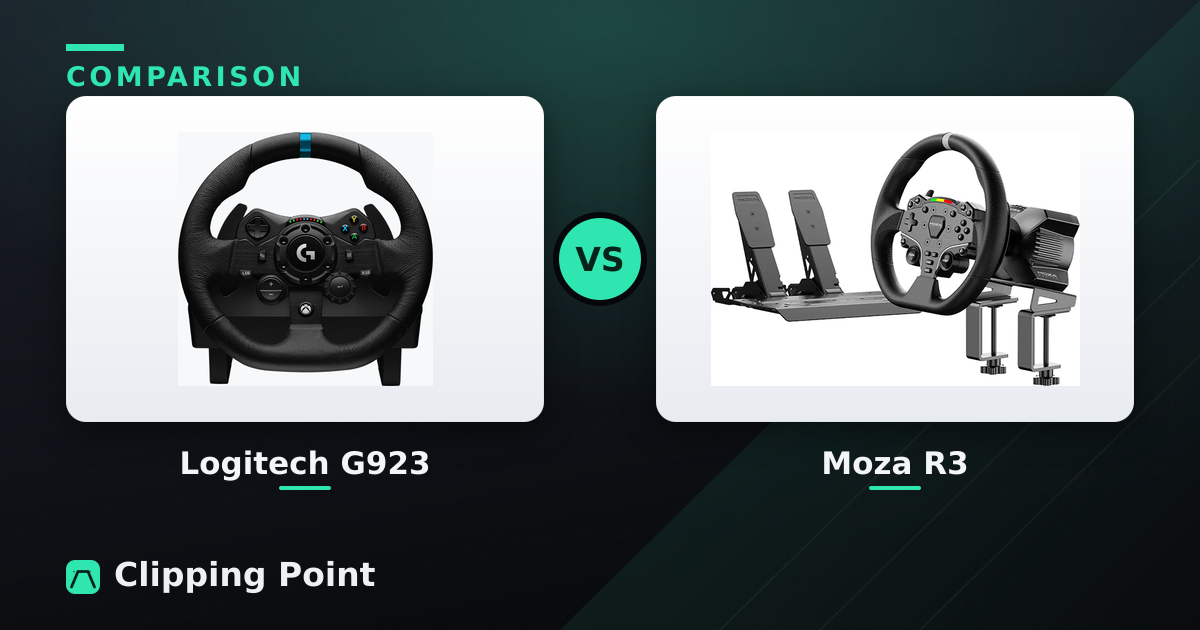
| Logitech G923 | Moza R3 | |
|---|---|---|
| Peak torque | 2.3 Nm | 3.9 Nm |
| Drive type | Gear-driven (TrueForce) | Direct drive |
| Platforms | PC · PS5/PS4 or Xbox (pick version) | PC · Xbox |
| In the box | Wheel + 3 pedals | Bundle: ES wheel + SR-P Lite pedals |
| Best for | Plug-and-play familiarity, console-first | Xbox players who want real direct drive cheap |
Specs from each manufacturer's current listings. Prices move constantly — hit the price buttons above for today's numbers.
If you race on PC or Xbox, buy the Moza R3 bundle and close the other eleven tabs. It costs roughly what a G923 costs on a normal day, it is a real direct drive base, and the thing the G923 does worst (telling you the front tires are about to give up) is the thing the R3 does best. If you race on PlayStation, the R3 does not work on your console at all, and never will, so the Logitech G923 wins by default. That is the whole decision for most people reading this.
The longer answer has caveats you should hear before you pay, because “direct drive” has turned into a magic word and the R3 is the smallest, cheapest version of it. It will not feel like your mate’s R9. The pedals in the box are the weak link. And there are a few situations where the old gear-driven Logitech is the smarter buy, which I’ll get to. But I have owned both, along with a G29 before them and far too many things since, and the default recommendation stands.
What is actually in each box
The Logitech G923 is one lump: wheel and base are permanently joined, you cannot swap the rim. You get a three-pedal set with potentiometer sensors, a desk clamp, and a power brick. Inside, a pair of helical gears turns a small motor into about 2.2 Nm at the rim, with 900 degrees of rotation. TrueForce, Logitech’s audio-driven vibration trick, is the headline feature and it is genuinely nice in Gran Turismo 7 and iRacing. In most other titles it does nothing. List price is around $400, but it has been discounted so relentlessly since 2020 that paying that is a mistake. Around $300, sometimes less, is the real price. There is a PlayStation version (which also does PC) and an Xbox version (which also does PC).
The Moza R3 bundle is three separate parts: the R3 base, a small round cylinder rated at 3.9 Nm peak; the ES wheel, a 280 mm rim with a plastic body, rubber grips and magnetic paddles; and the SR-P Lite two-pedal set. Plus a table clamp and a power supply. It runs around $400 for the whole bundle. The base is Xbox licensed, so it works on Xbox Series consoles and PC. No PlayStation. The wheel comes off the base with Moza’s quick release, which matters more than it sounds and I’ll come back to it.
| Logitech G923 | Moza R3 bundle | |
|---|---|---|
| Drive type | Helical gear | Direct drive |
| Torque | ~2.2 Nm | 3.9 Nm peak |
| Rotation | 900° | Adjustable, well past 900° |
| Pedals | 3, potentiometer, rubber “progressive” brake | 2, spring brake, no load cell |
| Platforms | PS + PC or Xbox + PC | Xbox + PC |
| Rim swappable | No | Yes |
| Street price | ~$300 | ~$400 |
The torque number is not the point
Everyone fixes on 2.2 versus 3.9 and decides the R3 is “almost twice as strong”. True, and mostly irrelevant. A well set up G923 is not weak in a way that ruins racing. What the gears ruin is the signal.
Here is what that means in a car. Take the Porsche 992 GT3 R at Brands Hatch in ACC and go into Paddock Hill Bend a little too hot. On the G923 the wheel gets lighter as the front washes out, but it arrives as a general change in weight, slightly late, with a faint ratchet through the rim as the gears take up lash. You register “understeer” about a car length after it started. On the R3 the drop in weight is instant and clean, you feel the exact moment the front tires let go, and you catch it with a small unwind instead of a panic lift. Same corner, same car, same driver. The R3 makes you faster there because it tells the truth sooner.
Same story over curbs. Spa’s Raidillon on the G923 sounds like an old inkjet printer. Genuinely. The gear chatter over the sausage curbs is loud enough that people ask about it on r/simracing every few weeks thinking their unit is faulty. It isn’t, that’s just what helical gears do under load. The R3 is silent apart from the fans.
The one place the G923 punches back is TrueForce in GT7. Engine vibration through the rim, ABS pulsing, tarmac texture. It is a cheap effect but it is a good cheap effect, and Moza has nothing equivalent on console.
A month with the G923
First hour is G HUB. Sometimes it detects the wheel immediately, sometimes you unplug and replug twice and swear a bit. Set the rotation in G HUB to 900 and leave it there, then set rotation per game inside the game. The one G HUB setting worth touching is centering spring: turn it off, every sim handles that itself.
Settings that actually work: in ACC, gain 100, minimum force 5 to 6 percent (the gears need a nudge to wake up around center), road effects 10, dynamic damping 100. In iRacing, run the auto strength calibration after a few laps and then bump the resulting value down by around 10 percent, because it will set itself right at the clipping point. Enable TrueForce in iRacing’s options at about 50 percent and go up from there if you like it.
The brake pedal is the daily annoyance. Logitech put a rubber block behind the pedal so it stiffens up near the end of travel, which is a kind of poor man’s load cell. Trail braking on it is guesswork for the first fortnight. Most people either learn to live with it or pull the rubber cone out; search “G923 brake mod” and you’ll find the five-minute version. The pedals also skate on carpet until you flip out the little spikes underneath, and even then a hard stop in the Mazda MX-5 at Lime Rock will walk them toward you.
After a few months the things that show up are a slight click at the wheel center, a paddle that starts to feel a bit hollow, and the dead-ish zone that was always there getting more noticeable as you improve. None of it is a fault. It is a $300 gear-driven wheel behaving like one. The upside is Logitech’s warranty and retail presence: if it dies, you walk into a shop and swap it.
If you want an H-pattern for Euro Truck or Dirt Rally 2.0, the Logitech Driving Force Shifter plugs straight in for around $60. It is plasticky and vague and I still recommend it as a first shifter because nothing else at that price exists.
A month with the R3
Out of the box the base is smaller than you expect. Clamp it to the desk with the included bracket, plug in the ES wheel, plug in the pedals to the base, USB to the PC. Then install Pit House, and expect a firmware update on first connect. Do the update. Do not do it the evening of a league race, because Moza’s updates have a habit of resetting your profiles and once in a while the base goes into a state where you have to power cycle it twice.
Pit House settings that get you a good baseline: maximum torque 100 percent (you will control strength in-game), rotation 900 for most GT cars, and turn the three “natural” sliders (damper, friction, inertia) down to around 10 to 15 each. Moza ships them higher, which makes the wheel feel heavy and slow like it’s turning through syrup. Speed-dependent damping I run around 50. In ACC, gain 100, dynamic damping 100, road effects 15, minimum force 0. That last one is the point: a direct drive base doesn’t need a fake minimum force because there’s no lash to overcome. In iRacing set max force to 3.9 Nm manually, tick linear mode, and let the game scale from there.
Desk flex is the thing nobody warns you about. At 3.9 Nm the R3 is polite compared to the bigger bases, but a cheap particleboard desk will still visibly wobble when you hit a curb, and the whole point of direct drive is lost if the desk is absorbing the detail. A sturdy desk is fine. A wheel stand or a basic cockpit is better. If your desk is the sort that shakes when you type, budget for that.
The ES wheel is fine. That is the highest praise it earns. The rubber grips are comfortable, the magnetic paddles are the best thing on it, the buttons are mushy, and there are no rotary encoders so you’ll map brake bias to buttons. Occasionally after a firmware update the base reports the wheel as disconnected and you reseat the quick release. Not a dealbreaker, just a thing.
The SR-P Lite pedals are the honest weak point. Two pedals, spring-loaded, Hall sensors. They are light enough that you will want to screw them to something. The brake is a stiffer spring than the throttle and that is the entire story: no load cell, no rubber stack, no progressive feel. Are they worse than the G923 pedals? Not really. Are they better? Also not really. They are a placeholder and you should plan to replace them.
On Moza as a company: they are the newer brand, support is mostly email and Discord, and warranty replacements go through regional warehouses that used to be slow and have improved. The Discord is active and the community has done more to document Pit House than Moza has. The gripes you’ll see there are firmware regressions, profile resets, and the ES wheel’s plastic feeling cheap next to the base it’s bolted to. Nobody complains about the force feedback.
The upgrade path is where the G923 loses badly
This part should be higher up, but you’d have skipped it.
The G923 is a dead end. The rim doesn’t come off. The pedals only talk to Logitech bases. When you outgrow it, and if you keep racing you will within a year, you sell the whole set for around $150 and start again from zero.
The R3 is a starting point. The base is a Moza quick release, so the Moza CS or KS rims bolt straight on when the ES starts to feel cheap. The Moza SR-P load cell pedals (around $200 for the set) plug into the same port and are a bigger upgrade than any wheel base change will be. And if you later want the R5 or R9, you keep the rim and pedals and only replace the small cylinder. Every part you buy in the Moza range keeps working. That is a real financial difference over two years, not a spec sheet one.
When the G923 is the right call
PlayStation. Obviously. GT7 with TrueForce on a G923 is a better experience than people give it credit for, and there is no Moza alternative on Sony’s platform at any price.
You want three pedals and an H-pattern out of the box, and your budget stops at around $350. Rally and trucking people, this is you. The Moza equivalent (bundle plus their third pedal plus the HGP shifter) lands well over $500.
You aren’t sure you’ll stick with it. A used G923 for under $200 is a cheap way to find out, and it holds resale.
You need it this weekend from a physical store. Moza is online only in most places.
Everyone else, and I mean everyone on PC or Xbox who plans to be doing this in a year, the R3.
FAQ
Is the Moza R3 really worth it over the G923? On PC or Xbox, yes, and by a wider margin than the price gap suggests. The difference in feedback clarity is not subtle, and the R3 keeps its value as part of an upgrade path where the G923 is one sale away from the bin. The only reason to pick the G923 on those platforms is needing three pedals and a shifter on a tight budget.
Does the Moza R3 work on PS5? No. Not with an adapter, not with any wheel, not with a future firmware update. Moza has no PlayStation licence on any base. If you are on PS5, the choice is the G923, the Thrustmaster T300 family, or a Fanatec base. Do not buy the R3 hoping.
Is 3.9 Nm enough for a direct drive wheel? For a first wheel, comfortably. Most people run their bigger bases at 50 to 60 percent anyway because full torque in a GT3 car is tiring over a stint. What you lose at 3.9 Nm is headroom: heavy curb strikes and big snap-oversteer moments clip, so the wheel goes flat right when things get dramatic. It’s the reason to go to an R5 or R9 eventually, not a reason to skip the R3 now.
Check these before you order
Confirm your platform, then confirm it again. The “R3 bundle” listing and the “R3 base only” listing look similar and the base-only one ships with no wheel and no pedals. Make sure the listing says ES wheel and SR-P Lite.
Measure your desk. The Moza clamp wants a lip of a couple of centimetres and a top under about 6 cm thick, and if the desk is the kind that rocks when you lean on it, buy a stand at the same time or you are throwing away half of what you paid for.
If you are on PlayStation, buy the Logitech G923 in the PS version, not the Xbox one, and pay no more than around $300 for it. Then spend the first evening pulling the rubber cone out of the brake.
If you are on PC or Xbox, buy the Moza R3 bundle, run the firmware update on day one, turn the natural damper and friction down, and start saving for the SR-P pedals. Those are the purchase that will actually make you faster.