
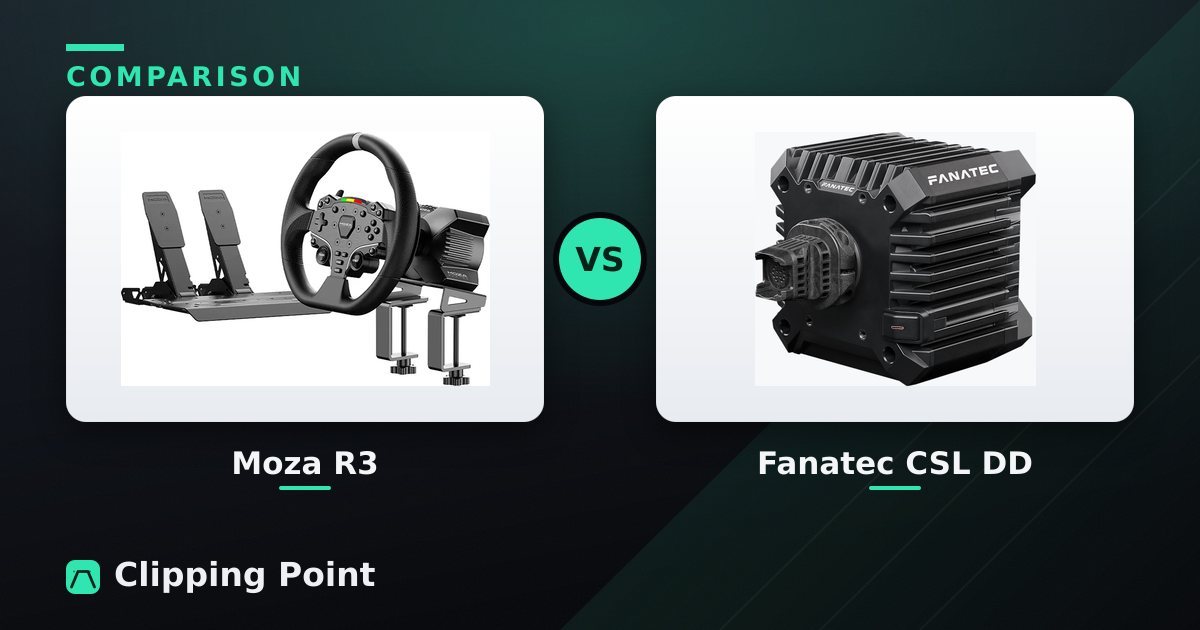
| Moza R3 | Fanatec CSL DD | |
|---|---|---|
| Peak torque | 3.9 Nm | 5 Nm (8 Nm with Boost Kit) |
| Drive type | Direct drive | Direct drive |
| Platforms | PC · Xbox | PC · Xbox |
| In the box | Bundle: ES wheel + SR-P Lite pedals | Base only |
| Best for | Xbox players who want real direct drive cheap | An upgrade path into the Fanatec ecosystem |
Specs from each manufacturer's current listings. Prices move constantly — hit the price buttons above for today's numbers.
Here’s the answer before the sales pitch: if you’re on PC or Xbox and this is your first direct drive wheel, buy the Moza R3 bundle. It costs less to get racing, the software is better, and the missing 1.1 Nm of torque will not be what holds you back. If you’re on PS5, the choice was made for you months ago and it’s Fanatec, specifically the Gran Turismo DD Pro, which is the same base with different firmware and a licensing sticker.
The reason has almost nothing to do with torque. It’s that the Fanatec CSL DD is a wheel base, priced around $350, and a wheel base spins in the air doing nothing useful. By the time you’ve added a rim and a set of pedals you’re near $600. The R3 arrives as a bundle with a wheel and pedals around $400, sometimes under that when Moza runs a sale. For someone spending their own money on their first DD, that gap buys a load cell brake, which will do more for your lap times than every Newton-metre either base can produce.
The 3.9 vs 5 Nm argument that nobody needs to have
The R3 makes 3.9 Nm. The CSL DD makes 5 Nm out of the box and 8 Nm with the Boost Kit 180 power supply, which is another $150-ish.
Now go look at what people actually run. Most CSL DD owners on a desk sit somewhere between 60 and 75 percent FFB, because past that the base starts trying to unbolt itself from the table. That puts real delivered torque at roughly 3 to 3.75 Nm. Which is to say: about what the R3 gives you at full whack.
Torque is the spec that sells wheels because it’s a single number that goes up. What you actually feel is detail resolution and how fast the motor can reverse direction, and both of these bases are fine at it. Coming from a Logitech G29 or a Thrustmaster T300, either one will feel like someone cleaned a smeared window. You’ll get front axle load and unload, you’ll feel a rear step out before the sound cue tells you, and kerbs will stop being a vague rumble. The step from belt to direct drive is enormous. The step from 3.9 to 5 Nm is not.
Where the CSL DD does pull ahead is sustained load. In ACC, a Ferrari 296 GT3 through Hugenholtz at Zandvoort loads the wheel up and holds it there, and the R3 runs out of headroom sooner, so peak details ride on top of a flattened signal. It’s noticeable if you’re looking for it. It is not noticeable if you’re still working out where the braking point is.
What you actually pay
| Moza R3 | Fanatec CSL DD | |
|---|---|---|
| Base + wheel + pedals | ~$400 bundle (ES wheel, SR-P Lite pedals) | ~$350 base + ~$130 rim + ~$110 pedals |
| Torque | 3.9 Nm | 5 Nm (8 Nm with ~$150 Boost Kit) |
| Load cell brake | Optional SR-P Lite upgrade kit, ~$70 | CSL Pedals Load Cell Kit, ~$100 |
| Quick release | Metal where it matters | QR1 Lite, plastic |
| Consoles | Xbox (native) | Xbox with a licensed rim; PS5 via GT DD Pro |
Fanatec’s pricing has a way of accumulating. You go in for a base, you leave having also been convinced you need the QR2 Lite because the included plastic one develops a creak, and a set of pedals, and a shifter mount, and suddenly the “budget” DD costs more than a used ClubSport DD. Their configurator is very good at this. Budget accordingly, or resist harder than I did.
First hour out of the box
The R3 setup is close to painless. Clamp it down, plug it in, install Pit House, run the firmware update it immediately demands, calibrate the wheel centre, done. Fifteen minutes if the download cooperates. The wheel attaches with a threaded collar you snug by hand.
Fanatec’s first hour is longer and more annoying, mostly because of driver versioning. Install the current driver package, run the firmware manager, and update base, wheel, and pedals separately, each of which wants its own reboot cycle. If a component shows as out of date and refuses to flash, unplug the wheel and flash the base alone. This is a rite of passage and every Fanatec owner has done it at 1am.
The payoff on the Fanatec side is the tuning menu built into the wheel hub. Being able to change damping or sensitivity from the wheel, mid-session, without alt-tabbing, is genuinely nice and Moza has no equivalent. Pit House is a better piece of software overall (cleaner, per-game profiles that actually load, telemetry graphs that help you see clipping) but it lives on your second monitor.
Mounting, and why your desk is the real problem
Both come with a table clamp. Both clamps are adequate. Your desk probably isn’t.
A 25mm particleboard desk with a hollow core will flex under 4 Nm, and that flex reads as mush in the FFB. You lose the crisp bits, which is the entire reason you bought a direct drive wheel. The fix is stupidly cheap: cut a piece of 18mm plywood about 300mm square, put it under the clamp so the load spreads across more desk instead of crushing one spot, and if your desk has legs at the corners, mount as close to a leg as you can get. Costs about ten dollars and does more for FFB feel than upgrading from the R3 to the CSL DD.
If you’re on a proper rig or a wheel stand with a top plate, both bases bolt down through the bottom with M6 hardware. The CSL DD’s mounting pattern is a bit awkward on some older stands and you may need the front-mount adapter. Check before you order.
Settings worth trying
For the R3 in Pit House: FFB strength 65 to 75, road sensitivity around 8, wheel speed 100, natural inertia low (5 to 10), damping 5. Set max rotation to 900 and let the sim override it per car. Don’t crank road sensitivity to feel “more” — you’re amplifying noise, and on a 3.9 Nm base you’ll clip almost instantly.
For the CSL DD tuning menu: SEN Auto, FF 100, FFS PEAK, NDP 20 to 25, NFR OFF, NIN OFF, INT 3, FEI 100, and then control overall strength in-game. The default NDP of 50 is too much damping and makes the wheel feel like it’s moving through syrup. Turning it down is the single biggest improvement most CSL DD owners make and most of them find it by accident six weeks in.
In iRacing, tick “use linear mode” and set max force by feel rather than by the auto button, which tends to overestimate. For the R3, start around 4 to 5 Nm; for the CSL DD, 6 to 7. Run a few laps in the Mazda MX-5 at Okayama and watch the force meter. If it’s pinned through Turn 1, you’re clipping and losing information exactly where you need it.
ACC: gain 70, min force 0, dynamic damping 80 to 100, road effects 20. ACC’s FFB is quieter than iRacing’s by design and people compensate by cranking gain until it clips. Don’t.
Le Mans Ultimate will make either base feel busy over Sebring’s bumps. That’s the game, not the wheel.
Things that surface after a few weeks
The R3’s ES wheel is fine and a bit boring. Rubberised plastic rim, decent buttons, no display, no shifters that feel like anything special. It does the job. The included SR-P Lite pedals are the weak point: two pedals, potentiometer brake, plastic frame, and they slide on carpet. The load cell upgrade kit for them is around $70 and it’s the best money in this entire article. Do it in month two if not month one.
The CSL DD’s known irritation is the QR1 Lite quick release, which is plastic and develops a small amount of rotational play. It’s not dangerous and plenty of people never notice. Plenty of others notice constantly and spend $100 on the QR2 Lite to make it stop. Budget for it as a maybe.
Fanatec’s other long-running gripe is service. Endor, the parent company, went through a financial mess in 2024 before Corsair took over the assets, and RMA times during that stretch were genuinely bad. Things have improved. But the reflex on r/simracing when someone posts a broken Fanatec part is still “good luck,” and that reputation was earned over years, not one bad quarter.
Moza’s counterweight problem is being younger. Firmware updates have occasionally shipped with regressions, and the standard advice in the Moza Discord is to wait a week after a release and see if anyone screams. Their RMA process in the US is handled through regional distributors, which is faster than Fanatec was at its worst and less established than Fanatec at its best. Resale is also a real factor: used Fanatec gear holds value remarkably well, and used Moza gear is a slightly softer market, though that gap is closing.
Consoles decide this for a lot of people
If you play Gran Turismo 7, stop reading and buy the Fanatec Gran Turismo DD Pro. Moza has no PS5 support at all. This isn’t close.
Xbox is the reverse of what you’d expect. The R3 is Xbox-licensed natively, so it works on console out of the box. The CSL DD only talks to an Xbox if you pair it with an Xbox-licensed Fanatec rim, which adds cost. Forza and Le Mans Ultimate players on Xbox: the R3 is the cheaper route by a decent margin.
Where the money should actually go
You will get faster from a load cell brake than from more torque. Braking is a pressure input and your leg has no idea how far it has pushed, only how hard. Going from a potentiometer to a load cell is the single most repeatable improvement available at this price, and every experienced sim racer will tell you the same thing while the forums argue about Newton-metres.
So the build I’d actually recommend at the bottom of the market: Moza R3 bundle, plus the SR-P Lite load cell upgrade, plus a piece of plywood under the clamp. That’s roughly $470 all in and it’s a properly good starting setup. If you’re PC-only and can stretch, the Moza R5 at around $600 with better pedals is the more sensible stretch than the CSL DD, because you’re buying pedals and torque rather than just torque.
FAQ
Is 3.9 Nm enough for a beginner? Yes, comfortably. You’ll saturate it in high-load GT3 corners and you’ll want more within a year if you race seriously. But you’d want more from 5 Nm too. Everyone always wants more.
Can I upgrade the Moza R3 to a bigger base later and keep my wheel? Yes. Moza rims use a common quick release across the range, so an R9 or R12 later keeps your wheel and pedals. Same is true within Fanatec’s CSL and ClubSport lines. This is the one place brand lock-in genuinely matters, and it argues for picking whichever brand you’d want to grow inside.
Does the CSL DD Boost Kit make it worth the extra money? Only if you’re on a rigid rig. On a desk, 8 Nm mostly means you’ll run 45 percent instead of 70 percent and feel identical. Buy it when you buy a proper cockpit, not before.
Before you click buy
Check three things. One: which platform you actually play on most, because PS5 ends this discussion instantly. Two: what your desk is made of, and whether you have somewhere to mount that isn’t a hollow-core slab. Three: whether the price you’re looking at includes a wheel and pedals or just a base, because Fanatec’s listings are very good at making $350 look like the whole story.
If all three check out and you’re on PC or Xbox, get the R3, get the load cell kit, and spend the difference on a year of iRacing instead of another 1.1 Nm.