
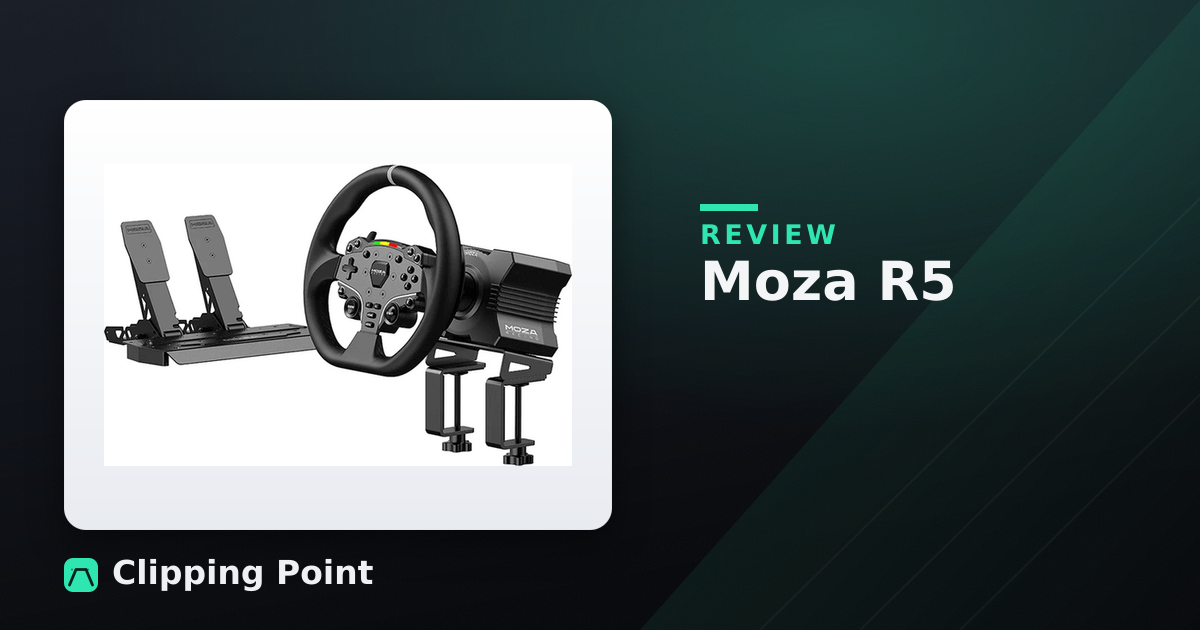
The Moza R5 is the direct drive bundle I’d hand most people buying their first real wheel in 2026, and I don’t say that lightly after the number of budget setups I’ve watched disappoint their owners. You get a genuine 5.5 Nm direct drive base, a wheel, and a set of pedals in one box, and the whole package punches straight through the belt-and-gear wheels it’s priced against. It isn’t perfect — the pedals are the weak link and it’s PC-only, which will end the conversation for some of you — but as a complete, racing-tonight setup, it’s the one I keep recommending.
| Moza R5 | Fanatec CSL DD | |
|---|---|---|
| Peak torque | 5.5 Nm | 5 Nm (8 Nm with Boost Kit) |
| Drive type | Direct drive | Direct drive |
| Platforms | PC | PC · Xbox |
| In the box | Base (bundle adds ES wheel + SR-P Lite pedals) | Base only |
| Best for | A first direct-drive base without overspending | An upgrade path into the Fanatec ecosystem |
Specs from each manufacturer's current listings. Prices move constantly — hit the price buttons above for today's numbers.
Who the Moza R5 is actually for
The R5 is aimed at one specific person: someone on PC who’s done with gear and belt wheels, wants real direct drive, and would rather buy one complete box than assemble a base, a rim, and pedals from three separate product pages. If that’s you, this is close to the default answer.
It is not for everyone, and I’d rather save you a return than sell you the wrong thing. If you’re on Xbox or PlayStation, stop here and look at something with console licensing, because the R5 is PC-only and no amount of wanting changes that. If you already race on a rigid aluminum rig and you know you want heavy, formula-style FFB, you’ll outgrow 5.5 Nm and should size up. And if the complete bundle costs more than you want to spend right now, my best wheel under $300 pick — the R5’s little brother, the R3 — does most of what this does for less.
Everyone in between, though — the PC sim racer who wants a base they won’t outgrow in a season and a bundle that gets them on track the same evening it arrives — is exactly the target. That’s most first-time direct drive buyers, which is why the R5 sits near the top of our best sim racing wheels hub.
What 5.5 Nm actually feels like
If you’re coming from a Logitech G923 or a Thrustmaster belt wheel, the first lap on the R5 quietly rearranges your expectations. It isn’t that it’s stronger, although it is. It’s that the center of the wheel finally has information in it.
On a gear or belt wheel there’s a dead, vague patch right around center where the FFB mushes together, and you end up steering by watching the car instead of feeling the front tires. Direct drive bolts the wheel straight to the motor shaft — no gears to round off, no belt to stretch — and that dead patch disappears. The instant the fronts start to wash into understeer arrives in your hands a beat before your eyes would have caught it. Through the esses at Suzuka in ACC, where the car loads and unloads side to side in quick rhythm, the R5 lets you feel each front tire take and release grip in sequence. On my old belt wheel that whole section was educated guesswork.
Now, 5.5 Nm in raw terms is entry-level torque and I won’t pretend otherwise. Spec-chasers online will tell you it’s weak, that you need 8 or 12 Nm to feel anything, and they’re chasing the wrong number. What you actually feel through a wheel isn’t shove, it’s detail — grip, kerb texture, the front end loading up mid-corner — and 5.5 Nm has more of that than you’ll use on a desk. Unless you’re bolted to a rigid rig, you’ll run the R5 below its ceiling anyway, because a desk can only absorb so much force before it starts flexing (much more on that below). I keep mine around 70% strength in Pit House and let the sims do the fine work.
Does the extra half-Newton over a 5 Nm base matter? No. I said this in my Moza R5 vs Fanatec CSL DD head-to-head and I’ll repeat it here: the gap between 5 and 5.5 Nm is something you notice for ten minutes and then forget forever. Buy the R5 for the complete bundle and the software, not for torque bragging rights.
The bundle: a genuinely good wheel, pedals that hold it back
The R5’s entire pitch is that it’s complete, so the wheel and pedals matter as much as the base does. The good news is the ES wheel is the strong half of the deal. It’s a round GT-style rim with rubberized grips, a sensible button layout, and — the part that surprised me — magnetic paddle shifters. Magnetic paddles at this tier are not a given, and they give a crisp, clicky upshift that cheap plastic contact paddles simply can’t. It’s a plastic wheel and it feels like one if you go looking for the seams, but in your hands during a stint it’s genuinely good, and you won’t be itching to replace it the way you are with most bundled rims.
The SR-P Lite pedals are where the bundle shows its price. It’s a two-pedal set, throttle and brake, and out of the box the brake is a spring-and-potentiometer unit, not a load cell. For your first month they’re fine. Then you’ll learn what a load-cell brake does — it measures how hard you press rather than how far you push, so you brake by pressure like in a real car, and your braking suddenly becomes repeatable — and you’ll want one. Moza sells a load-cell upgrade that drops into the SR-P Lite, the saving grace, but it’s another purchase down the line.
The bigger day-one gripe is physical. The pedal faces are small, and the whole assembly is light enough that under a hard stop it’ll skate across the floor if you haven’t bolted it to something. On a hard floor with nothing to brace against, you’ll spend the evening chasing them toward the far wall. Treat bolting them down as part of setup, not an optional extra.
The honest framing is this: the base is the part you keep for years, the wheel is better than the bundle needed it to be, and the pedals are training wheels you’ll eventually upgrade. That’s not a flaw unique to the R5 — every complete bundle at this price ships pedals you’ll outgrow — but it’s plainly where the money was saved, so go in knowing it.
Pit House software, and the settings I’d start with
Moza’s Pit House software runs the whole show, and it’s one of the R5’s quiet advantages. It’s clean, modern, handles per-game profiles, live telemetry, and firmware, and mostly it stays out of your way. Set next to the driver-and-Fanalab juggling act on the Fanatec side, a newcomer is going to find Pit House far less intimidating on night one.
It isn’t flawless. Every so often you’ll plug in and Pit House won’t see the base until you replug the USB — a five-second annoyance that shouldn’t happen but does. And the very first thing a new R5 wants to do is update its firmware, so budget fifteen minutes for that before your first race rather than getting ambushed by it. First-time firmware is the one setup step people actually post about; it’s harmless, it just needs to happen before you’re driving.
Here are real starting numbers instead of the vague “adjust to taste” cop-out:
- ACC: Pit House strength around 70%, in-game gain 65 to 70%, minimum force 0 to 3%, dynamic damping around 30%. ACC’s own FFB runs soft, so you’ll push gain higher than feels natural.
- iRacing: use the auto button on a fast lap to set max force, then nudge it stronger until the wheel just barely stops clipping through a quick corner. On 5.5 Nm that landed me in the low-teens on the strength number.
- Rotation: leave it at 900 degrees in software and let each sim request the correct angle per car. Setting it manually per car on day one is a rabbit hole you don’t need.
Clipping is the mistake to avoid. Run everything at 100% and the FFB signal maxes out into a flat wall of force, and you lose all the fine texture underneath — the exact detail you bought direct drive for. Turn it down until gravel, a kerb, and a locking front tire all feel different. Then stop fiddling and go race — the urge to keep tuning is the enemy of getting faster.
Build quality and the PC-only catch
The base itself is reassuringly solid. It’s compact, the housing is part metal, it doesn’t creak under load, and the quick release snaps the wheel on and off cleanly with no play once it’s seated. Moza’s build has quietly caught up with anyone else’s at this tier; the old idea that the newer brand means flimsier hardware just doesn’t hold anymore. The included desk clamp is decent too — though, and I can’t stress this enough, the clamp is not the limiting part of your setup. Your desk is.
Direct drive puts real torque into whatever it’s mounted to, and that force has to go somewhere. On a rigid rig it returns as clean feedback. On a hollow-top particle-board desk it goes into flex: the desk twists a few millimeters and springs back, and now there’s a wobble in your FFB that has nothing to do with the car. People blame the base, crank the settings, and make it worse. If you’re desk-mounting, at minimum shove the desk against a wall so it can’t rock forward under braking; better, get a wheel stand. I go deep on this in the best direct drive base for a desk guide, because mounting rigidity does more for how the R5 feels than any slider in Pit House.
Now the catch that ends the conversation for some of you: the Moza R5 is PC-only. There’s no Xbox or PlayStation license on this base. If you’re a console player, it simply will not work with your machine, and no firmware update or workaround changes that — this is a licensing wall, not a software gap. Moza does make console-capable bases (the R3 and R12 have Xbox variants), but the R5 isn’t one of them. Confirm your platform before you order. A PC-only base bought for an Xbox is the single most common return in this entire category.
Where it annoyed me
I’ve scattered the gripes through this review, so here they are in one place, because a review that only lists positives is an advertisement.
The pedals, first and biggest. Small faces, light enough to slide, and a potentiometer brake until you pay for the load-cell upgrade. Plan for that upgrade on day one and you won’t feel cheated.
The torque ceiling. 5.5 Nm is entry-level, full stop. For GT3 and touring cars on a desk it’s plenty, but if you race a lot of heavy open-wheel or you’re on a rigid rig chasing the strongest possible front-end feel, you’ll run the R5 flat out and still want more. That’s a category limit rather than a defect, but it’s real, and it’s precisely why some people should size up instead of buying this.
The firmware-and-USB fiddliness. Minor but present — the first-plug firmware update and the occasional “replug the USB” moment are friction points a more mature ecosystem wouldn’t have.
And the one that’s more feeling than fact: Moza is still the younger brand. Two years of fast firmware and reliable parts have largely answered the long-term-support worry, and I’d back Moza’s trajectory over the alternatives today. But if resale value five years out keeps you up at night, that uncertainty is fair to weigh.
The verdict: who buys it, who sizes up
Buy the Moza R5 if you’re on PC, you’re stepping up from a gear or belt wheel, and you want a complete direct drive setup that gets you racing the night it lands. For that buyer — most first-time DD buyers — it’s the box I’d put in your hands without hesitating. The base is one you’ll keep for years, the ES wheel over-delivers, and Pit House makes it painless to live with. Add the load-cell pedal upgrade when the itch hits, bolt the pedals down, mount the base to something rigid, and you’ve got a setup that embarrasses wheels costing far more.
Size up if you already know you want heavier FFB or you’re building a rigid rig for serious open-wheel racing. The Moza R9 at 9 Nm or the R12 at 12 Nm give you headroom the R5 can’t reach. Step sideways to the Fanatec CSL DD only if you already own compatible Fanatec gear — I laid that whole decision out in the Moza R5 vs Fanatec CSL DD comparison. And step down to the R3 if the R5’s complete price is more than you want to spend this month.
But if you’re the person the R5 was built for — a PC racer buying their first real wheel — this is the one. It’s why it lands near the top of our best sim racing wheels rankings, and it’s the bundle I’d spend my own money on tonight.