
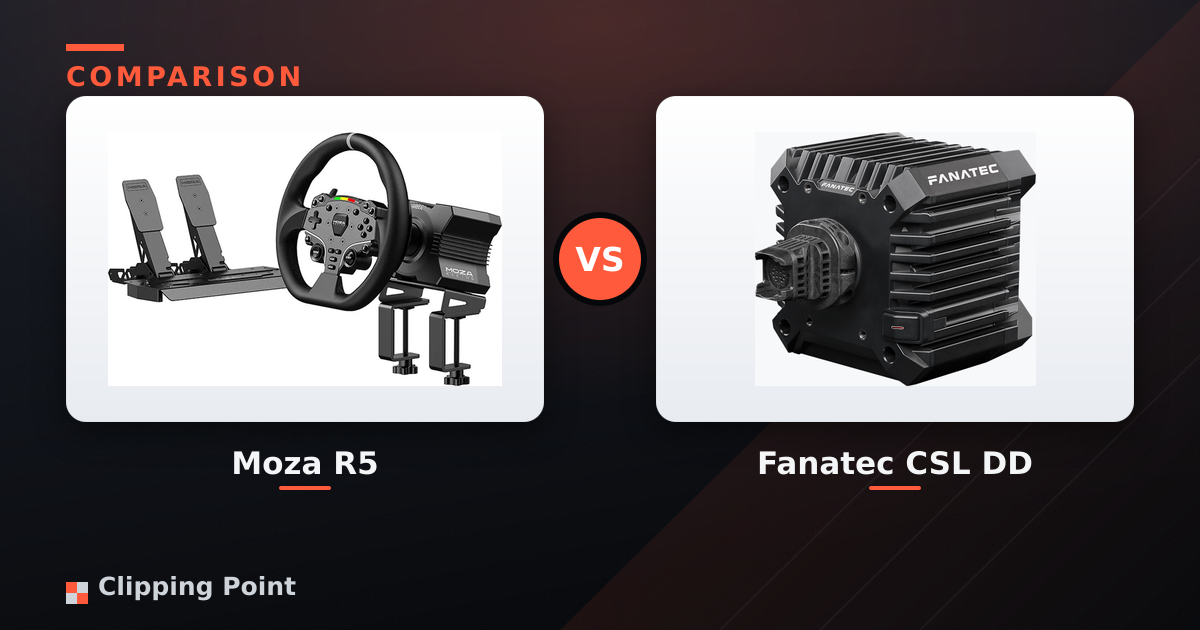
| Moza R5 | Fanatec CSL DD | |
|---|---|---|
| Peak torque | 5.5 Nm | 5 Nm (8 Nm with Boost Kit) |
| Drive type | Direct drive | Direct drive |
| Platforms | PC | PC · Xbox |
| In the box | Base (bundle adds ES wheel + SR-P Lite pedals) | Base only |
| Best for | A first direct-drive base without overspending | An upgrade path into the Fanatec ecosystem |
Specs from each manufacturer's current listings. Prices move constantly — hit the price buttons above for today's numbers.
If you’re picking between these two tonight and want the answer before the coffee goes cold: for most people buying their first direct drive in 2026, the Moza R5 bundle is the smarter buy. It arrives complete, the torque is a hair higher, and Moza’s parts and software have quietly caught up to the point where the “newer brand” worry doesn’t hold much water anymore. The Fanatec CSL DD is still a fine wheelbase, and both sit near the top of our best sim racing wheels picks. The problem is what the sticker price hides and the state of the company you’d be buying from.
That’s the verdict. Now the part where I actually justify it, because “buy the Moza” without the reasons is exactly the recycled-listicle nonsense that probably brought you here at midnight.
What you’re actually comparing
Here’s the trap. People line these two up as if they’re the same kind of purchase, and they aren’t. The Moza R5 is almost always sold as a bundle: the R5 base, the ES round wheel, and the SR-P Lite pedals, for somewhere around $599 depending on sales. The Fanatec CSL DD is sold as a wheelbase only. Base 5 Nm unit runs about $350, and the 8 Nm Boost Kit version around $420. Neither of those numbers includes a wheel or pedals, and if this whole bracket is above your ceiling, our best sim racing wheel under $300 pick is the cheaper way into direct drive.
So the real Fanatec bill, once you add a McLaren GT3 V2 rim (roughly $250) and the CSL Pedals with the load cell kit (another $200 or so), lands north of $800 before shipping. The Moza gets you racing out of one box for two-thirds of that. If you already own a Fanatec wheel from an old CSL Elite setup, that math flips hard in Fanatec’s favor, and I’ll come back to that, because it’s the one scenario where I’d tell you to buy the CSL DD without hesitating.
Torque, and why 0.5 Nm doesn’t matter
On paper the R5 puts out 5.5 Nm peak and the CSL DD does 5 Nm, or 8 Nm with the Boost Kit. The internet loves to argue about this. Ignore most of it.
At this tier you are torque-limited enough that the difference between 5 and 5.5 Nm is something you’ll feel for about ten minutes and then forget. Both will happily clip (that’s when the FFB signal maxes out and detail flattens into a wall of force) if you crank the in-game gain like a lunatic. The 8 Nm Fanatec has genuine headroom over the Moza, and if raw strength is the only thing you care about, that’s the CSL DD’s real trump card. But 8 Nm through a small GT-style rim on a desk is already more than a lot of people run comfortably for a two-hour endurance stint. I keep my R5 around 70% strength in Pit House and let the sims do the fine work. Chasing the last Newton-meter is a beginner’s obsession that goes away the week you actually start racing instead of tweaking.
What matters more than peak torque is how clean the force is at low levels, the little kerb texture and the moment the front tyre lets go. Both of these bases are direct drive, so both are worlds past any belt or gear wheel you might be upgrading from. The R5’s motor feel is slightly smoother out of the box, something I dig into in the full Moza R5 review. The CSL DD can feel a touch notchier at very low forces until you get the settings dialled, though most people never notice.
Living with them past the first hour
Unboxing the Moza is the better first evening. Everything’s in one box, the base clamps to a desk with the included bracket, the ES wheel snaps on with Moza’s quick release, and Pit House walks you through a firmware update that, yes, will probably want to run the moment you plug in. Budget fifteen minutes for that update. First-time firmware on a fresh R5 is the one setup annoyance people actually post about.
The Fanatec first-hour experience depends entirely on driver roulette. Fanatec’s driver-and-Fanalab situation has improved, but there’s still a specific version dance where the newest driver isn’t always the most stable one, and the community keeps a running list of “known good” versions for a reason. When it works it’s great. When you land on a bad combo you’ll be reading forum threads at 1 a.m. instead of driving. That unpredictability is a Fanatec tax that’s existed for years.
After a week, the quirks that surface are different for each. On the Moza, the SR-P Lite pedals are the weak link. They’re fine, they have a load-cell brake option, but the pedal faces are small and the whole assembly is light enough that it’ll slide if you don’t bolt it to something. On the Fanatec side, the base CSL Pedals without the load cell are genuinely not worth using; the brake is a potentiometer and feels like stepping on a light switch. If you go Fanatec, the load cell kit isn’t optional in any real sense. That’s the $200 nobody mentions in the “$350 direct drive!” videos.
A load-cell brake, by the way, is the single biggest jump in lap-time consistency most people get from a new setup. It measures pressure instead of travel, so you brake with your leg the way you would in a real car. First time I switched to one I dropped half a second at the Bus Stop at Watkins Glen in ACC just from braking the same way twice in a row. Whichever base you buy, prioritise the load cell over almost everything else.
Desk flex will ruin either one
Nobody warns you about this and it’s the number one reason people are disappointed with their first direct drive. A 5 Nm base bolted to a wobbly particle-board desk transfers that force straight into the desk, and the desk flexes, and suddenly your crisp direct drive feels like it’s mounted on a trampoline. I ran my first DD on a cheap IKEA desk and spent a month thinking the wheelbase was faulty. It wasn’t. The desk was.
If you’re desk-mounting, you need something heavy and rigid, ideally braced against a wall. Both brands sell wheel stands and cockpits; Moza’s cockpits tend to undercut Fanatec’s on price. If a proper rig isn’t in the budget yet, at minimum push the desk against a wall so it can’t rock forward under braking and cornering load. This one change does more for the feel than any FFB slider.
Software, and the settings I’d actually start with
Moza’s Pit House is the more modern piece of software. Cleaner layout, live telemetry, per-game profiles, and it doesn’t fight you. Fanatec’s tuning lives partly on the base’s own screen and partly in Fanalab, which is more powerful and more fiddly. Power users prefer Fanalab’s depth. Newcomers prefer that Pit House just works.
Some real starting points instead of the vague “adjust to taste” cop-out:
- iRacing: on either base, turn off the in-app “use damper/min force” auto stuff first. Set the sim’s max force with the auto button on a fast lap, then nudge it stronger until the wheel just barely stops clipping through a fast corner. On the 5.5 Nm R5 that landed me around 12 to 14 on the strength number.
- ACC: in-game gain around 65 to 70%, minimum force at 0 to 3%, dynamic damping around 30%. ACC’s own FFB is soft, so you run higher gain here than you’d expect.
- Rotation: leave it at 900 degrees in software and let each sim request the correct angle per car. Setting it manually per car is a rabbit hole you don’t need on day one.
Spend a night on those and stop fiddling. The urge to keep tuning is the enemy of actually getting faster.
The Fanatec question nobody wants to say out loud
You cannot talk about buying Fanatec in 2026 without talking about the company. Fanatec went through a very public financial mess and was absorbed by Corsair. Support and shipping had a genuinely rough stretch, with people waiting months on orders and RMAs, and that reputation is still fresh in every r/simracing thread where someone asks this exact question. Things have stabilised under Corsair. But “it’s probably fine now” is a weaker pitch than Moza, which has been shipping quickly and expanding its lineup at a pace that’s made the rest of the market nervous.
Moza’s own risk is the opposite one. It’s a younger brand, and some people are (fairly) cautious about long-term support and resale. Two years in, the parts availability and firmware cadence have been good, and the range of wheels and add-ons that fit the R5 has grown a lot. The resale worry is real but shrinking. I’d take Moza’s trajectory over Fanatec’s recent history if I were spending my own money today.
Quick comparison
| Moza R5 (bundle) | Fanatec CSL DD | |
|---|---|---|
| Peak torque | 5.5 Nm | 5 Nm (8 Nm w/ Boost Kit) |
| What’s in the box | Base, wheel, pedals | Base only |
| Real all-in cost | ~$599 | ~$800+ once wheel + load-cell pedals added |
| Software | Pit House (simple) | Fanalab + drivers (deep, fiddly) |
| Load-cell brake | Optional on included pedals | Effectively required, sold separately |
| Company risk | Newer brand, fast support | Post-Corsair recovery, patchy recent history |
FAQ
Is the 8 Nm Boost Kit worth it over the base 5 Nm CSL DD? If you’re already committed to Fanatec, yes, get the 8 Nm from the start rather than upgrading later. The extra headroom means less clipping and a stronger sense of the front end loading up. It does not, by itself, close the value gap with the Moza bundle, because you’re still buying the wheel and pedals separately.
Can I use my old Fanatec wheel on the CSL DD? Yes, and this is the one case where the CSL DD wins outright. If you’re coming from a CSL Elite or CSU and already own a Fanatec rim, buying just the CSL DD base is a cheap, sensible upgrade and the Moza’s bundle advantage evaporates. Moza wheels do not fit Fanatec bases and vice versa, so an existing collection locks you in.
Which feels stronger and more detailed for GT3 racing? For GT3 in ACC or iRacing, both are more than enough. The 8 Nm Fanatec has a slight edge in outright strength, the R5 is marginally smoother at low force. The bigger determinant of how good either feels is your mounting rigidity and your pedals, not the half-Newton difference between the bases.
So, who buys what
Buy the Moza R5 bundle if this is your first direct drive and you don’t already own Fanatec gear. One box, faster to get running, better software for a newcomer, and you’re not hunting for driver versions on launch night.
Buy the Fanatec CSL DD, in 8 Nm form (I cover it on its own in the Fanatec CSL DD review), if you already own a compatible Fanatec wheel, or you specifically want that extra torque ceiling and you’re comfortable buying the load-cell pedals as a separate line item.
Before you order either, check two boring things. First, what you’re bolting it to. A rigid mount changes the feel more than any spec on this page, and a 5 Nm base on a wobbly desk is a waste of money. Second, add the load-cell brake to your cart no matter which base you pick. That’s the upgrade you’ll feel every single lap, long after you’ve stopped caring who won the torque argument.