
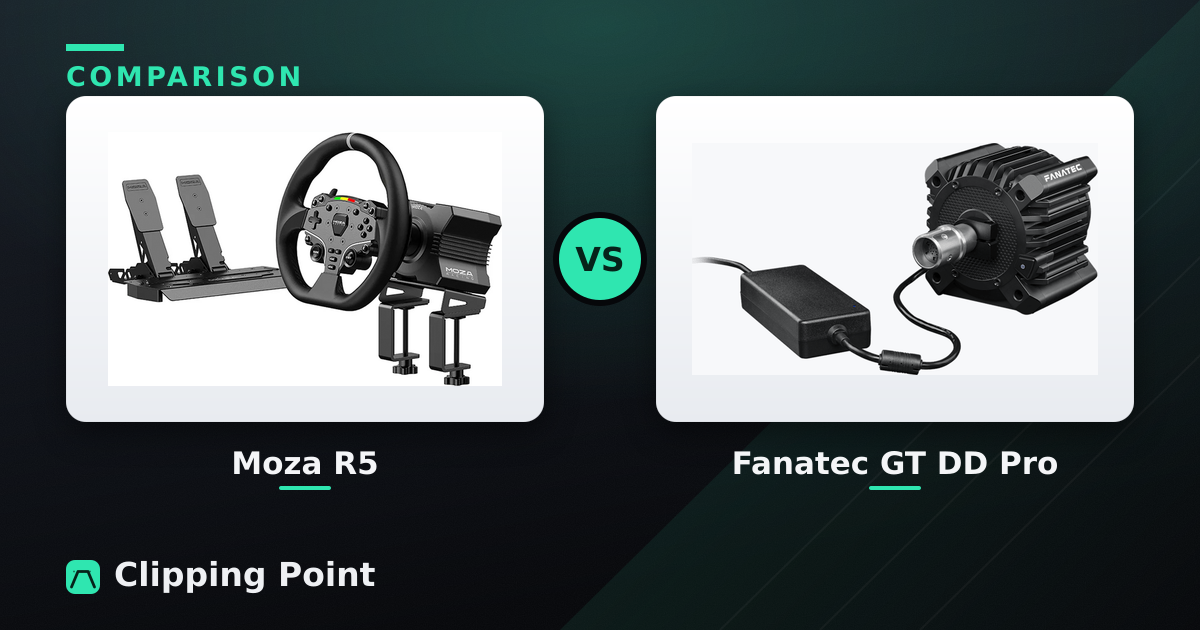
| Moza R5 | Fanatec GT DD Pro | |
|---|---|---|
| Peak torque | 5.5 Nm | 5 Nm (8 Nm with Boost Kit) |
| Drive type | Direct drive | Direct drive |
| Platforms | PC | PC · PS5/PS4 |
| In the box | Base (bundle adds ES wheel + SR-P Lite pedals) | Bundle: wheel + pedals |
| Best for | A first direct-drive base without overspending | The go-to direct-drive base for PlayStation |
Specs from each manufacturer's current listings. Prices move constantly — hit the price buttons above for today's numbers.
If you’re on a PS5 and Gran Turismo 7 is the reason you’re shopping at 11pm, buy the Fanatec Gran Turismo DD Pro. That’s the whole answer for you. The Moza R5 will not turn a single wheel in GT7, not with an adapter, not with a firmware trick, not next year. Sony’s licensing is a locked door and Fanatec has the cheapest key.
If you’re on PC, the Moza R5 bundle is the better buy and it isn’t particularly close. You get more usable pedal, a metal quick release, software that doesn’t fight you, and roughly a hundred bucks left over. The GT DD Pro’s console support is the only thing keeping it in the conversation, and you pay for that license whether you use it or not.
Now the part where I earn those two paragraphs.
What’s actually in the box
The R5 bundle runs around $599 and regularly dips near $499 on sale. You get the R5 base (5.5 Nm), the ES wheel, and the SR-P Lite two-pedal set. Everything you need to drive is in there, including a table clamp.
The GT DD Pro bundle is around $599 in its 5 Nm form and about $799 with the Boost Kit 180 that takes it to 8 Nm. That gets you the base, the round Gran Turismo wheel, and the CSL Pedals. Those CSL Pedals are the part nobody mentions in the YouTube thumbnails: two pedals, potentiometer brake, no load cell. The load cell kit is another ~$100 and it is not optional if you care about braking consistency, which means the real price of a GT DD Pro setup you won’t immediately want to upgrade is closer to $900.
| Moza R5 bundle | Fanatec GT DD Pro bundle | |
|---|---|---|
| Torque | 5.5 Nm | 5 Nm (8 Nm with Boost Kit) |
| Platforms | PC only | PS5, PS4, PC |
| Pedals included | SR-P Lite (pressure-based brake) | CSL Pedals (pot brake) |
| Quick release | Metal | QR1 Lite (plastic) |
| Realistic all-in price | ~$599 | ~$700–900 |
The torque argument is mostly noise
People fixate on 5.5 versus 8 Nm like it’s the deciding factor. It isn’t, and here’s why: almost nobody buying a first direct drive wheel has a rig stiff enough to actually use 8 Nm.
Clamp either of these to a 25mm particleboard desk and crank the gain. Under load in a fast direction change, the desk twists. You feel that twist as a lag in the wheel, a soft mushy edge to every input, and the desk drums against the wall. Your force feedback is now partly a report on your furniture. I have watched a friend’s IKEA Bekant flex visibly through the Porsche Curves at Le Mans with a 5 Nm base, and he was convinced the wheel was broken.
5.5 Nm is genuinely enough to feel understeer build, catch a snap, and read kerbs. Both wheels here will beat you up if you set them badly. The difference between 5.5 and 8 shows up as headroom in the heavy stuff (a GT3 car at Spa with no power steering assist, older F1 mods, big kerb strikes), and headroom is a real thing, just not a $200 thing when the money would buy you a load cell instead.
Buy the 5 Nm GT DD Pro if you go Fanatec. Add the Boost Kit later if you ever build a proper aluminium profile rig. You almost certainly won’t for a year.
First hour with each
The R5 unboxing is unremarkable in the best way. Clamp it down, plug the ES wheel onto the QR (it seats with a solid click and no play), install Pit House, and it’ll prompt you to update firmware. That update takes a few minutes and it’s the only fiddly bit. Pit House is genuinely one of the better bits of sim hardware software: one window, per-game profiles, sliders that do what they say. Set base FFB to 100% and control everything from inside the sim. Nobody needs the Pit House EQ curves on day one.
Fanatec’s first hour is a bit more 2014. You download a driver package from their site, pick the right version (the community will tell you which driver is “the good one” this month, and the community is usually right), and the base does a calibration sweep that sounds like a small industrial machine clearing its throat. Then you learn the on-wheel tuning menu, which is a tiny screen and two buttons and a set of three-letter acronyms: SEN, FF, NDP, NFR, INT, FEI. It’s fine once you know it. It’s also a system designed before anyone assumed a beginner would own a direct drive wheel.
On PS5 there’s no driver at all, which is the whole point. Plug it in, GT7 sees it, done. That plug-and-drive experience is worth real money and I’m not going to pretend otherwise.
Pedals, which is where the money actually goes
Here’s my strongest opinion in this article: your first upgrade priority after a direct drive base is a load cell brake, and it is not close. Wheel torque affects how the car talks to you. Brake pressure sensing affects how consistently you can hit an apex, lap after lap, which is the entire skill of driving fast.
A potentiometer brake measures how far you push. A load cell measures how hard. Human legs are much better at repeating a pressure than a distance, which is why the first week on a load cell feels like someone turned the lights on. Trail braking stops being a guess.
Moza’s SR-P Lite brake reads pressure rather than travel, and while it’s a budget pedal set (light, plastic-heavy, absolutely must be bolted or wedged against something solid or it will walk away from you under braking), it puts you in the right world on day one. Fanatec’s CSL Pedals in the bundle do not. You will feel that difference at Okayama in an MX-5 long before you feel the difference between 5.5 and 8 Nm.
Both pedal sets are temporary. Both will be sold on Facebook Marketplace within eighteen months. But one of them teaches you the right habit and one of them teaches you to brake by memorising pedal travel, a habit you then have to unlearn.
How they feel on track
The R5 through Eau Rouge in the 992 GT3 R (ACC, ~65% in-game gain, 100% in Pit House, dampening off) gives you a clean, slightly dry signal. Kerb detail is good. The base runs cool and quiet since there’s no fan, and the passive cooling means it’ll clip a little under sustained heavy load in a long stint, which you’ll notice as the wheel going slightly numb after 40 minutes at Bathurst. Not a dealbreaker at this torque level.
The GT DD Pro at 8 Nm has a slightly heavier, more mechanical character. Fanatec’s FFB signal has a low-frequency weight to it that a lot of people prefer. It’s also got more filtering in the default settings than I like, so if your first impression is “this feels like driving through syrup”, drop FEI to around 90-100 and set NDP low (10-20), which sharpens things considerably.
In GT7 specifically, run in-game Max Torque around 5-7 and Sensitivity around 4-5. GT7’s force feedback is not a simulation of physics so much as an interpretation of it, and no wheel makes it feel like iRacing. Gr.3 cars at Dragon Trail are enjoyable. They’re just not talkative in the way ACC is.
In Le Mans Ultimate, both bases do a decent job of the Sebring bumps, which is the test I actually use. LMU’s FFB is loud in the good way and either wheel will rattle your desk on the back straight.
What breaks, rattles, and annoys
The GT DD Pro’s QR1 Lite is plastic and it develops play. Not immediately. Around month three, you’ll notice a small dead click when you reverse direction, and it will drive you insane once you’ve heard it. The fix is a Fanatec QR2 upgrade, which is another ~$100+, or living with it. This is the single most common complaint I see from GT DD Pro owners on r/simracing after the honeymoon ends, and it’s legitimate.
Moza’s QR is metal from the start. Advantage Moza, full stop.
The R5’s underside mounting is M6 and the bolt pattern is small, which occasionally annoys people bolting to a wide rig plate. The base itself is compact enough that on a deep desk you may want a riser to get the wheel angle sane.
Fanatec’s shipping and support reputation was, for years, the running joke of the hobby. Order in November, receive in February, RMA queue measured in geological time. Since Corsair took over the parent company, things have improved and orders generally show up when they say they will. But the support culture hasn’t fully reset, and if something goes wrong you should expect a slower process than you’d get from a mainstream electronics brand.
Moza’s counter-argument is that they’re newer, which cuts both ways. Support has been quick and direct in my experience and the community reports the same. Their firmware release cadence is fast, sometimes fast enough that a new version breaks something for a week. Read the Discord before you update anything the night before a league race.
The console thing, stated plainly
If you own a PS5, the GT DD Pro is your entry point to direct drive and the alternatives are worse or dramatically more expensive. Logitech’s PS-compatible DD wheel is roughly double. That’s the market. Fanatec earned that position by paying for the license and building the hardware around it, and you’re paying a premium for the privilege, but the privilege is real.
If you own an Xbox, neither of these works. Look at Moza’s R3 or Fanatec’s CSL DD.
If you’re on PC only and you’re weighing the GT DD Pro because you “might get a PS5 later”, don’t. Buy the hardware for the machine you own. The PS5 you might buy in two years can have its own wheel, or you can sell this one.
Settings worth starting from
- Moza R5, iRacing: rotation auto/900, base at 100%, use iRacing’s auto force calculation then back it off 10%, linear mode on. Turn damping off.
- Moza R5, ACC: in-game gain 60-70, minimum force 0-2, dynamic damping ~50, road effects 10-20.
- GT DD Pro, ACC: SEN Auto, FF 100, NDP 15, NFR 0, NIN 0, INT 3, FEI 100. Then in-game gain 60-70.
- GT DD Pro, GT7: SEN Auto, FF 100, in-game Max Torque 5-7, Sensitivity 4-5.
Start there, drive twenty laps, then change one thing at a time. The single biggest mistake beginners make is running maximum force everywhere and then wondering why their arms hurt and they’re slow.
FAQ
Is 5 Nm enough for a beginner, or will I outgrow it fast? It’s enough. You’ll outgrow the pedals long before the base, and most people who “outgrow” 5 Nm are actually reacting to a flexy mount rather than a lack of torque. If you’re the kind of person who upgrades constantly, buy the base you want in two years now and skip this whole tier.
Can the Moza R5 work on PS5 with an adapter? No. Third-party passthrough adapters exist for various platforms and they’re a mess of firmware issues and inconsistent support, and Sony’s authentication makes GT7 in particular a hard no. Don’t spend $100 finding this out.
Is the Fanatec Boost Kit 180 worth it? Only if your wheel is bolted to something rigid. On a desk clamp, the extra 3 Nm mostly goes into flexing your furniture. Buy the 5 Nm bundle, spend the difference on the load cell kit, and add torque when you have a rig that deserves it.
Before you order
Go look at your desk. Push down hard on the front edge where the clamp will sit, then push it side to side. If it moves, budget $30 for a length of 40x40 aluminium profile or a plank to spread the load, or accept that a chunk of what you paid for will be absorbed by wobbling plywood. Every direct drive complaint thread that starts with “the FFB feels vague” ends with someone discovering their mount.
Then decide on one question and one only: does the wheel need to work on a PlayStation? Yes means Fanatec GT DD Pro, 5 Nm version, plus the load cell kit as soon as you can afford it. No means Moza R5 bundle, and put the leftover money toward a shifter or a proper wheel rim when the ES starts feeling small.