
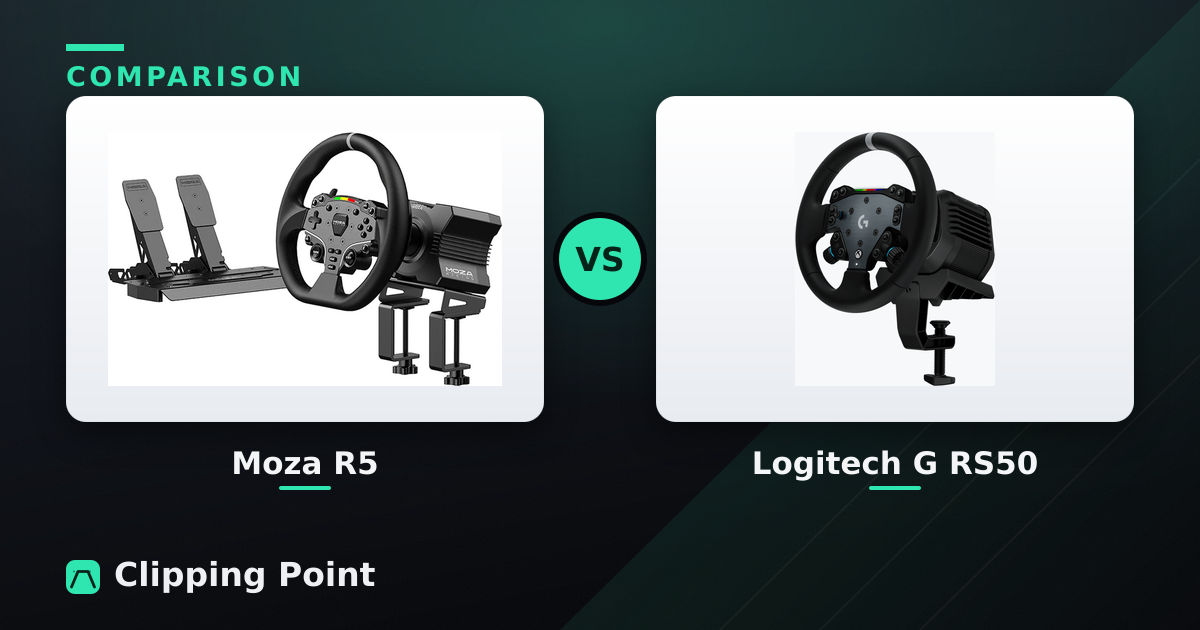
| Moza R5 | Logitech G RS50 | |
|---|---|---|
| Peak torque | 5.5 Nm | 8 Nm |
| Drive type | Direct drive | Direct drive |
| Platforms | PC | PC · PS5 · Xbox |
| In the box | Base (bundle adds ES wheel + SR-P Lite pedals) | Base (system bundle adds wheel + pedals) |
| Best for | A first direct-drive base without overspending | One base that just works on every platform |
Specs from each manufacturer's current listings. Prices move constantly — hit the price buttons above for today's numbers.
Here’s the answer you came for: if you race on a PlayStation or Xbox, buy the Logitech G RS50 and stop reading, because the Moza R5 doesn’t work on consoles at all and no firmware update is going to change that. If you’re on PC only, it gets more interesting, and my actual recommendation is the R5 for most people, mainly on price. But the RS50 is the first Logitech wheel I’d genuinely consider buying since the G25, and that sentence would have gotten me laughed out of a Discord server two years ago.
The gap between these two is smaller than the spec sheets suggest and larger than the marketing admits, just in different places than you’d expect. Torque is not the story. Pedals and platform support are the story. Let me earn the verdict.
What you’re actually buying
The Moza R5 bundle lists around $599 and is on sale often enough that paying full price is a rookie mistake. I’ve seen it under $500 more than once. For that you get the 5.5 Nm R5 base, the small ES wheel (about 260mm, round, rubber grips), and the SR-P Lite two-pedal set. It is a complete package out of one box, PC only, and Moza’s accessory catalog behind it is enormous: formula rims, GT rims, a handbrake, an active pedal now if you’ve lost your mind and your savings.
The Logitech G RS50 is around $600 for the base side of the equation, and by the time you’ve got a rim on it and the Logitech RS Pedals under the desk you’re closer to a thousand dollars than to the Moza’s bundle price. That’s the comparison nobody puts in the headline. Base versus base they look like neighbors. Rig versus rig, the Logitech setup costs roughly double what a discounted R5 bundle does.
What the extra money buys: 8 Nm peak instead of 5.5, TRUEFORCE (Logitech’s audio-driven vibration system, more on that later), a proper quick release, a load-cell brake in the RS Pedals, and the tri-platform thing, which really is the RS50’s party trick. One base that works on PC, PS5, and Xbox is something Fanatec never managed cleanly and Moza doesn’t offer at all.
The bases, side by side
| Moza R5 | Logitech G RS50 | |
|---|---|---|
| Peak torque | 5.5 Nm | 8 Nm |
| Platforms | PC only | PC, PlayStation, Xbox |
| Software | Pit House | G HUB |
| Typical cost to race | ~$500-600 all-in (bundle) | ~$900-1,000 all-in |
On paper 8 Nm versus 5.5 Nm reads like a class difference. In the chair it’s less dramatic. Both are direct drive, so both give you the thing that actually matters coming from a G29 or G923: the motor talks to your hands constantly instead of through a gearbox full of slack and cogging. Slip angle, kerb texture, the rear stepping out at Paddock Hill Bend in ACC before the screen shows it. A gear-driven wheel tells you about that oversteer roughly when your car is already facing the pit wall. Either of these tells you in time to catch it.
Where the extra torque earns its keep is headroom. With 5.5 Nm you’ll run the R5 near its ceiling in heavier cars, and heavy static loads (a GT3 car leaning hard through Pouhon, say) can start to compress the detail. The RS50 at 8 Nm keeps more in reserve, so the fine grain survives on top of the load. Is that worth $400? For an aspiring iRacing GT3 grinder, maybe. For someone running the MX-5 at Summit Point twice a week, absolutely not.
Living with the R5
Setup is twenty minutes if you read nothing and ten if you do. The included table clamp is decent, the base is small enough to look reasonable on a desk, and it runs silent because there’s no fan to whine at you.
Pit House, Moza’s software, is where opinions split. It does everything: FFB curves, telemetry, per-game profiles, firmware. It also nags about updates, occasionally forgets your wheel exists until you replug the USB, and has a habit of shipping firmware that the Moza Discord then spends a week discussing in the tone of people defusing a bomb. My standing advice: once your R5 works, do not update firmware mid-season unless a patch note names a problem you personally have.
Settings that took me too long to land on, free of charge: in Pit House, max output 100%, road sensitivity down around 2 or 3 (the default makes every track feel like gravel), speed-dependent damping off, spring off. In ACC run in-game gain about 75-80%. In iRacing, use the auto-FFB button per car and let it set strength; it usually lands somewhere sane and you stop clipping without thinking about it.
The weak links in the bundle are honest ones. The ES wheel is small and plasticky, with clacky paddles that work fine and feel cheap. And the SR-P Lite pedals are the part you will replace. The brake is spring-based, so you’re braking by ankle position instead of pressure, which caps how consistent you can ever be. The upgrade path is the reason this bundle still makes sense: a Moza SR-P load-cell set is around $200, and the day you install it your braking consistency improves more than any wheel base purchase will ever manage. That’s not a review cliché, it’s the single most repeated piece of advice on r/simracing, and it’s repeated because it keeps being true.
Quirks after months: occasional USB handshake sulking through cheap hubs (plug it into the motherboard), and one center-calibration drift that a recalibration fixed in a minute. Nothing has broken. Moza’s QC reputation has quietly become fine, which is a strange thing to write about a brand people treated as a gamble in 2022.
Living with the RS50
The RS50 feels like Logitech hired people who actually sim race, which the G923 did not. The quick release is proper, the build is dense, and the motor is smooth in a way that surprised the Fanatec owners I know who tried it, mostly because they wanted it to be worse.
TRUEFORCE is the divisive bit. It drives vibration from the game’s audio and physics at high frequency, so engine harmonics and surface texture buzz through the rim on top of the normal force feedback. In GT7 on a PS5 it’s legitimately great, the best version of that game’s feedback I’ve felt. In PC sims it ranges from “nice garnish” to “why is my wheel idling like a diesel.” Turn it down to 20-30% and it adds texture; leave it at default and it turns the rim into a subwoofer, and whether you want a subwoofer in your hands through Eau Rouge is between you and your wrists.
G HUB is the tax you pay. Logitech’s software has been the most complained-about thing the company ships for years, and the RS50 doesn’t escape it. It’s better than its reputation on the wheel side, but expect the occasional update that resets a profile, and expect to grumble.
The Logitech RS Pedals deserve their own sentence: load-cell brake, solid feel, adjustable, and the fact that they’re in the same generation as the base means a Logitech upgrader gets a coherent setup in one order instead of mixing brands. If you’re coming from a G923, the brake alone will reshape your lap times more than the base will. Load cells are a revelation the first week, every time, for everyone.
The honest caveat is age. The R5 has years of firmware maturity and community settings folklore behind it. The RS50 is new. Early firmware for any new base has rough edges, and long-term reliability is an open question by definition, though Logitech’s hardware historically outlives its welcome. There are G27s from 2010 still lapping.
The part everyone skips: your desk
Both of these will find every weakness in your mounting situation. The R5 at 5.5 Nm makes a cheap IKEA desk shimmy under load. The RS50 at 8 Nm makes it walk. Direct drive on a flexing surface is genuinely worse than a gear-driven wheel on a solid one, because every bit of desk wobble arrives back through the rim as vague mush and you paid hundreds of dollars for precision you’re throwing away.
Before you order either, look under your desk. If it’s a hollow-core top on four skinny legs, budget for a wheel stand or an aluminum profile rig, or at minimum clamp near a leg and brace it against a wall. This is the least glamorous advice in the article and the most likely to determine whether you love your purchase.
So which one
PC racer, budget-conscious, or new to direct drive: Moza R5 bundle, no hesitation. It’s the cheapest competent entry into DD, the accessory range means you can grow it piece by piece for years, and the money you save over the Logitech route funds the SR-P load-cell pedals, which matter more than the missing 2.5 Nm ever will. A discounted R5 bundle plus SR-P pedals costs less than the RS50 setup and will produce better lap times for most drivers. That’s the math that decides it.
Console racer: Logitech G RS50, because it’s this or Fanatec, and Fanatec’s shipping and support horror stories are a genre of their own at this point. One base covering PS5, Xbox, and PC also means a console-to-PC migration someday costs you nothing.
Logitech loyalist upgrading from a G29 or G923: the RS50 is the upgrade you’ve been waiting a decade for, and I mean that without sarcasm. Familiar software, dramatically better hardware, your muscle memory intact. The R5 is the better value in a vacuum, but the RS50 with RS Pedals is a bigger single leap from where you’re sitting, because you’re gaining direct drive and a load-cell brake in one purchase.
The person I’d talk out of the RS50: a PC-only racer on a tight budget buying the base alone and planning to keep old spring pedals “for now.” You’d be spending the extra $400 on torque headroom while keeping the actual bottleneck under your right foot. Buy the cheaper base and fix the pedals first.
FAQ
Does the Moza R5 work on PS5 or Xbox? No. Moza bases are PC only, full stop, and there’s no adapter or workaround worth your time. If Gran Turismo 7 or console Forza is in your life, the R5 is off the table and the RS50 is the obvious pick at this price.
Is 8 Nm a big upgrade over 5.5 Nm? Noticeable, not transformative. Both are miles beyond gear-driven wheels. The RS50’s extra headroom keeps detail alive under heavy sustained load in GT3 and formula cars; in lighter cars you’d struggle to pick them apart blindfolded. If the price gap were $100 I’d say pay it. At the real-world gap, spend the difference on pedals or a rig.
Is TRUEFORCE a gimmick? About 30% gimmick. In GT7 it adds real information and feels great. In iRacing and ACC it’s texture, pleasant at low settings and buzzy at defaults, and plenty of RS50 owners run it nearly off. Don’t buy the base for TRUEFORCE; treat it as a bonus that’s occasionally brilliant.
Before you click buy
Buy the Moza R5 bundle if you’re PC-only, and put a Moza SR-P load-cell pedal set in the same cart if the budget allows, because you’ll order it within three months anyway. Buy the Logitech G RS50 with the Logitech RS Pedals if you’re on console, or if you’re a Logitech upgrader who wants one box, one brand, one big leap. And before either order, check two things: that your desk won’t flex (or that a rig is in the budget), and the current sale price on the R5 bundle, because at $599 versus the Logitech it’s a debate, and at $479 it isn’t one.