
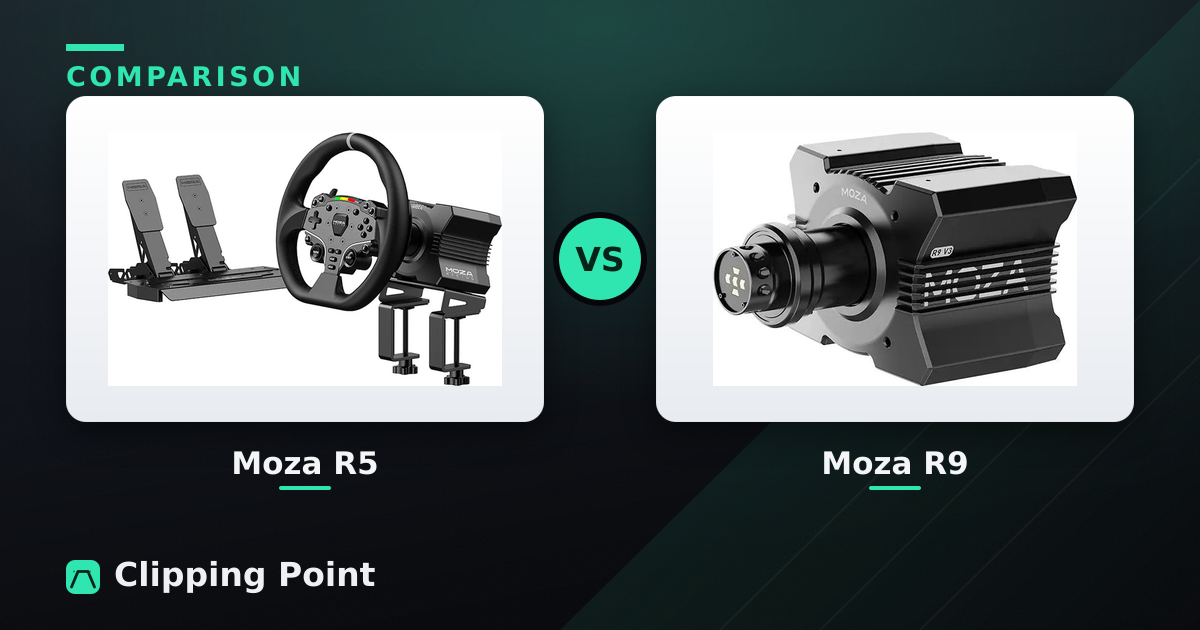
| Moza R5 | Moza R9 | |
|---|---|---|
| Peak torque | 5.5 Nm | 9 Nm |
| Drive type | Direct drive | Direct drive |
| Platforms | PC | PC |
| In the box | Base (bundle adds ES wheel + SR-P Lite pedals) | Base only |
| Best for | A first direct-drive base without overspending | Mid-range headroom without stepping up in price |
Specs from each manufacturer's current listings. Prices move constantly — hit the price buttons above for today's numbers.
Buy the Moza R9 if you already know sim racing is going to stick, because the extra torque headroom is the difference between a base you replace in a year and a base you keep for five. Buy the Moza R5 bundle if you are not sure yet, because it is the cheapest sane way into direct drive and everything you bolt to it (wheel, pedals, hub) carries straight over to a bigger Moza base later. That is the whole upgrade-path argument, and it is the reason this comparison is less painful than most: you are not choosing between two dead ends.
The part nobody puts in the first paragraph: the gap between 5.5 Nm and 9 Nm matters less than the gap between clamping either of these to a wobbly IKEA desk and bolting them to something rigid. I have watched people spend $200 extra on the R9 and then lose most of it to a flexing tabletop. Sort your mounting first. Then read on.
What you’re actually comparing
The Moza R5 is a 5.5 Nm direct drive base, usually sold as a bundle with the ES wheel and the SR-P Lite pedals for somewhere around $599, and periodically less when Moza runs one of its frequent sales. The Moza R9 is a 9 Nm base sold on its own for around $439, less on sale. So the honest price comparison for a first-time buyer is not $439 vs $599. It is R9 plus a wheel plus pedals, which lands you around $750 to $800 before a wheel stand, against the R5 bundle’s one-box price.
Both use the same Moza quick release, the same Pit House software, the same firmware pipeline, and the same accessory catalog. A wheel you buy for the R5 clicks onto an R9, an R12, or an R16 without adapters. This is the quiet strength of staying inside one brand and it is exactly why the R5 is not a trap purchase the way a $250 belt-drive wheel would be.
On paper the R9 also has slightly better internals: a bigger motor, a beefier power brick, marginally higher peak rotation speed. In the hands, at matched torque levels, they feel closer than the spec sheet implies. More on that below, because it is where most of the arguing happens.
Living with the R5
First hour with the R5 bundle is genuinely easy. One box, table clamp included, Pit House recognizes everything, and you are turning laps inside 45 minutes if your USB ports cooperate. The clamp is decent. Your desk probably is not. At 5.5 Nm a sturdy desk survives; a hollow-core one visibly wobbles under curb strikes, and you will find yourself gripping the desk edge with your knees like an idiot. I did this for two weeks before admitting I needed a wheel stand.
The ES wheel that comes in the bundle is a 260 mm round rim with rubbery grips and buttons that feel like a mid-2000s DVD remote. It works. The paddles are magnetic and snappy, which is more than you can say for wheels at this price from anyone else. You will not love it, but you will not need to replace it on day one either.
The SR-P Lite pedals are the actual weak point. Spring-based brake, no load cell, and after a month you will be braking on muscle memory of pedal position rather than pressure, which is backwards. The single best upgrade for any R5 owner is the Moza SR-P load cell pedals at around $200 for the three-pedal set. That upgrade changed my lap times more than any base swap ever has. People on r/simracing say this constantly and they are right; a load cell brake is the one piece of sim gear that is genuinely as good as the forum consensus claims.
As for the base itself, 5.5 Nm is enough to feel everything that matters. In the iRacing MX-5 at Lime Rock the R5 gives you the little rear-end shimmy over the crest into the downhill perfectly well. Front grip loading in the ACC GT3 cars comes through clearly. Where you feel the ceiling is in heavy, high-downforce stuff. Take a GT3 through Eau Rouge with in-game gain set where the rest of the track feels good and the wheel just tops out, a flat plateau of force where there should be a gradient. iRacing’s FFB meter will show you clipping in exactly these spots. You can lower the gain to avoid it, but then the quiet parts of the lap go numb.
Is that a dealbreaker? For a first year in the hobby, no. Plenty of quick drivers race 5 Nm bases on purpose because it is less fatiguing over a 60-minute stint.
Living with the R9
The R9 does not feel 64 percent better. It feels maybe 20 percent better in normal driving, and 100 percent better in the specific moments the R5 clips. Curbs at Monza in a Porsche GT3 R have actual violence to them. Snap oversteer arrives with enough force that catching it becomes a reflex training exercise rather than a visual one. In Le Mans Ultimate, where the hypercars load the wheel hard through Porsche Curves, the R9 keeps rendering detail where the R5 flatlines.
The headroom argument is the real one, though. Running a 9 Nm base at 70 percent output gives you the same peak force as an R5 at full tilt, but with dynamic range to spare, cooler operation, and no clipping. Almost everyone I know with an R9 runs it between 60 and 80 percent. That is what you are paying for: not more force, more room.
Setup quirks, since you asked. The R9 ships with a noticeably larger power brick, so plan for that under your desk. Pit House will occasionally push a firmware update that requires you to unplug and replug the base in a specific order, and the Moza Discord has a permanent low-grade thread of people who got a base stuck mid-update and had to run the recovery tool. It always recovers. It is still annoying at 11 pm before a race. Moza’s software cadence is fast and mostly good, which is more than Fanatec owners could say during the dark years of their support backlog, but fast also means the occasional update you should wait two days on before installing.
Mounting: do not desk-clamp 9 Nm. Moza sells the clamp and it physically works, but a full-force curb strike will walk the clamp on a smooth desk and flex anything that is not butcher block. A cheap wheel stand from around $100, or better, an aluminum profile rig, is effectively part of the R9’s price. Budget for it or buy the R5.
Settings that have served me well on the R9, as a starting point rather than gospel: Pit House maximum output around 75 percent, road sensitivity at 2 or 3, natural damper around 10 percent, spring at zero. In iRacing, let the auto-FFB set the in-game strength per car and leave it alone. In ACC, gain around 65 with dynamic damping at 100. If the wheel feels notchy in slow corners, it is almost always too much road sensitivity, not a hardware problem. Half the “my R9 feels grainy” posts on the subreddit trace back to that one slider.
The spec-sheet arguments that don’t matter
People obsess over slew rate and peak rotation speed numbers between these two bases. Ignore them. Both bases turn faster than your hands can. The R9’s advantage in countersteer response is real but small, and you will never notice it below the level of competitive league racing.
The other recurring debate is Moza R9 vs the Fanatec CSL DD at 8 Nm. I will save you the three-hour Reddit spiral: the bases are peers on force feedback quality, Fanatec has a broader wheel catalog and a rougher recent history with shipping and support, and Moza is the younger brand that has been iterating harder. If you already have Fanatec pedals or wheels, stay there. If you are starting fresh in 2026, Moza’s accessory pricing and release pace make it the easier default, and this whole article assumes you have made that call.
One more non-issue: heat. Neither base thermally throttles in normal use. The R9 barely gets warm at 75 percent output. Cross it off the worry list.
The upgrade-path math
Here is the actual decision, in money.
Path one: buy the R5 bundle now for around $599. Race for a year. If the hobby sticks, sell the R5 base (they hold value reasonably well, expect to recover half or a bit more) and buy an R9 or R12 base only, keeping your wheel and pedals. Total sunk cost of the detour: maybe $150 to $200. That is cheap tuition for finding out whether you actually race or whether the rig becomes a coat rack. Most rigs become coat racks. Nobody admits this.
Path two: buy the R9 base for around $439, add the ES wheel for around $60 to $90 as a bundle add-on, and go straight to the Moza SR-P load cell pedals instead of ever owning the Lites. You land around $750 plus mounting, and there is no base upgrade in your future for years. If someone told me they were certain about the hobby, this is what I would tell them to buy, and I would tell them to spend on the pedals before spending on a nicer rim.
Path two is better if and only if the certainty is real. Be suspicious of your own enthusiasm at 1 am.
FAQ
Is the Moza R5 enough for iRacing? Yes. You will clip in high-downforce cars during heavy compression corners, and you can see it happen on the F meter. For Mazdas, GT4, and most of the road racing ladder it is genuinely fine, and lower peak torque means less fatigue in long stints. Nobody is slow because of an R5.
Can I keep my wheel and pedals if I upgrade from the R5 to the R9 later? Everything transfers. Same quick release across the whole Moza base lineup, and pedals connect over USB or through the base either way. The base is the only thing you replace, which is the entire point of starting inside Moza rather than with an off-brand bundle.
Do I need a rig for the R9 or is a desk clamp fine? Treat a rigid mount as part of the R9 purchase. The clamp works mechanically, but at 9 Nm any ordinary desk flexes enough to eat the detail you paid for, and hard curb strikes can shift the clamp. A basic wheel stand solves it for around $100.
Before you order
Buy the Moza R5 bundle if this is your first wheel, your mounting situation is a desk, or there is any real chance sim racing is a phase. Put the money you saved toward the Moza SR-P load cell pedals the moment the Lite brake starts annoying you, which will be within a month.
Buy the Moza R9 if you already race regularly on something worse, you have or will buy a stand or rig, and you want to skip the resale shuffle. Run it around 70 to 75 percent output and enjoy never thinking about clipping again.
Two checks before either order: measure your desk depth if you are clamping, because the clamp needs a solid lip and about 4 cm of overhang to bite properly, and check Moza’s site for their current sale calendar first. They discount often enough that paying full list price is usually just impatience.