
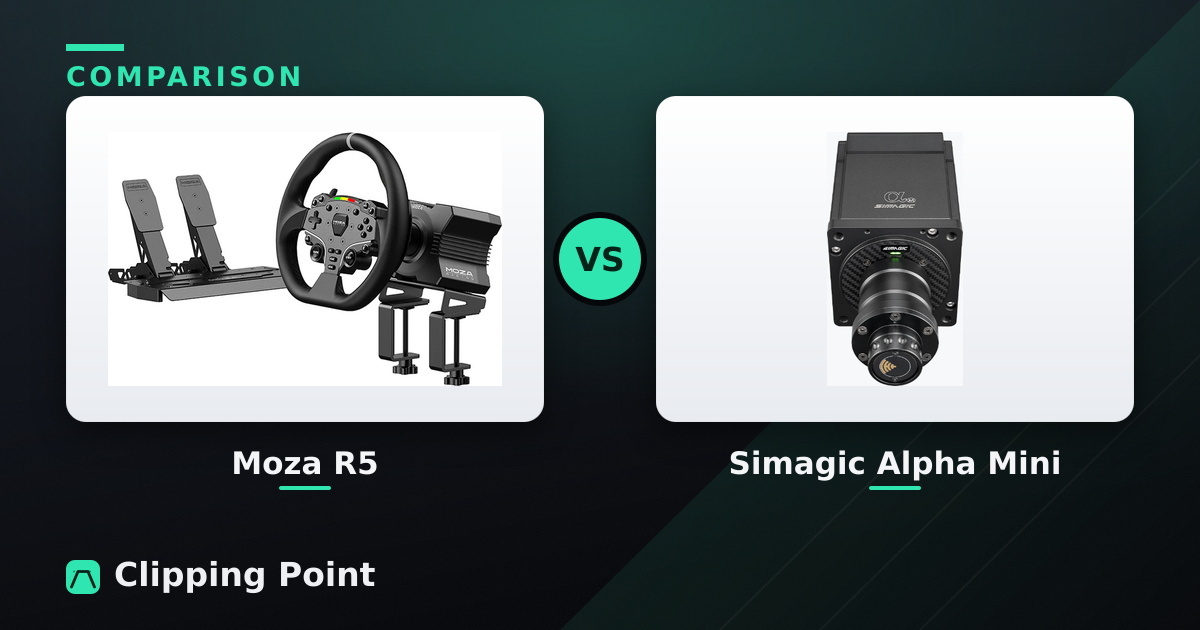
| Moza R5 | Simagic Alpha Mini | |
|---|---|---|
| Peak torque | 5.5 Nm | 10 Nm |
| Drive type | Direct drive | Direct drive |
| Platforms | PC | PC |
| In the box | Base (bundle adds ES wheel + SR-P Lite pedals) | Base only |
| Best for | A first direct-drive base without overspending | Enthusiasts chasing detail over plug-and-play |
Specs from each manufacturer's current listings. Prices move constantly — hit the price buttons above for today's numbers.
Buy the Simagic Alpha Mini if you already own a rig, or you will own one within a few months. Buy the Moza R5 bundle if you’re clamping to a desk and you need pedals in the same box tonight. That’s the decision. The rest of this is me showing my work, because the 4.5 Nm gap between these two matters, just not for the reason the spec sheets imply.
The thing nobody tells you upfront: these are not the same kind of purchase. The R5 is normally sold as a bundle around $600 with the base, the ES wheel, and the SR-P Lite pedals. The Alpha Mini is a base, alone, around $550 to $600, and by the time you’ve added a quick release, a rim, and pedals worth using you’re closer to $1,200. Comparing them as though they’re two products on a shelf at the same price is how people end up disappointed in month two.
5.5 Nm vs 10 Nm, and what torque actually buys you
Torque is not “how hard the wheel fights you.” That’s the beginner reading, and it’s why forum threads about this pair go in circles. Peak torque is headroom. It’s how much force the motor has left over when the game asks for a curb strike on top of the tire load it’s already holding.
At 5.5 Nm, the R5 runs out of that headroom sooner. In a GT3 car with meaningful downforce, you get to a corner like the Kyalami esses in ACC and the base is already near its ceiling holding steady-state cornering load. The kerb hit lands on top of it and gets squashed flat. That’s clipping. You don’t feel it as “weak,” you feel it as vague, like the detail evaporates exactly when the car is doing something interesting. Turn the strength down to stop the clipping and now everything is faint. It’s a real trade and it’s the honest limitation of a 5.5 Nm base.
The Alpha Mini at 10 Nm has enough spare motor that you can run 60 to 70 percent gain and still never clip. Which is the actual point. Nobody sane runs a 10 Nm base at 10 Nm for a two-hour endurance race. You run it at six, and the six is clean.
Here’s the part the torque-obsessives skip: below roughly 8 Nm, the difference between bases is mostly about motor quality and the software, not the number. And Simagic’s motor is a bigger, slower-turning unit with more mass behind it, which is why the Alpha Mini feels heavier and more planted at low speed even when you match the two bases at 5 Nm output. That’s the upgrade you’re paying for. Not the top number.
What actually shows up in the box
The R5 bundle arrives in one box and you’re driving in about forty minutes. Base, ES wheel, two pedals, a table clamp, a modest power brick. The ES wheel is plastic with a rubbery grip section and magnetic paddles that click nicely for about six months before the click gets a little mushy. It’s a perfectly fine first wheel. It is not a wheel you’ll still be using in 2028.
The Alpha Mini shows up as a heavy aluminium block and not much else. Around 7 kg of base, a chunky external PSU, and a bolt-on hub. Note that: a bolt-on hub. The QR1 quick release is a separate purchase around $100, and if you skip it you’re undoing six bolts every time you want to swap rims. Plenty of people never swap rims and never need it. Plenty of other people find that out the expensive way. Simagic also ships no pedals, no clamp worth the name, and its desk-mount solution has always been the weak point in the lineup.
Real talk on the SR-P Lite pedals in the R5 bundle: they include a load-cell brake. At that price that’s genuinely surprising, and it’s the single biggest lap-time improvement most people get out of the whole bundle. Braking to a pressure instead of a position is the thing that fixes your inconsistency under braking. If you buy the Alpha Mini and then pair it with whatever old potentiometer pedals you have lying around, you will be slower than the guy on the R5. Every time.
Setup, first hour, and the software argument
Moza’s Pit House is the better piece of software and it isn’t especially close. Firmware updates work, profiles switch per-game automatically, and the UI won’t confuse anyone. The catch is that it wants to be running in the background for some features, and it occasionally decides your base has disconnected when it hasn’t. Restarting Pit House fixes it. Mildly irritating, not a dealbreaker.
Simagic’s TrueDrive has improved a lot but still feels like it was designed by the engineers rather than for the customer. Profile management is fiddly, some sliders interact in ways nothing explains, and the Simagic Discord has a permanent low hum of people asking which firmware version they should actually be on. Once it’s configured you never touch it again, which is the saving grace.
Starting points I’d genuinely use:
Moza R5, Pit House: FFB strength 100 percent (you need all of it), road sensitivity around 8, natural inertia 100 to 130, damping 5, friction 2, max rotation 1080 and let the game set the rest. Then in iRacing, run the auto-calibration and take whatever Nm figure it gives you, then subtract about 15 percent. iRacing’s auto setting assumes you want peak fidelity, not peak comfort.
Simagic Alpha Mini, TrueDrive: overall force 60 percent to start, damping 5 to 8, friction 3, inertia at default, filter as low as you can stand. Filter smooths the signal but it also smooths away the front-end information you bought a direct drive to receive. In ACC specifically: gain 70, minimum force 0 (you do not need min force on direct drive, that setting exists for gear-driven wheels), dynamic damping 40, road effects 20.
The mistake I see constantly on both bases is people cranking in-game gain to compensate for a low base setting, or vice versa. Pick one place to set your strength. Leave the other at 100 percent. Doubling up on gain is how you get a wheel that feels like it’s transmitting gravel.
On track
Porsche 992 Cup at Road America, iRacing. On the R5, the front axle going light over the crest into turn 1 is there, you can feel it, but it’s a suggestion. On the Alpha Mini the same moment has weight to it and you can hold the car on the edge of it because the wheel is telling you continuously rather than in headlines. That’s the honest gap.
Hypercar at Sebring in Le Mans Ultimate is where the R5 struggles most. The surface is aggressive, LMU’s FFB is already busy, and 5.5 Nm cannot separate “the road is terrible” from “the rear is leaving.” Both bases go a bit numb, but the Alpha Mini keeps them distinguishable.
Where the R5 is completely fine: Mazda MX-5 and Global Mazda MX-5 Cup, anything on the iRacing rookie ladder, Formula Vee, most road cars in Assetto Corsa. Low downforce, low steering load, plenty of feel. If that’s your racing, you would not notice the Alpha Mini’s extra torque doing anything except making your arms tired.
The desk problem is bigger than the base problem
Here’s where I talk someone out of a purchase. If you’re clamping to a flat-pack desk, a 10 Nm base does not give you 10 Nm. It gives you maybe 6 Nm of force and 4 Nm of your desk flexing, twisting, and then springing back at you slightly out of phase with the game. You feel it as a wobble that doesn’t correspond to anything on track. Your desk becomes an uncredited part of the force feedback chain, and it is not a good one.
The R5 at 5.5 Nm is right at the edge of what a decent desk tolerates. The Alpha Mini is not. If you’re desk-mounted with no plans to change that, buying the Alpha Mini is buying torque you will structurally never receive. Put that money into pedals instead and you’ll be faster.
A cockpit doesn’t have to be expensive. A used 8020 rig or a stiff wheel stand solves it. But budget for it as part of the Alpha Mini purchase, not as a someday thing, because the base is only as good as what it’s bolted to.
What breaks, rattles, or annoys
| Moza R5 | Simagic Alpha Mini | |
|---|---|---|
| Peak torque | 5.5 Nm | 10 Nm |
| Comes with | Base, wheel, load-cell pedals | Base only |
| Quick release | Included | QR1 is extra, around $100 |
| Weight | ~3 kg | ~7 kg |
| Software | Pit House, good | TrueDrive, fiddly but stable |
| Console support | None (PC only) | None |
| Realistic all-in cost | ~$600 | ~$1,100 to $1,300 |
Both bases get warm. Neither has a fan, both are passively cooled, and after a long stint the Alpha Mini’s housing is hot enough that you notice. That’s normal for direct drive and not a fault.
Both also have some cogging, that faint notchy texture you feel when turning the wheel slowly with the sim paused. Simagic owners argue about this constantly. In motion, at speed, with FFB running, you will never notice it. People who obsess over cogging are testing their wheel, not driving it.
Moza’s weak spot is that it’s a young company shipping product quickly, and QC has been uneven. Loose hardware, the odd DOA unit, wheel button quality that’s fine but not more than fine. Their support has actually been responsive in my experience and their firmware cadence is good. Simagic’s hardware is more solid but their RMA process runs through distributors and can be slow depending on where you live. Check who your regional distributor is before you order. That matters more than any spec here.
Neither talks to a PlayStation or an Xbox. If you’re on GT7, both of these are the wrong answer and you’re looking for a Fanatec GT DD Pro, shipping reputation and all.
FAQ
Is 5.5 Nm enough for iRacing? For rookie and D-class racing, yes, comfortably. For GT3 and prototypes it’s workable but you’ll be managing clipping rather than enjoying detail. Most people who race seriously outgrow 5.5 Nm inside a year.
Can I use a Moza wheel on the Simagic base, or the other way round? Not natively. Both use their own hub and pin layout. Third-party adapters exist but you lose button functionality on some combinations and it’s a fiddle. Assume you’re committing to one brand’s rims when you pick a base.
Should I buy the Alpha Mini and cheap pedals, or the R5 bundle? R5 bundle. A 10 Nm base with bad pedals is slower and less enjoyable than a 5.5 Nm base with a load cell. Braking feel is where lap time lives.
Before you order
Measure your mounting surface and be truthful about it. If it’s a desk, get the Moza R5 bundle, race on it for a year, and put the saved $600 toward a rig and better pedals. You’ll upgrade the base later and the R5 holds resale value reasonably well.
If you have a rig, or a stand you know is rigid, get the Simagic Alpha Mini, add the QR1 in the same order so you’re not disassembling things later, and budget separately for pedals with a load cell. Then check where your regional Simagic distributor is before you click buy. That one search takes two minutes and will matter enormously on the day something goes wrong.