
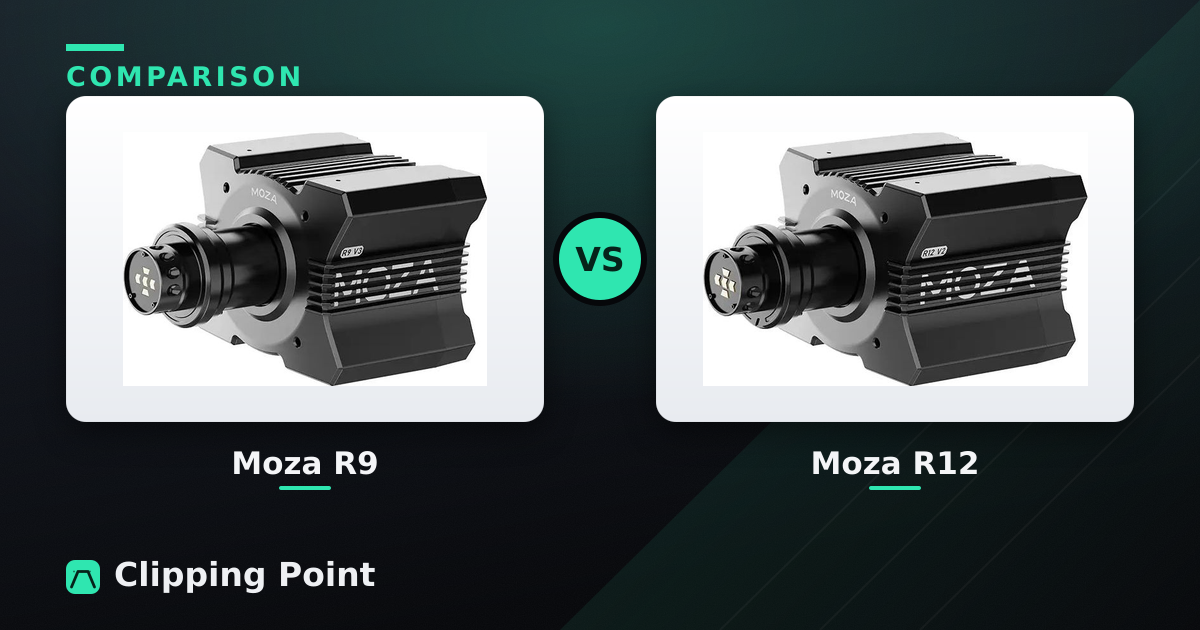
| Moza R9 | Moza R12 | |
|---|---|---|
| Peak torque | 9 Nm | 12 Nm |
| Drive type | Direct drive | Direct drive |
| Platforms | PC | PC · Xbox |
| In the box | Base only | Base only |
| Best for | Mid-range headroom without stepping up in price | Strong FFB for GT and formula without going pro |
Specs from each manufacturer's current listings. Prices move constantly — hit the price buttons above for today's numbers.
The answer, up front: most people searching this comparison should buy the Moza R9, spend the leftover money on a load-cell brake or a better rim, and stop thinking about it. The Moza R12 earns its price for a narrower group: people bolted to an actual rig (aluminum profile or a stiff wheel stand, not a desk), who run iRacing, Le Mans Ultimate, or ACC at force levels where a 9Nm base spends real time clipping. If that second sentence describes you, the R12 is one of the few in-family upsells I’ll defend, and I’ll explain exactly why below.
I ran an R9 clamped to a desk for about a year, then moved it to an 8020 rig, then swapped in an R12 and kept both in the house long enough to A/B them properly. The difference between them is real. It is also narrower than the spec sheets and the YouTube thumbnails suggest, and it shows up in specific situations, not everywhere.
What 3Nm actually buys you
The marketing framing is “12Nm is 33% stronger than 9Nm,” which is true and mostly useless. Nobody drives around holding peak torque. Your arms would give out in twenty minutes and you’d develop a flinch at every curb.
The real argument for the R12 is headroom. Force feedback signals have spikes: curb strikes, the compression at the bottom of Eau Rouge, the moment the rear steps out and the wheel tries to self-center hard. If your base’s ceiling is 9Nm and you’ve tuned your everyday cornering forces to feel meaty, those spikes hit the ceiling and flatten out. That’s clipping, and clipped moments are precisely the ones where you needed information most. A 12Nm base running the same everyday forces has roughly a third more room before the signal squashes.
Put differently: the R12 isn’t for people who want a heavier wheel. It’s for people who want the same weight they already run, with the loud moments left intact. When I moved from the R9 at 100% output to the R12 at about 75%, steady-state cornering in the same car felt nearly identical. What changed was Sebring. The 992 Cup over the back-straight bumps went from a slightly mushy rumble to individual, countable hits. That’s the detail argument, and it’s legitimate.
Whether it’s worth around $160 to you is a different question. Keep reading.
Living with the R9 first
Because this is the base most of you should actually buy, it deserves more than a paragraph.
Out of the box, setup is undramatic. Base, external power brick (a chunky one, plan a shelf or zip-tie spot for it), USB cable, and Moza’s quick release, which is a proper motorsport-style pin design rather than the screw-collar arrangement cheaper bases use. First annoyance arrives immediately: there’s no table clamp in the box. It’s a separate purchase, about $40, and the number of people who discover this the evening the base arrives is large enough that it’s a running joke on r/simracing. Order it with the base if you’re desk-mounting.
Pit House, Moza’s software, is genuinely one of the better tuning apps in the hobby now. It was rough in 2022; it isn’t anymore. You’ll want it running at startup, because a few settings live on the PC side, and occasionally a firmware update resets your profile, so screenshot your numbers once you’re happy. Speaking of numbers, a starting point that has survived months of fiddling for me on the R9: maximum output 90 to 100%, natural damper around 8 to 10%, spring at zero, speed-dependent damping off, and 900 degrees of rotation with per-car angle handled by the sim. In iRacing, use the auto button in the black box or set the max force in Nm manually so the mapping stays linear. Do not install irFFB out of habit. Direct drive made it unnecessary and it mostly adds latency and forum arguments.
Quirks that surface after a week or two: the quick release on some units has a barely-there rotational tick, a millimeter of slack you feel when reversing wheel direction fast. Some people never notice it. The people who do fix it with a wrap of PTFE tape on the pins and then post about it as though they’ve achieved enlightenment. The base itself is passively cooled, so there’s no fan whine (a real advantage over Fanatec’s CSL DD, which has one), and it gets warm but never alarmingly so, even after a two-hour stint.
Nine newton-meters, for reference, is already a lot. It will twist a flimsy desk visibly. It has enough authority to hurt a thumb hooked through the wheel during a spin. Most owners run it between 75 and 100% and are happy for years.
What the R12 adds, specifically
Torque, obviously. But the number I’d point at first is slew rate, which is how fast the motor can change its output, and which Moza rates meaningfully higher on the R12. Peak torque decides how hard the wheel can push. Slew rate decides how sharp the edges of the signal are. Fast transients, like the initial bite of a snap oversteer moment or the front tires breaking away in a formula car, arrive a fraction sooner and feel more like a click than a swell. In iRacing’s Super Formula Lights, the R12 telegraphs the rear letting go early enough that my save rate measurably improved. On the R9 the same information exists, but it’s rounder.
The other practical difference is where each base sits in its range. Running the R9 near 100% means the motor works close to its limits, and the character coarsens slightly at the top: a faint graininess under sustained heavy load. The R12 doing the same job at 70-something percent stays composed. It’s the difference between a hatchback at redline and a wagon at a fast cruise. Same speed. Different composure.
In ACC, the difference is harder to sell. That sim’s force feedback smooths a lot at the source, and a Ferrari 296 through the middle sector at Spa feels excellent on both bases. Gain around 65 to 70% on either, dynamic damping left at default. Le Mans Ultimate is the opposite case: its FFB is detailed and spiky, curbs at Sebring and the Porsche Curves at Le Mans carry real texture, and it’s the sim where I’d least want to give the R12 back.
Here’s the short version of the spec gap, since a table earns its place exactly once in this article:
| Moza R9 | Moza R12 | |
|---|---|---|
| Peak torque | 9 Nm | 12 Nm |
| Street price | around $439, dips near $399 | around $599 |
| Typical daily output | 85–100% | 65–80% |
| Mounting reality | survives a good desk clamp | wants a rig |
The mounting problem nobody prices in
This is where I talk some of you out of the R12, in keeping with house tradition.
Direct drive torque is only as good as whatever it’s bolted to. A base that flexes its mount converts crisp detail into wobble and adds a vague, springy layer over everything. At 9Nm, a thick desk with the clamp positioned over a leg is workable. At 12Nm, running the forces that justify buying 12Nm in the first place, most desks become part of the force feedback. You’ll feel the desktop oscillate on curb strikes. People buy the stronger base chasing detail and end up with less of it than the R9 gave them on the same furniture.
So the R12 purchase is really an R12-plus-rigid-mounting purchase. If you already have a rig, fine, proceed. If you don’t, a usable wheel stand or profile rig adds $150 to $400 to the real cost of the upgrade, and at that point you should ask whether the money is better spent elsewhere. Which brings up the question that actually decides most of these purchases.
The budget question that matters more than torque
If you’re choosing between the R12 with Moza’s base ES steering wheel and the R9 paired with the nicer CS V2P rim and money left toward pedals, take the second option every time. It isn’t close. A better rim improves every second you spend driving. Extra torque improves the loud moments. And if you’re still on a non-load-cell brake pedal, stop reading comparisons of wheel bases entirely, because a load-cell brake is worth more lap time than any base swap in this hobby. The r/simracing consensus on this one is boring and correct.
The R12 upsell makes sense only when the rest of the chain is already sorted: rigid mount, load-cell pedals, a rim you like. Then, and only then, is the last bottleneck the base, and the $160 buys something you’ll notice every session.
FAQ
Is 9Nm enough for sim racing? Yes, for the overwhelming majority of people, including fast ones. Plenty of aliens run less. The gains from 9 to 12Nm are about signal headroom and transient sharpness, not some capability cliff. Nobody is slow because they own an R9.
Can I run the Moza R12 on a desk clamp? Mechanically, yes, with the same optional clamp the R9 uses. Practically, you’ll need to run it turned down far enough that you’ve mostly bought an expensive R9. A stiff desk with the clamp over a leg can cope at moderate settings, but the forces that justify the R12 will flex normal furniture.
Is the R12 smoother than the R9, or just stronger? Both, but the smoothness is the part you’ll notice. At matched force levels the R12 operates further from its limits and handles fast transients more cleanly. If someone blindfolded you and set both bases to identical everyday weight, the tell wouldn’t be strength. It would be curbs.
Buy this, check that
Buy the Moza R9 if you’re on a desk, if your pedals are still stock non-load-cell units, or if this is your first direct drive base. It’s the sensible center of Moza’s range and you will not outgrow it quickly. Buy the Moza R12 if you’re rig-mounted, your pedals are handled, you run iRacing or Le Mans Ultimate at healthy force levels, and you’ve caught your R9-owning friends’ bases clipping on the telemetry. That reader exists, I was that reader, and for them the R12 is the correct spend.
Before you order either: add the table clamp to the cart if you’re desk-mounting, since it ships separately. Check that your rig’s front-mount or bottom-mount hole pattern matches (Moza publishes the drawings). Budget for an e-stop if you want one, because that’s also not in the box. And screenshot your Pit House profile the day you get it dialed. Future you, staring at a post-firmware-update default profile at 11pm before a league race, will be grateful.