
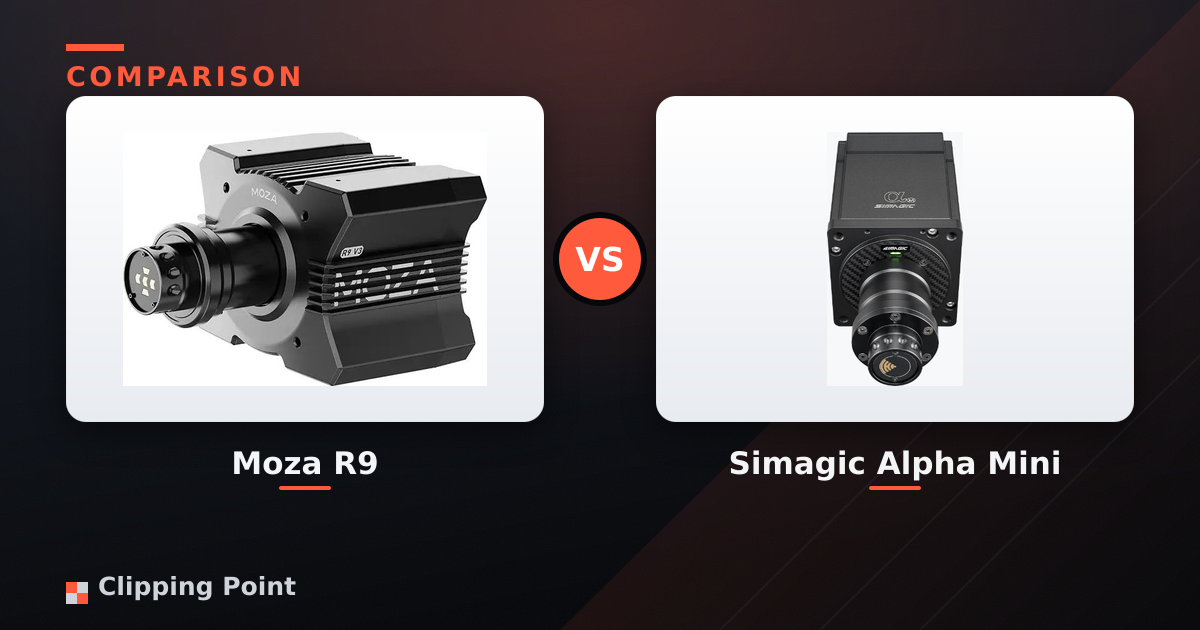
| Moza R9 | Simagic Alpha Mini | |
|---|---|---|
| Peak torque | 9 Nm | 10 Nm |
| Drive type | Direct drive | Direct drive |
| Platforms | PC | PC |
| In the box | Base only | Base only |
| Best for | Mid-range headroom without stepping up in price | Enthusiasts chasing detail over plug-and-play |
Specs from each manufacturer's current listings. Prices move constantly — hit the price buttons above for today's numbers.
If you’re standing at the $450 to $550 line trying to pick between these two, here’s the answer before the reasoning: the Moza R9 is the smarter buy for most people building a first serious setup, and the Simagic Alpha Mini is the one to get if force feedback feel is the single thing you care about and you’ll tolerate rougher software to have it. They are close. Closer than the spec sheet makes them look. But they are not the same machine, and the gap shows up in places nobody puts in a comparison chart.
I’ve run the R9 as my daily base for the better part of a year (the full Moza R9 review is the long version) and borrowed an Alpha Mini from a friend long enough to stop being a tourist with it. Both are 9-to-10 Nm class direct drive bases, both will ruin gear-driven and belt wheels for you permanently, and both are a genuine step up from a Logitech G923 that no amount of settings tweaking closes. The question isn’t whether either is good. It’s which set of compromises you want to live with.
The torque number is a trap
On paper the Alpha Mini makes 10 Nm and the R9 makes 9. People treat that 1 Nm like it decides the fight. It doesn’t. What you actually feel is how the base delivers torque, not the ceiling, and here Simagic has a real edge that’s hard to put into a number. The Alpha Mini’s motor gives you this dense, textured signal off center. Small weight transfers, the moment a front tire starts to give up grip, kerb detail. It feels like the information is arriving a beat sooner. Simagic has spent years tuning FFB and it shows in the way the wheel loads up mid-corner.
The R9 is not far behind, and this matters: for the first month you will not notice a thing missing, because 9 Nm through a good wheel is already more than your forearms are ready for. You’ll be running it at 50 to 60 percent strength anyway. I ran mine around 55 percent in iRearing with the in-game force set per car, and at that level the difference between the two bases narrows to something you’d only catch in a back-to-back on the same track in the same session. Which almost nobody does before they buy.
Where the R9 gives ground is at the very edges of detail, the fine stuff under braking when the car is light and skittering. The Alpha Mini communicates that slightly better. If you’re the kind of driver chasing tenths in a GT3 lobby and you live in the last two percent of the tire, you’ll feel it. If you’re learning where the braking zones even are, you won’t, and paying extra for feel you can’t yet use is how people end up with $3,000 rigs and a 4.2 iRating.
Software is where this actually gets decided
Nobody puts software in the headline, and it’s the thing you’ll touch every single day. Moza’s Pit House is the better app. It’s not perfect. It’s had update hiccups, and there was a stretch where a firmware push would occasionally throw a calibration error that a reflash fixed, which is exactly the kind of thing that makes you swear at a screen at 11pm. But the interface is clean, profiles per game work, and the whole thing feels like software written this decade.
Simagic’s SimPro Manager is functional and looks like it was designed by an engineer who was in a hurry. You can get everything dialed, but you’ll spend more time hunting for settings and the layout fights you. Some people don’t care. Some people set FFB once and never open the app again, and if that’s you, ignore this whole section. For everyone who likes to tweak per-car, the R9’s software is a real, daily, quality-of-life win that the reviews chasing torque numbers skip right over.
There’s also the ecosystem angle, and I’ll use that word exactly once. Moza’s lineup slots together cleanly. The Moza R9 base, their wheels, the Moza CRP load cell pedals, a wheel plate, shifters, all talk to each other through the one app with one login. Buying into it is tidy. Simagic makes excellent hardware too, particularly their pedals, but the sense of a single coherent kit is stronger on the Moza side right now.
Unboxing and the first hour
The R9 arrives lighter than you expect and mounts with two options, table clamp or bolt-through. Do not use the clamp on a flexy desk, and if desk-mounting is your plan, our best direct drive base for a desk guide covers what actually holds. I mean it. Direct drive turns desk flex into a wobble you can see, and the whole illusion falls apart when the base is rocking the table back at you under load. If your desk moves when you lean on it, either bolt the base through the top or accept you’re building a proper rig sooner than you planned. This is the single most common reason people post “my new DD feels weird” on r/simracing, and the answer is almost always the mount, not the base.
The Alpha Mini is a heavier, denser unit. It feels more expensive in your hands, more like a lump of industrial hardware, and it wants a solid mount even more than the R9 does because of how hard it can pull. First-hour setup on both is similar: install the app, update firmware, set rotation and strength, go drive. Budget an evening. Firmware updates on first boot are non-negotiable on both brands and the R9’s initial flash in particular can look like it’s hung when it isn’t. Let it finish.
Settings worth trying instead of the defaults
Default profiles on both bases ship too strong and too clippy for most wheels and most hands. Some starting points I actually use rather than generic advice:
On the R9 in ACC, I run the base strength around 55 percent, rotation matched per car (usually 640 to 800 degrees for the GT3s the game sets automatically), and I turn the in-game gain down until the peak force meter stops pinning red on kerbs. Clipping is the enemy. A base that never clips at 60 percent tells you more than one screaming at 90.
On the Alpha Mini, because the motor is punchier off center, I’d start lower, nearer 45 to 50 percent, and let the natural detail do the work rather than cranking overall force. People buy this base, run it at 80 percent because “10 Nm,” and then wonder why their arms are dead after two stints and they can’t feel anything subtle. Turn it down. You’ll drive better and last longer.
For both, rotation for formula cars wants to drop to 360 to 540 degrees depending on the car, and road cars sit happy at 900. Get that per-car auto-rotation working through the app early; driving a Formula car on 900 degrees because you never set it is a rookie mistake I made for two weeks.
Living with them past the honeymoon
A week in, the quirks surface. The R9’s quick-release has a tiny amount of play with some wheels that you’ll notice as a faint knock on hard direction changes. It’s cosmetic to the driving but it annoys the kind of person it annoys. The base runs cool and quiet. I’ve had zero thermal cutouts even in long endurance stints, where cheaper bases will throttle torque as they heat.
The Alpha Mini’s gripe, and you’ll find this echoed in the Simagic Discord, is support and logistics. Simagic ships out of China and if something goes wrong, spare parts and RMA can be a slow, patience-testing process depending on where you live. Moza has been building out regional support faster, and while they’re a newer brand and carry the “will they be around in five years” question that any young company does, the day-to-day ownership experience has been the smoother of the two for me. Neither has Fanatec’s reputation for making you wait months on a warranty claim, which is the bar both cleared just by existing.
What people actually argue about online: Simagic owners will tell you the R9 feels “notchy” or synthetic by comparison, and there’s a grain of truth to it at the extreme. Moza owners point out you can buy the R9 base and a set of load cell pedals for close to what the Alpha Mini base costs alone, and that’s also true and, for a buyer, probably the more important fact.
The money, plainly
The Moza R9 base runs around $440. The Alpha Mini base tends to land nearer $500 to $550 depending on sales and region. That is not the whole story, because a base without pedals is a paperweight, and this is where the R9 pulls ahead for anyone building from scratch. The single biggest jump in your lap times won’t come from the wheelbase. It’ll come from load cell brakes, which measure pressure instead of position and let you brake by feel the way a real car does. Bolting the saved money into a set of load cell pedals will do more for your driving than the extra 1 Nm ever will.
That’s the real argument for the Moza side. Same money, more of it goes toward the thing that actually makes you faster.
FAQ
Is the Moza R9 strong enough, or will I outgrow 9 Nm? For a road car and GT3 diet, 9 Nm is plenty and you’ll run it well under half power for a long time. You’d only outgrow it chasing heavy formula or vintage cars with no power steering where more torque adds real information. Most people never get there. If you know you’re that person, look at the R12 or a bigger Simagic Alpha instead of the Mini; our best sim racing wheels guide runs through the tiers above this one.
Can I use my Fanatec or Thrustmaster wheel on these bases? Not natively. Both use their own quick-release and their own wheels, and cross-brand adapters exist but are a fiddly, sometimes flaky path. Plan on buying into one brand’s wheels, which is another reason the tidier Moza kit appeals if you’re starting fresh.
Does the extra 1 Nm on the Alpha Mini actually matter? In your hands, for the first several months, no. In a blind back-to-back at the limit in a GT3, a good driver can feel the Simagic’s delivery is a touch richer. The number itself is close to irrelevant. The feel behind it is real but small, and smaller than the price gap.
What to actually do
Buy the Moza R9 if you’re building your first proper direct drive setup, you want software that doesn’t fight you, and you’d rather put the leftover cash into load cell pedals. That covers most people reading this. Buy the Alpha Mini if force feedback feel is your top priority, you’ve driven direct drive before and know you want the extra detail, and clunky software won’t bother you.
Before you order either: check your desk. Push down hard on the front edge and watch it move. If it flexes, factor in a proper mount or a rig now, because the best direct drive base in the world feels like garbage bolted to a wobbling table, and that, not the brand on the box, is what makes or breaks the first week.