
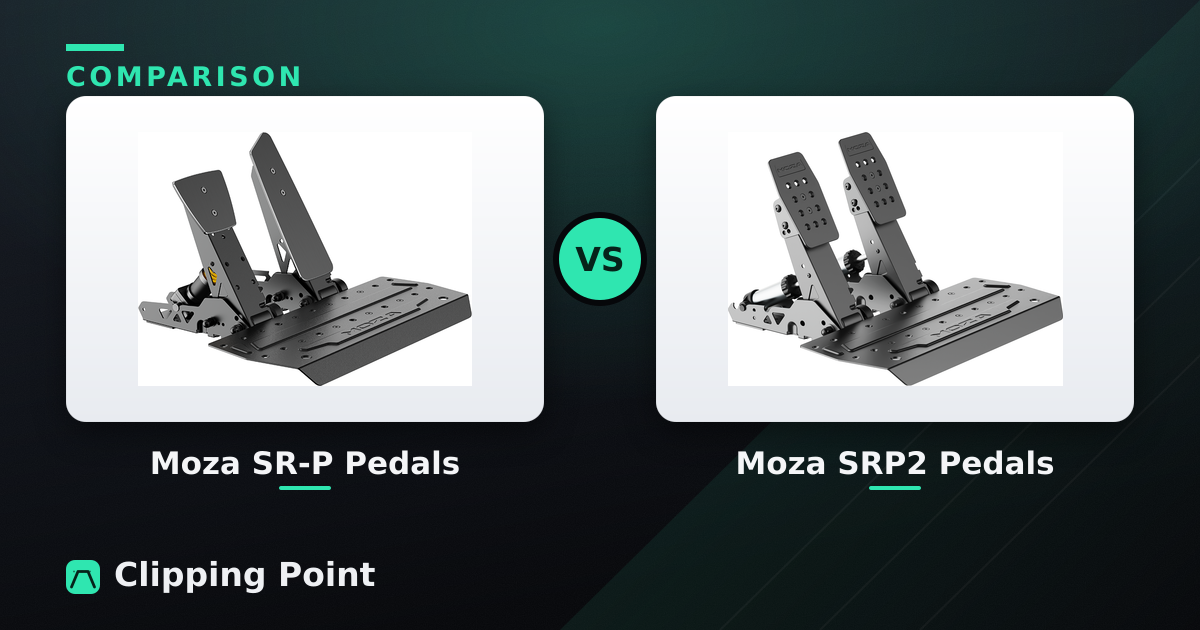
Short answer: if you’re buying Moza pedals for the first time, get the Moza SRP2. The price gap over the original is small enough that the better brake and the all-metal build pay for themselves the first time you try to trail brake without the pedal squirming. If you already own the Moza SR-P set, the upgrade is a much harder sell, and for most people I’d say skip it. A ten dollar elastomer mod gets you 60% of the way to the SRP2 brake feel, and the remaining 40% is not worth selling pedals used and paying the difference.
That’s the verdict. The rest of this is me earning it, because the details matter more than the headline and there are a couple of situations where I’d flip that advice.
What the SR-P actually was
The original SR-P three-pedal set did one thing that mattered: it put a real load cell brake in the box at around $150, at a time when the competition wanted you to buy a base set and then a load cell kit on top (Fanatec’s CSL route), or spend around $200 on Thrustmaster T-LCMs. If you bought an R5 or R9 bundle any time between 2022 and 2024, you probably have SR-Ps under your desk right now. Millions of people learned what a load cell brake is on these pedals.
And a load cell genuinely is the single biggest upgrade in sim racing. Bigger than direct drive, in my opinion, and I say that as someone who owns a direct drive base. Braking against pressure instead of travel is the difference between guessing your brake input and repeating it. Lap time lives in the brake zone. Once you’ve calibrated your left leg to “push this hard for 80%,” you can hit it lap after lap in a way a potentiometer pedal never allows.
The SR-P’s problem was everything around that load cell. The brake feel out of the box is soft and springy, more like a stiff throttle than a brake. There’s a rubber elastomer in the stack that compresses too easily, so you get a long squishy travel phase before the load cell really starts reading. On top of that, the pedal arms have noticeable lateral play, the housings are plastic where you want metal, and after a few months mine developed a squeak on the brake return that no amount of silicone grease fully killed. The clutch is fine because nobody cares about the clutch. The throttle spring is light to the point that resting your foot on it registers input until you add a deadzone.
None of this made them bad pedals. At the price they were the obvious pick. But the r/simracing threads about them all converge on the same sentence: “great value, mod the brake.”
What the SRP2 changes
The Moza SRP2 is Moza reading those threads and fixing the list, mostly. Price lands around $200 for the three-pedal set, and around 25 to 30% less if you skip the clutch, which you should unless you drive H-pattern.
The real changes, in order of how much they matter:
The brake stack. This is the whole upgrade. The SRP2 brake uses a redesigned two-stage setup: an initial compliant phase that mimics pad travel, then a much firmer phase where the load cell does its work. In practice it means the pedal firms up quickly and progressively instead of wallowing through an inch of mush. It finally feels like you’re braking against something. It is still not a CRP-class brake, and it is nowhere near hydraulic feel, but it’s a legitimate brake pedal instead of a stiff spring with a sensor attached.
Metal where there was plastic. Housings, arms, adjustment hardware. The pedals feel like one piece now. The lateral slop that let the original SR-P brake arm wiggle a few millimeters side to side is basically gone. This sounds cosmetic until you’re braking hard into Turn 1 at Monza in an ACC GT3 and your foot is coming in at a slight angle, which it always is, and the original pedal flexes sideways just enough to change where the pressure lands. The SRP2 doesn’t do that.
Adjustability you’ll actually use. Pedal face height and angle adjust without disassembling half the unit, and swapping or reordering the brake elastomers is a five minute job instead of a fiddly one. On the original I put off brake stack experiments because getting to the stack was annoying. On the SRP2 I tried three configurations in one evening.
What didn’t change: the connection scheme (they still plug into your Moza base, with a USB adapter available if you run another brand’s wheel), the general footprint, and the fundamental architecture. This is a revision, not a rethink.
Living with them
Setup on both is about twenty minutes if you’re hard mounting, longer if you’re fighting a desk. The SRP2’s baseplate arrangement is stiffer, but let me be blunt about the desk question: load cell pedals and desks barely coexist. To brake properly on a load cell you push with real force, 15 to 30 kg through your leg, and that force has to go somewhere. On carpet the whole assembly creeps backward. Against a wall it works until the wall is further than your leg. If you’re on a desk setup with no wheel rig, budget for at least a fold-flat cockpit or a board-and-wall-brace arrangement before you budget for the pedal upgrade, because a sliding SRP2 brakes worse than a fixed SR-P. This gets relearned in the Moza Discord about once a week.
Quirks that surface after the first month, from my own log: the SRP2 throttle spring is heavier than the SR-P’s, which I prefer, but it made my old deadzone setting feel laggy until I zeroed it out. The brake elastomers have a break-in period of maybe two weeks where the feel softens slightly and then stabilizes; calibrate once out of the box and again after ten hours. And Pit House, Moza’s software, remains its usual self: powerful, occasionally weird, prone to needing a restart after firmware updates. Keep it updated anyway, because early SRP2 firmware had a brake reading that would drift a percent or two when cold, and that got patched.
Settings worth stealing. In Pit House, set the brake maximum to around 60 or 70% of the load cell’s range rather than 100. Nobody benefits from needing a leg press to reach full braking, and repeatability matters more than machismo. In iRacing, do the in-sim calibration and use the brake force curve at zero or slightly negative; the pedal’s own progression is enough now, which was not true on the original SR-P, where I ran a chunk of nonlinearity to fake progressive feel. In ACC, run gamma at 1.0 with the SRP2. The MX-5 at Okayama in iRacing is my pedal test loop: three braking zones, all different speeds, and after two evenings on the SRP2 my brake trace overlays were tighter than they’d ever been on the SR-P. Not faster right away. More repeatable, which becomes faster.
Things that still annoy me on the SRP2: the clutch is still an afterthought with a vague bite point, the supplied hex hardware strips easier than it should (use your own bits), and the pedal faces are still on the small side if you drive in shoes.
The upgrade math for existing SR-P owners
Here’s where I talk you out of it. Say you sell your SR-P set used for around half what you paid and buy SRP2s. You’ve spent real money to improve one pedal, the brake, by an amount that a stiffer aftermarket elastomer or the classic o-ring stack mod approximates for pocket change. The SR-P modding scene is mature. People have been stuffing firmer rubber into these things for years and posting the recipes, and a modded SR-P brake lands surprisingly close to a stock SRP2. What you can’t mod away is the lateral play and the plastic, and only you know whether that stuff bothers you. It bothered me at month eighteen. It did not bother me at month three.
The other reason to hold: the Moza CRP2 exists, at around $560. If you’re the kind of driver who’s going to end up on serious pedals anyway, and if you’re reading a 2,000 word pedal comparison at midnight you probably are, then the smart path is modded SR-P now, CRP2 later, skipping the SRP2 entirely. Two upgrades in the same family a year apart is how sim racing quietly eats your savings.
Flip side, the cases where I would upgrade an existing set: your SR-P has developed the squeak or the drift that some early units get and it’s out of warranty anyway; you race in a league and brake consistency is actively costing you positions; or you can sell the SR-Ps to a friend getting into the hobby at a fair price, which makes the net cost small and puts a load cell under someone new. That last one is the best version of this transaction.
| SR-P (3 pedal) | SRP2 (3 pedal) | |
|---|---|---|
| Street price | around $150, often discounted | around $200 |
| Brake feel stock | soft, springy, wants mods | firm, two-stage, usable stock |
| Build | steel arms, plastic housings | metal throughout |
| Lateral play | noticeable on the brake | minimal |
| Desk friendly | not really | still not really |
FAQ
Do Moza SRP2 pedals work without a Moza wheelbase? Yes, with Moza’s USB adapter, sold separately. Direct to the base is the cleaner route if you’re in the family, one cable and one device in the sim. If you run a Fanatec or Simagic base and just want the pedals, the adapter works fine, but at that point also price the standalone competition before committing.
Is the SR-P still worth buying now that the SRP2 exists? Only at a proper discount. If a bundle or clearance sale puts the SR-P set way below the SRP2, it remains a good load cell starter with a known modding path. At full price the gap is too small; buy the SRP2.
Can I use SRP2 pedals on carpet or under a desk? You can plug them in, sure. You cannot brake properly on them without fixing them to something rigid, because a load cell brake works by resisting your leg. Solve mounting first. A cheap wheel stand plus SR-Ps beats floating SRP2s every time.
Before you order
Buy the Moza SRP2 if you’re new to Moza, bundling with an R5 or R9, or replacing potentiometer pedals from a Logitech or Thrustmaster starter set. Skip the clutch pedal unless you shift with a real H-pattern. Keep your Moza SR-P set if you already own it and it isn’t broken; spend an evening and a few dollars on a stiffer brake stack instead, then put the saved money in a jar labeled CRP2.
And before any of this, look down at your setup. If the pedals aren’t bolted, strapped, or braced to something that cannot move, that’s the actual upgrade, and it costs less than either set of pedals in this article.