
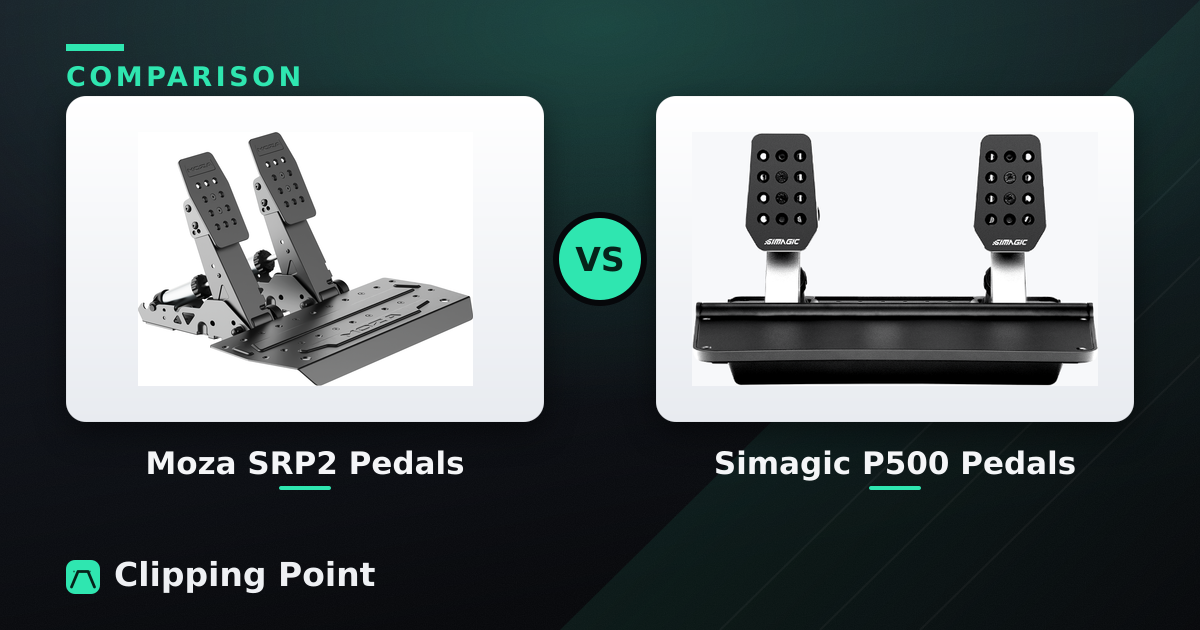
If you want the answer before the reasoning: buy the Simagic P500 if your budget stretches to it and you care mostly about the brake, which you should, because the brake is the entire reason load-cell pedals exist. The P500’s stock brake feel is closer to “right” out of the box than anything else near its price, and Simagic’s hardware quality has been quietly excellent for a couple of years now while everyone was busy arguing about Fanatec’s shipping emails.
The Moza SR-P2 is not a consolation prize, though. It’s cheaper, it comes with a clutch in the three-pedal configuration, it plugs straight into USB without needing a Moza wheelbase, and after twenty minutes of elastomer swapping it gets to maybe 85 percent of the P500’s brake feel. If you already own a Moza base, or you genuinely need a clutch, or the price gap is the difference between buying now and waiting two months, get the SR-P2 and don’t lose sleep. But asked flat out which set I’d put on my own rig with someone else’s money, it’s the P500, and it’s not agonizingly close.
What you’re actually buying
Both are load-cell pedal sets aimed at the same person: someone stepping up from a Logitech or Thrustmaster potentiometer brake, or from entry Hall-effect sets like the Moza SR-P Lite, who isn’t ready to spend CRP2 or P1000 money. Prices move around with sales and region, but figure somewhere around $200 to $250 for the SR-P2 depending on whether you take two pedals or three, and around $270 for the P500 as a two-pedal set. Simagic sells the clutch separately, so a like-for-like three-pedal comparison narrows the gap less than the sticker prices suggest, and in the two-pedal fight the Moza is clearly the cheaper ticket.
Construction on both is metal where it matters. Neither feels like the plastic-armed stuff a tier down. The Simagic edges it on machining and finish: cleaner edges, better fasteners, adjustments that move in defined steps instead of “loosen four bolts and eyeball it.” Moza’s build is fine, genuinely fine, but you can see where the cost came out. The throttle spring on the SR-P2 is light enough that my first stint I kept breathing the pedal on straights without meaning to. There’s an adjustment for it. Use it.
Sensors are a non-argument. Both brakes use load cells rated way past any force a human ankle wants to apply repeatedly, and both throttles use contactless sensors that won’t develop the Logitech scratchy-spike problem. Anyone selling you one set over the other on sensor spec is reading a brochure at you.
The brake is the whole argument
Here’s the thing nobody puts in spec sheets: a load-cell brake is only as good as the stack of springs and rubber between your foot and the sensor, because that stack is what your brain calibrates against. The sensor just reports.
The P500’s stack is the better starting point. Stock, it has a short soft initial travel and then ramps into a firm wall, which is roughly what a real brake with pad contact feels like. On my rig it needed one change (I went one elastomer firmer) and then I stopped thinking about it, which is the highest compliment pedal hardware can get. Trail-braking downhill into Paddock Hill Bend in ACC, the P500 gives you a readable band between “slowing” and “locked” that you can lean on lap after lap. My braking points stopped wandering. That consistency is worth more than any other spec on either box.
The SR-P2 out of the box is softer and springier, with more of a linear squish that makes threshold braking feel like guessing. Plenty of people run it stock and are happy. I wasn’t. The fix is cheap and takes an evening: firm up the stack with the included harder elastomers, then cap the calibrated maximum force in software so you’re using the meat of the sensor’s range without pushing the rig off the floor. Configured that way it’s genuinely good, and the gap to the P500 shrinks to something you’d only notice swapping back to back. But the Simagic asks less of you to get there, and a mid-range buyer shouldn’t need a tuning session to make the brake believable.
One honest note on elastomers generally: both sets soften slightly over the first few weeks as the rubber breaks in. If your braking feels different in week three, that’s why. Recalibrate, don’t panic.
Software, and the numbers worth setting
Moza’s Pit House is the slicker of the two apps and gets updated constantly, which cuts both ways. The interface is clean, curve editing is easy, and per-pedal deadzones take seconds. It also occasionally ships an update that breaks something dumb for a week, a pattern anyone on the Moza Discord will confirm through gritted teeth. Simagic’s SimPro Manager used to be the clunkiest thing in sim racing, and the 2.0-era versions are dramatically better, though it still has that translated-menu feel in places. Both do the job. Neither will make you angry more than once a month.
Settings that actually matter, whichever you buy:
- Set your maximum brake force in the software to a number you can hold repeatedly, not your one-rep max. On a stiff cockpit that might be 55 to 70 kg; mounted to anything flexy, much less. If you finish a 20-minute race with a pumped calf, lower it.
- In iRacing, set the brake force factor to 0 so the input is linear and let the load cell do the shaping. The default curve exists for potentiometer pedals and just muddies a load cell.
- In ACC, brake gamma at 1.00 for the same reason.
- Kill the deadzones at both ends of the throttle, then verify full travel in-game, not just in the app. Every sim reads calibration slightly differently and it’s a two-minute check that saves a “why am I slow on straights” forum post.
Mounting will decide whether you like either one
Read this part twice if you’re on a desk. A load-cell brake worth using requires shoving hard against something that does not move. Clamped wheel-stand setups and pedals sitting on carpet turn both of these sets into expensive frustration: the hardware flexes, your calibration reference flexes with it, and the consistency you paid for evaporates. This is the single most common regret thread on r/simracing, way ahead of anyone’s brand complaints.
You don’t need a $600 aluminum profile rig. Bolting either set to a plank of plywood wedged against a wall works. A cheap fixed cockpit works. But budget for rigidity before you budget for pedals, because a $150 Hall-effect set hard-mounted will beat a floating load cell every single time.
On the actual mounting: both use slotted base plates with standard-ish hole patterns, and both lined up with my profile rig without drama. Moza includes rubber feet for hard-floor use that you should remove the moment you bolt down. Heel support is where I’ll ding Simagic slightly: depending on your plate and seating position the P500 can leave your heel lower than feels natural, and some owners end up adding a heel rest. On the SR-P2 I didn’t notice the issue, though I race in flat-soled shoes, which, yes, I know how that sounds.
A month in: the small annoyances
The SR-P2’s throttle developed a faint click at the top of travel around week two. A drop of grease on the pivot fixed it and it hasn’t returned, but it’s the kind of thing the P500 simply hasn’t done. Moza’s fast release cadence also means the SR-P2 will probably be superseded or revised sooner; the company iterates like a phone maker, which is great for progress and mildly irritating for anyone who bought last quarter.
Simagic’s annoyances are mostly about buying, not owning. Depending on where you live you’re either ordering from a regional dealer with normal shipping or waiting on a China dispatch with tracking that goes dark for a week. Support responses come, and they’re competent, but they arrive on their own schedule. Nobody in this bracket matches, say, a good local retailer’s returns process, so buy from one if you can.
Neither set has given me a sensor fault, a disconnect, or a calibration drift worth mentioning. The days when mid-range pedals meant spiking inputs are over, and both brands deserve some credit for that.
The clutch, and the lock-in question
The SR-P2’s included clutch is a basic sprung pedal and that’s all it needs to be, because a sim clutch gets used for launches and the occasional H-pattern nostalgia session and otherwise functions as a footrest. If you run Le Mans Ultimate GT3s or iRacing formula cars, you will touch it once per race. Paying extra to add Simagic’s clutch only makes sense if you actually shift an H-pattern; everyone else can keep the money.
Neither set locks you into anything, which is the quiet win here. The SR-P2 runs standalone over USB, so it works fine next to a Fanatec or Simagic wheelbase, and the P500 likewise doesn’t care whose wheel you turn. If you’re deliberately avoiding a single-brand ecosystem, both are safe picks, and your eventual upgrade path stays open in every direction: Moza CRP2 if you go up the Moza line, Simagic P1000 if the P500 sells you on the brand.
| Moza SR-P2 | Simagic P500 | |
|---|---|---|
| Street price | ~$200–250 | ~$270 (2 pedals) |
| Clutch | Included on 3-pedal set | Sold separately |
| Brake out of the box | Soft, needs tuning | Very good stock |
| Standalone USB | Yes | Yes |
| Build/finish | Good | Better |
FAQ
Do Moza SR-P2 pedals work without a Moza wheelbase? Yes. They connect over USB and show up as a normal controller in Windows, so you can run them with any base. You only need the wheelbase connection if you want everything through one plug.
Can you add a third pedal to the Simagic P500? Yes, Simagic sells the clutch as a separate module. Factor that into the price if a three-pedal set matters to you, because it moves the comparison meaningfully in Moza’s favor on cost.
Will either work on PS5 or Xbox for Gran Turismo 7? No. Both are PC hardware, and consoles only talk to licensed gear. If GT7 is your main sim, you’re shopping Fanatec, Logitech, or Thrustmaster instead, and nothing in this article should change your mind.
Before you order
Buy the Simagic P500 if you’re on a rigid rig or willing to build one, you mostly race GT and formula stuff where the clutch is decorative, and roughly $270 is livable. It’s the set I’d keep.
Buy the Moza SR-P2 if you own a Moza base, want three pedals without an add-on purchase, or the price difference funds the plywood and bolts you actually need. Plan one evening with the elastomers and the calibration screen before you judge the brake.
And whichever way you go, check your mounting situation first. Measure whether your pedals can brace against something solid at full braking force. If the answer is “sort of,” fix that before either of these boxes ships, because rigidity is the upgrade you’re really shopping for.