
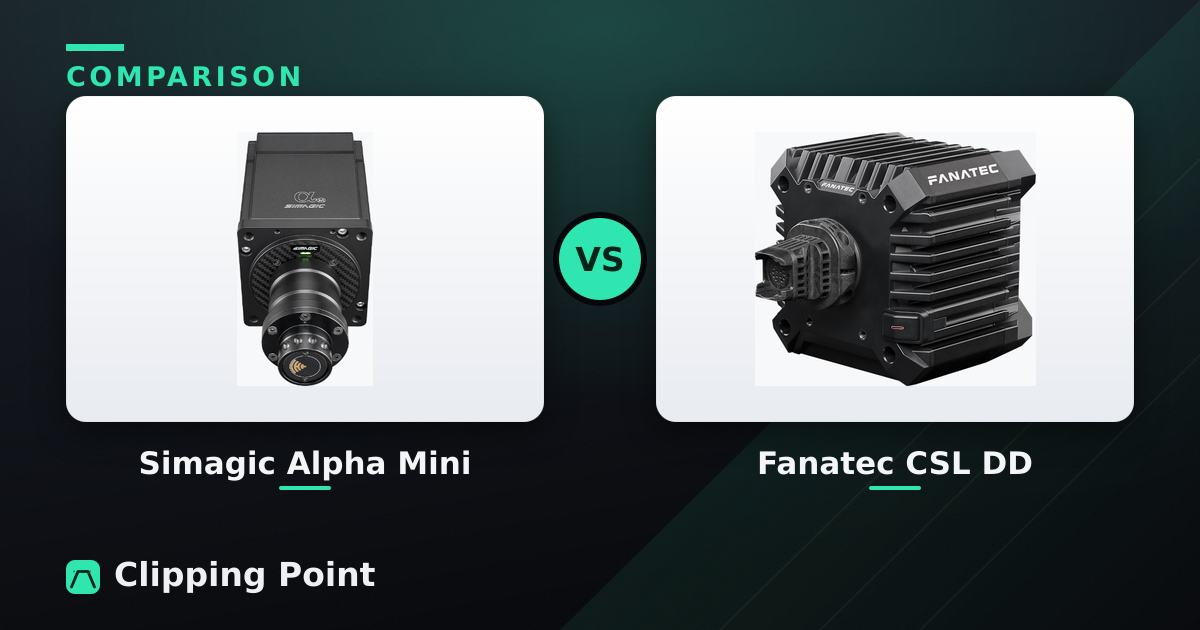
| Simagic Alpha Mini | Fanatec CSL DD | |
|---|---|---|
| Peak torque | 10 Nm | 5 Nm (8 Nm with Boost Kit) |
| Drive type | Direct drive | Direct drive |
| Platforms | PC | PC · Xbox |
| In the box | Base only | Base only |
| Best for | Enthusiasts chasing detail over plug-and-play | An upgrade path into the Fanatec ecosystem |
Specs from each manufacturer's current listings. Prices move constantly — hit the price buttons above for today's numbers.
If you race on PC, have something rigid to bolt a wheel base to, and don’t own a Fanatec wheel already, buy the Simagic Alpha Mini. It ships with 10 Nm of usable, fast torque for roughly what a Fanatec CSL DD costs once you add the Boost Kit that takes it from 5 Nm to 8. The Simagic motor is stronger, the quick release is proper metal out of the box, and you’re not gambling on Fanatec’s customer service, which has spent several years earning its reputation the hard way.
That’s the verdict for maybe 60 percent of the people searching this comparison. The other 40 percent should stop reading Simagic spec sheets right now, because the Alpha Mini will never, under any firmware, work on a PlayStation or an Xbox. If console is in your plans, even vaguely, the CSL DD (or its PlayStation sibling, the Fanatec GT DD Pro) is the answer by default. Fanatec’s licensing moat is real. It’s the best reason the company still exists.
Now the part where I earn all that.
The torque number, and what it’s actually worth
On paper this looks like a rout. Alpha Mini: 10 Nm peak. CSL DD: 5 Nm stock, 8 Nm if you pay around $150 extra for the Fanatec Boost Kit 180, which is just a bigger power supply in a box. So the Simagic gives you 25 percent more torque than a fully upgraded CSL DD, for less total money.
Here’s the nuance the spec sheet skips: almost nobody drives at 10 Nm for a full stint. I ran the Alpha Mini around 60 to 70 percent for most of a year, which puts steady-state forces right in CSL DD Boost Kit territory. Your forearms are not the limiting factor you think they are; a 45-minute race in a GT3 car at 10 Nm is a workout, not a hobby.
What the extra headroom buys you is dynamics. When a base runs at 70 percent of its capacity instead of 95, the spikes (kerb strikes, snap oversteer, the moment the rear steps out at Eau Rouge) still have somewhere to go. On the CSL DD at 8 Nm you can feel the ceiling. Catch a slide in the 992 GT3 Cup in iRacing and the counter-force arrives slightly flattened, like the base is doing its best impression of the event rather than the event itself. The Alpha Mini just hits you. First time I clipped the inside kerb at the Sebring hairpin with the Simagic at full strength, I understood why people bolt these things down with M8 hardware.
Is that difference worth restructuring your purchase around? On PC, yes, because it’s free. You’re not paying a premium for the Simagic’s motor. You’re mostly just not paying Fanatec’s Boost Kit tax.
Out of the box and the first hour
The CSL DD wins the unboxing. It’s a tidy aluminum brick, the desk clamp (sold separately, note, about $40) is decent, and Windows recognizes it immediately. Fanatec’s driver package installs, nags you about a firmware update, and you’re turning laps in twenty minutes. The included quick release on base-spec bundles is the QR1 Lite, though, and it is plastic, and you will notice. There’s a faint rotational slop under hard inputs that people on r/simracing have been complaining about since 2021. The metal QR2 fixes it for another chunk of money. Budget for it; the plastic one at 8 Nm is not a long-term relationship.
The Simagic first hour is messier. SimPro Manager, the config software, has improved a lot since the machine-translated days, but it still occasionally forgets a wheel exists until you unplug and replug the USB, and the sheer number of adjustable parameters (mechanical damper, inertia, friction, three kinds of filtering) is intimidating when all you wanted was to drive. The defaults are also too soft. Out of the box the Alpha Mini feels muted, and I’ve watched more than one person conclude the base is overrated before they’ve touched a setting. Give it the hour. Turn the overall strength up, drop the damper to near zero for formula cars, and it wakes up.
One genuine Simagic advantage that never makes the comparison videos: the quick release is a motorsport-style metal collar as standard. Swapping rims takes five seconds and there’s zero slop. Fanatec makes you buy your way to that feeling.
Living with them
After a few months, here’s what actually surfaces.
The CSL DD is quiet and cool and generally forgettable in the good sense. Its firmware updates are frequent, which cuts both ways: Fanatec has shipped updates that improved FFB noticeably, and it has also shipped updates that broke things and got pulled. The Fanalab software for tuning is functional and ugly. The base itself has been reliable for most owners, and I want to be fair about that, because Fanatec’s hardware engineering was never really the problem.
The problem is everything around the hardware. Order fulfillment horror stories, RMAs that take months, support tickets answered by what appears to be a lottery system. The Black Friday meltdown a couple of years back was bad enough that it arguably contributed to Corsair buying the company. Things have improved since the acquisition, and I’d rate ordering from Fanatec today as merely normal rather than an act of faith. But when someone asks why sim racers flinch at the brand name, that history is why.
Simagic’s quirks are different. The Alpha Mini’s fan can spin up audibly under sustained heavy FFB, which you’ll hear between corners if you race without headphones. SimPro Manager sometimes fights with Windows USB power management; disable selective suspend or the base can drop mid-session, which at 10 Nm is a memorable way to learn about USB settings. And Simagic is still a China-based company selling mostly through regional distributors, so warranty service means going through whoever you bought it from. The distributors have a decent reputation, the official Discord is active and staff actually answer, but it’s a different support model and you should know that going in.
Neither base has a widespread hardware failure pattern I’d warn you off. That’s worth saying plainly, because five years ago it wasn’t true of budget direct drive as a category.
Mount it properly or don’t bother
Both of these will destroy a flimsy desk mounting. This gets underestimated constantly. At 5 Nm a clamped CSL DD on a solid desk is livable. At 8, the desk becomes part of the force feedback, flexing and springing in ways that smear out exactly the detail you paid for. At the Alpha Mini’s 10, a desk mount is genuinely a waste of the hardware; you’ll turn the strength down to stop the wobble and end up with an expensive belt-drive experience.
A basic wheel stand helps. An aluminum profile rig or a solid cockpit is where these bases actually live. If your honest plan is “clamped to my IKEA desk indefinitely,” buy the CSL DD, skip the Boost Kit, and put the savings toward pedals. That is a real recommendation, not a insult. 5 Nm done rigidly beats 10 Nm on a trampoline.
Settings worth stealing
Numbers, because vibes-based reviews annoy me too.
CSL DD in iRacing: let iRacing’s auto force-level set strength per car, FEI at 100 (drop to 80 if kerbs feel spiky), natural damper around 15 to 20 percent for GT cars, interpolation filter low. In ACC, in-game gain around 65 to 70 percent with the base at 100 percent keeps you out of clipping in the Ferrari 296 GT3.
Alpha Mini in SimPro Manager: overall strength 60 to 70 percent for GT racing, mechanical damper under 10, inertia and friction near zero for open wheelers, game FFB gain set so the clipping meter only flickers on the biggest kerbs. In Le Mans Ultimate, which has genuinely excellent stock FFB, resist the urge to add filtering at all. The Hypercars over the Porsche Curves at Le Mans with this base running mostly raw is the best argument for the extra torque I can offer in text.
The catalog question
Here’s where Fanatec claws real ground back, and it’s the honest core of the whole comparison. Buying a wheel base means buying into a family of rims, pedals, and shifters, and Fanatec’s catalog is the deepest in sim racing at this price. Xbox-licensed rims, the PlayStation-licensed GT DD Pro for Gran Turismo 7, formula rims, round rims, a load-cell pedal upgrade path with the CSL Elite V2s. If you want one vendor, one plug, and a console option, nobody else offers this. That single-ecosystem convenience is Fanatec’s actual product; the wheel base is almost incidental.
Simagic’s rim lineup is smaller but the build quality per dollar is better, with most rims landing around $250 to $400, and because the base is a standard PC device you can also run other brands’ gear alongside it without drama. Their Simagic P1000 load-cell pedals are excellent if you’re building a full setup, though at that point you’ve left CSL DD money well behind.
| Simagic Alpha Mini | Fanatec CSL DD | |
|---|---|---|
| Peak torque | 10 Nm | 5 Nm (8 with Boost Kit) |
| Base price | around $450 | around $350, plus roughly $150 for the Boost Kit |
| Quick release | Metal, included | Plastic QR1 Lite; metal QR2 costs extra |
| Platforms | PC only | PC and Xbox (PlayStation via GT DD Pro) |
| Support model | Distributor and Discord | Direct from Fanatec/Corsair, mixed history |
FAQ
Is 5 Nm enough, or do I need the Boost Kit? 5 Nm is enough to be fast and to feel most of what direct drive offers over belt drive. The Boost Kit adds punch and headroom, not lap time. If the budget is tight, rigid mounting and better pedals improve your driving more than the extra 3 Nm will.
Can the Simagic Alpha Mini work on PS5 or Xbox? No, and no adapter changes that. Console FFB support requires licensed hardware, and Simagic doesn’t have the licenses. This is a hard wall, not a firmware gap.
Is Simagic reliable enough to trust over a known brand? At this point, yes. Simagic has been shipping direct drive bases since around 2019, the Alpha line has a solid track record, and the active complaints you’ll find are software annoyances rather than dead motors. “Known brand” is also doing odd work in that question given which company’s support history we just covered.
Before you order
Buy the Simagic Alpha Mini if you’re PC-only with a rig or stand, you’re comfortable spending an evening in SimPro Manager, and you’d rather have the strongest motor in the price bracket than the biggest accessory catalog.
Buy the Fanatec CSL DD if you’re on a desk clamp, want the simplest path from box to track, ever intend to race on Xbox, or already own Fanatec rims or pedals. Get it in a bundle with a wheel, skip the Boost Kit initially, and add the QR2 before you add torque.
Two checks before either order: measure your mounting surface and confirm your front-mount hole pattern actually matches the base you picked, and price out the full setup including a rim, because a base without a wheel on it is a very expensive paperweight and both companies quote the naked-base price in the headline.