
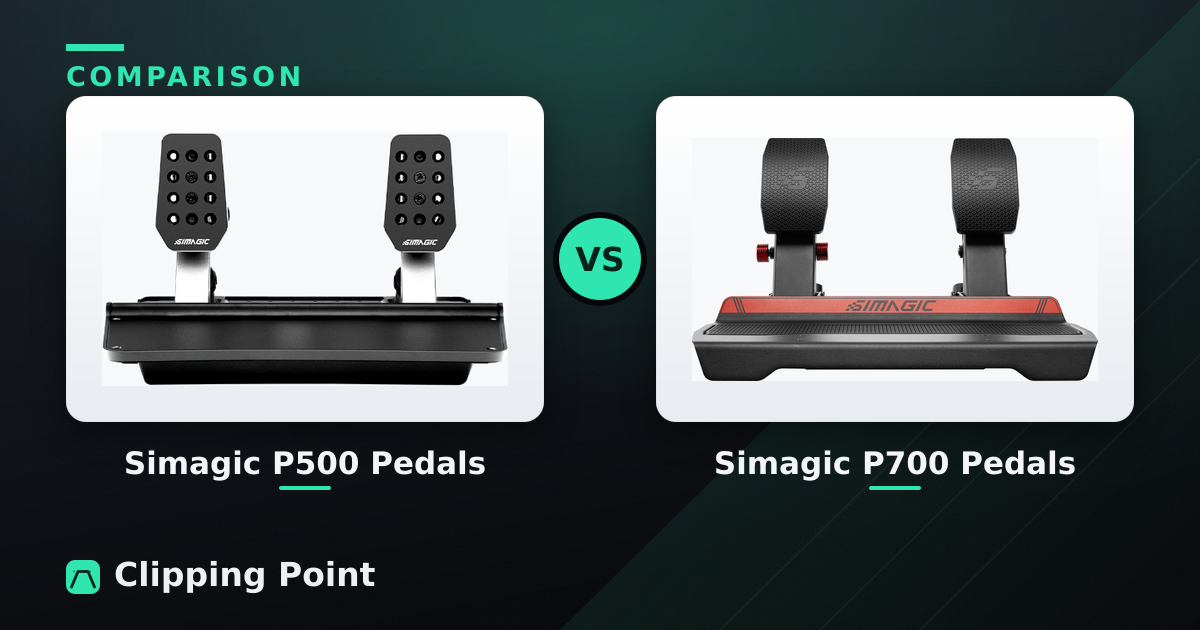
If your pedals live on a wheel stand or clamp to a desk, buy the Simagic P500, pocket the difference, and put it toward a proper mount. If you’re bolted to an aluminum profile rig and you brake hard enough that repeatability decides your lap time, the Simagic P700 is worth the extra money, and I’d stop agonizing and order it. That’s the whole verdict. The rest of this is me earning it, because the difference between these two sets is real but narrower than the price gap suggests, and it lives almost entirely in one pedal.
Both are load-cell sets. Both run standalone over USB, so they work with a Fanatec base, a Moza base, a Logitech Pro, whatever. Both use Simagic’s SimPro Manager software, which is better than it was two years ago and still occasionally makes you sigh. The throttle on each is fine. The clutch on each is fine. You are paying the upgrade money for the brake, and specifically for how the brake behaves in the last 20 percent of pressure, where trail braking actually happens.
What the extra money buys
The P500 brake is a load cell behind an elastomer stack. Press the pedal, the elastomers compress, the cell reads force, done. It’s the same basic architecture as a Fanatec CSL LC kit or Moza’s SR-P Lite, just built noticeably better, with a metal chassis that doesn’t creak and adjustment that doesn’t require disassembling half the pedal.
The P700 adds two things that matter and several that don’t. The ones that matter: a higher-rated load cell with a two-stage elastomer arrangement, and a damper on the brake. The damper is the actual product. Elastomers alone give you a force curve, but they give it to you instantly, and your leg is not a precision instrument at 2 a.m. after four stints. The damper adds resistance that depends on how fast you stab the pedal, which smooths out the panic-brake spike and makes small pressure corrections feel like corrections instead of coin flips. Hydraulic-damped brakes are the thing people mean when they post “load cell was a revelation, damped load cell was the second revelation” on r/simracing, and for once the forum consensus is right.
The ones that don’t matter as much: nicer machining, a beefier baseplate, more pedal-face adjustment range, a clutch that feels slightly less like an afterthought. Pleasant. Not worth money on their own.
Price-wise you’re looking at around $250 to $300 for the P500 depending on region and whether you take the two-pedal or three-pedal version, and somewhere around $450 and up for the P700 set. Check current pricing, because Simagic’s regional distributors do their own thing and sale weeks move these numbers around a lot.
Unboxing and the first hour
Simagic packs pedals well. Dense foam, everything bagged, a full set of allen keys you’ll actually use, spare elastomers in a labeled bag instead of the mystery-hardware ziplock some brands ship. The baseplates have slotted holes on sensible spacing, so if you’re coming from most common rigs you won’t be drilling. Desk-clamp users: neither set ships with a desk mount, plan for that.
First-hour reality: plug in USB, install SimPro Manager, and immediately accept a firmware update, because there is always a firmware update. Calibrate each pedal through its full travel, then set your maximum brake force. This is the step people skip and then post “load cell brakes are overrated” threads about. Out of the box the brake max is set high. Start around 55 to 60 percent of whatever you can comfortably hold for a two-second brake zone, race a week, then creep it up. Your calf will tell you when you’ve found the ceiling.
In iRacing, set brake force factor to 0.0 (linear) and do your shaping at the pedal, not in the sim. In ACC, leave gamma at 1.00 for the same reason. Stacking curves in both places is how you end up with a brake you can’t explain to yourself.
One genuine annoyance: SimPro Manager stores profiles locally and has, twice in my time with it, quietly reverted to defaults after an update. Screenshot your settings. It takes ten seconds and saves you a night of “why am I locking the left front into every corner.”
The part that matters: braking
Here’s the test I keep coming back to. Monza, turn one, Porsche 992 GT3 R, iRacing. You arrive at about 280 km/h and need a huge initial hit followed by a long, decaying release down through the chicane. This corner exposes brake hardware like nothing else.
On the P500, the initial hit is great. Load cell, firm stack, no complaints, and it’s a massive step up from any potentiometer pedal you might be upgrading from. The release is where you notice the ceiling. As you bleed off pressure, the elastomers rebound at their own rate, and there’s a slightly springy, undamped quality to the pedal coming back at your foot. You adapt to it. Within a week it’s your normal. But your minimum-pressure consistency in long brake zones will have a bit more scatter, and you’ll see it in the telemetry as fuzz on the brake trace during trail-off.
On the P700, that same release is planted. The damper resists the pedal returning just as it resists the pedal going in, so the pressure you intend is the pressure you get. My brake traces got visibly cleaner within two or three sessions, and my worst laps got closer to my best laps, which matters more than the best laps did. In ACC at Spa, holding 10 or 15 percent brake through the entry to Pouhon-style fast stuff, the difference is even more obvious: the P500 asks you to actively balance the pedal, the P700 just sits where you put it.
Is that worth roughly $150 to $200? On a rigid rig, for someone racing in splits where a tenth is ten positions, yes, and it’s not close. On a flexing desk, no, and I’ll get to why.
The throttle, the clutch, and other pedals you’ll stop thinking about
The throttles are near-identical in feel, with swappable springs for tension. The P700’s has a longer, slightly smoother travel that’s nice for rain races in Le Mans Ultimate, where partial throttle out of slow corners is the whole game. It’s a small thing. Nobody has ever bought pedals for the throttle and nobody should start.
Clutches: both work, both have a detectable bite point, both are perfectly adequate for launching in iRacing and then resting your foot for the next 40 minutes. If you don’t drift or race classic content, the two-pedal P500 exists for exactly you, and it’s the best value in the whole Simagic pedal range.
The brakes creak, eventually. Both of them. It’s the elastomer stack working against its guide, and a dab of the included silicone grease fixes it in five minutes. This comes up in the Simagic Discord roughly weekly, always from someone convinced their pedal is dying. It isn’t. Grease it. Also check the pedal-face bolts after the first month, because a couple of mine walked loose and the resulting click drove me mildly insane for two sessions before I found it.
Mounting is the actual deciding factor
Read this section twice if you’re on a desk.
A damped, high-force load cell brake transmits everything you give it into whatever it’s bolted to. If that thing is a desk, the desk moves. If it’s a wheel stand, the stand twists. Every millimeter of flex is fake pedal travel your brain has to filter out, and it filters it out by being less precise. I ran a P700-class brake on a wheel stand for a month during a house move, and it braked worse than the cheaper set did on my rig. All of the P700’s advantage lives in stiffness. Flexible mounting deletes it and you paid for nothing.
The P500, tuned to a moderate max force, tolerates imperfect mounting far better. Softer stack, lower forces, less energy going into your furniture. This is the entire logic of my verdict up top, and it’s the thing spec-sheet comparisons never mention.
| Simagic P500 | Simagic P700 | |
|---|---|---|
| Price | around $250-300 | around $450+ |
| Brake | load cell + elastomers | load cell + elastomers + damper |
| Best case | wheel stand, desk, first rig | 8020 rig, hard mounting |
| Weak point | undamped brake release | wasted money if mounting flexes |
Against the rest of the market
Cross-shopping is fair here. Moza’s CRP2 sits near the P700’s money and is a genuine rival, with the usual Moza caveat that they iterate fast and support maturity is still catching up. Fanatec’s CSL Elite V2 pedals are fine hardware wrapped in Fanatec’s shipping and support reputation, which I’m no longer willing to gamble on and I say that as someone who owned three of their wheels. Heusinkveld Sprints remain the reference two-pedal set, and they cost Sprint money, which is to say considerably more than a P700 for a set that doesn’t include a clutch. The P700’s pitch is 80 percent of the Sprint experience for half the outlay, and having driven both, I think that math roughly holds.
If money genuinely isn’t a constraint and you’re deep enough to care, Simagic’s own Simagic P-HPR line above these is where the true hydraulic stuff lives. Most people asking “P500 or P700” should not be in that conversation yet.
Which one, then
Buy the Simagic P700 if you have a rigid rig, you already know load cell braking, and you race timed content where consistency is the currency. The damper is not a luxury at that point. It’s the difference between a brake you operate and a brake you trust, and once you’ve driven damped you will not go back. I didn’t.
Buy the Simagic P500 if this is your first load cell set, your mounting situation is compromised, or the P700 money would otherwise come out of your rig budget. A P500 on a rigid mount beats a P700 on a wobbly one every single time, and upgrading pedals later is easy. Upgrading a desk into a rig is the purchase that actually changes your driving.
The one buyer I’ll talk out of both: if you’re still on a Logitech or Thrustmaster base and pedals combo and can only upgrade one thing, and you mostly do casual lapping, a better wheelbase will make you happier day to day. Pedals win for lap time. Wheels win for fun. Know which one you’re actually shopping for.
FAQ
Do Simagic pedals work with non-Simagic wheelbases? Yes, fully. They connect over their own USB cable and show up as a separate controller, so they’ll run alongside a Fanatec, Moza, Asetek, or Logitech base with zero drama. Bind the axes in-sim and you’re done. You only need SimPro Manager for calibration and curves, not for day-to-day running.
Is the P700 too stiff for desk mounting? Stiffness isn’t really the problem, force is. You can soften the P700’s stack and lower its max force until a desk survives it, but at that point you’ve paid P700 money to run P500 forces, and the damper’s benefit mostly disappears under desk flex. If a desk is your medium-term reality, the P500 is the better-engineered choice for you, not just the cheaper one.
Should I get the two-pedal or three-pedal version? Two, unless you have a concrete use for a clutch: H-pattern shifting, drifting, historic content, or clutch-drop starts you refuse to automate. In GT3 and formula sims the clutch is furniture. You can add one later if your habits change, and most people’s don’t.
Before you order either: measure your mounting situation with your foot, not a ruler. Sit down, press your current brake as hard as you’d want your new max force to be, and watch whether anything visibly moves. Nothing moves, buy the P700 and enjoy it. Something moves, buy the P500 and spend the difference on whatever stops the moving. That test costs nothing and it’s more useful than every spec sheet Simagic publishes.