
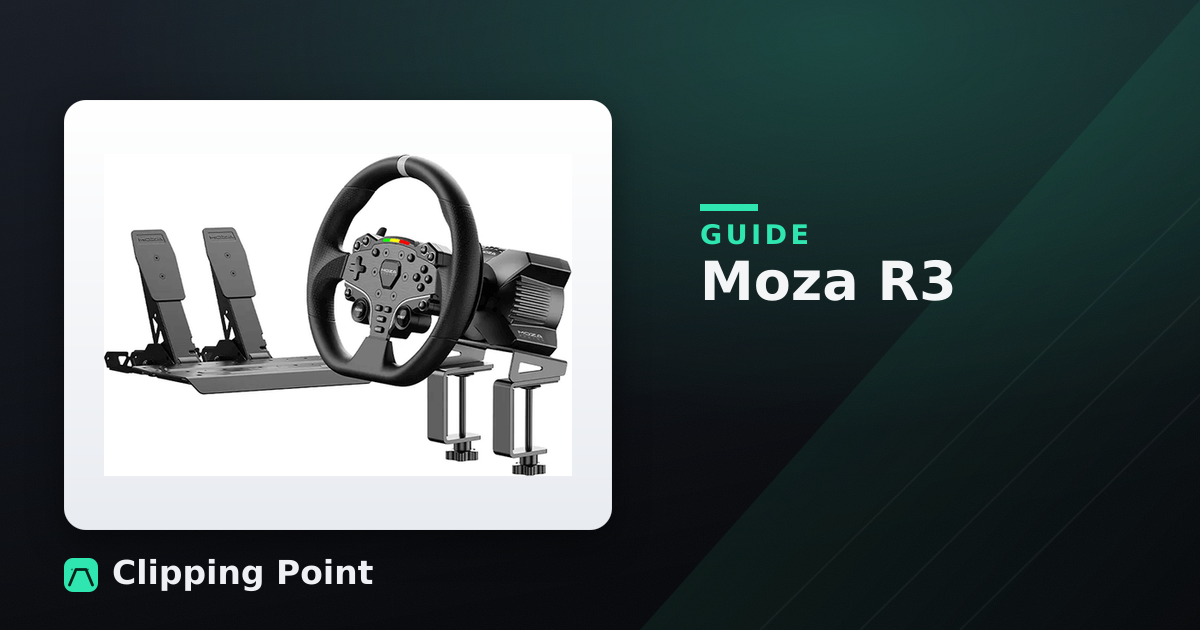
Buy the Moza R3. That’s the answer if you’re standing at $300 and want a wheel that won’t feel like a downgrade the week after you buy it. It’s a 3.9 Nm direct drive base with a wheel and a pedal set in the box, and at its usual sale price it sneaks under the line. Everything else in this bracket is either a belt-driven relic pretending it’s still 2019, or a bare base that blows the budget the second you add pedals and a rim.
I’ll defend that pick, and I’ll also tell you where it annoyed me, because it did. But first the thing nobody selling you a wheel wants to say out loud: at $300 you are buying the base of a hobby, not the finished thing. The pedals that come bundled at this price are the part you’ll replace first, usually within a year, and budgeting as if the wheel is a one-and-done purchase is how people end up frustrated. Plan for the base to stay and the rest to churn. If you want the whole ladder above this price, our best sim racing wheels guide ranks it by tier.
Why direct drive, and why 3.9 Nm is enough
A few years ago “direct drive under $300” was a punchline. You bought gears or belts (Logitech, Thrustmaster) and you accepted the notch, the deadzone slop, the FFB that clipped and clattered. Then Moza and Fanatec dragged entry DD down into gear-wheel money and the whole floor moved.
Direct drive means the wheel bolts straight to the motor shaft. No belts stretching, no plastic gears rounding off, no dead spot in the center where you can’t feel the front tires load up. That center feel is the whole point. On a gear wheel you’re always a half-second behind the car because the mush around center hides the moment the fronts start to let go. On even a weak DD base you feel it arrive. That’s the upgrade people mean when they say direct drive “ruined” gear wheels for them.
Now, 3.9 Nm. Spec-chasers online will tell you it’s weak, that you need 8 or 12 or 15 Nm to feel anything. Ignore most of that. Real GT3 cars don’t have heavy wheels; they have power steering. What you actually want is detail and no clipping, and 3.9 Nm delivers plenty of both for a wheel you’re gripping in a normal chair on a normal desk. I’ve run the same laps at Brands Hatch in ACC on a 3.9 Nm base and a 9 Nm base back to back, and yes the bigger motor has more shove over the curbs, but the information about grip is basically identical. Unless you’re bolted to an aluminum rig, you’ll be turning a strong base down anyway because your desk can’t take the load. More on that in a second, because it’s the thing that actually ruins budget DD setups.
The Moza R3, after the honeymoon
Unboxing is quick. Base, wheel rim, a two-pedal set, a table clamp. The clamp is the first tell that this is a budget product. It works, it holds, but if you crank the FFB up and lean on the wheel through a long corner you’ll feel the whole thing flex against your desk. That’s not Moza being cheap so much as physics; a clamp on a hollow-top IKEA desk was never going to be rigid.
Setup runs through Moza’s Pit House software. It’s fine. Not pretty, occasionally you’ll plug in and Pit House won’t see the base until you replug the USB, and the firmware updater has bricked exactly nobody I know but always makes me hold my breath. First thing to do: set the wheel rotation. For most GT and touring cars I run 540 degrees. Formula stuff, less. Rally, crank it up to 900. The default out of the box is often set wider than you want for circuit racing and the car feels lazy until you fix it.
Here’s where I’d start the force feedback, and these are numbers I actually use, not spec-sheet guesses. In Pit House, base FFB strength around 70 to 80 percent so you leave headroom before clipping. In ACC, in-game gain around 65 to 70, with the minimum force setting nudged up just enough to kill the center deadzone (start around 4 to 6 and feel for when the small vibrations appear at center). In iRacing, use the auto setting once per car, then back it off a touch if the curbs feel like they’re trying to remove the wheel from your hands. The single biggest mistake beginners make is running everything at 100 percent and then wondering why the FFB feels like a flat wall of noise. That’s clipping. You’ve maxed the signal and lost all the fine stuff underneath. Turn it down until you can feel gravel differently from a curb differently from the tires locking.
The bundled pedals are the weak spot, and I want to be honest about it. They’re potentiometer pedals with a spring, no load cell. For your first month they’re totally fine and you’ll be a happy person. Then you’ll watch someone talk about load-cell brakes and how you brake by pressure not by position, and you’ll get the itch. A load cell measures how hard you push, like a real brake, so you can slam it and trust muscle memory instead of feathering by eye. Once it clicks it’s genuinely hard to go back. Budget for a load-cell pedal upgrade down the line and treat the bundled set as training wheels. That’s not a knock on the R3 specifically; every wheel at this price ships pedals you’ll outgrow.
Desk flex is the real enemy, not the motor
If you take one thing from this: the wheel base is rarely the limiting part of a cheap setup. Your desk is.
Direct drive puts real torque into whatever it’s mounted to, and that torque goes somewhere. On a rig it goes into rigid metal and comes back as clean feedback. On a desk it goes into flex. The desk twists a few millimeters, springs back, and now your FFB has a wobble in it that has nothing to do with the car. People blame the base, crank the settings, make it worse, and conclude budget DD is “harsh.” It’s not. It’s their desk doing a slow-motion trampoline impression.
Two fixes. Cheap one: shove the base as close to a desk leg as the cable lets you, and clamp to the thickest part of the top. Better one: a wheel stand or a proper rig. A basic wheel stand runs less than a night out and does more for feel than any amount of settings tweaking. If you’re set on desk-mounting, our best direct drive base for a desk guide covers which bases and clamps hold. If you’re buying a DD base and a desk clamp and nothing else, you’re leaving half the wheel’s ability on the table. I’d almost rather someone buy a slightly cheaper base and a stand than the fanciest base clamped to a flexy desk.
What about the alternatives
The Logitech G923 and the Thrustmaster T248 still sell by the truckload, and I understand why. They’re cheaper, they’ve got a shifter option, they’re at every electronics store. If your budget is hard-capped at $200 and it’s DD or nothing, sure, a gear wheel gets you racing. But if you can stretch to the Moza on sale, the belt-and-gear wheels feel a generation behind the moment you’ve driven both. The TrueForce trickery on the G923 is clever and it’s still not direct drive. Don’t let a shifter bundle talk you into a worse wheel; most people who swear they’ll drive H-pattern trucks end up racing GT3 with paddles inside a month.
The other trap is the bare base. The Moza R5 (our full review here) and Fanatec’s entry bases are excellent and they are not $300 by the time you’ve added a rim and pedals. A Fanatec CSL DD is a lovely thing, but Fanatec’s shipping and support reputation is genuinely rough right now, wait weeks for a replacement, RMA horror stories all over the forums, and I can’t tell someone spending their money carefully to walk into that. Moza’s the newer brand with the shorter track record, and its software has rough edges, but the stuff arrives and it works and their Discord actually answers. For a first DD wheel I weight that heavily.
Here’s the bracket the way I’d rank it:
| Wheel | Type | Torque | In the box | My take |
|---|---|---|---|---|
| Moza R3 | Direct drive | 3.9 Nm | Base, rim, 2 pedals | Best real answer under $300 on sale |
| Moza R5 (bundle) | Direct drive | 5.5 Nm | Varies | Better base, usually over budget once complete |
| Logitech G923 | Gear | ~2.3 Nm | Wheel, 3 pedals | Fine if capped at ~$200, feels dated |
| Fanatec CSL DD | Direct drive | 5–8 Nm | Base only | Great hardware, risky support, over budget |
FAQ
Is 3.9 Nm enough force feedback, or will it feel weak? It’s enough. You’ll likely run it at 70-80 percent anyway to avoid clipping and to keep your desk from flexing. The number people chase online matters far more on a rigid aluminum rig than in the chair-and-desk setup most buyers actually have. Detail beats brute force, and 3.9 Nm has the detail.
Can I just add better pedals later instead of buying a whole new wheel? Yes, and you should plan on exactly that. The base is the long-term part. A load-cell brake is usually the first and most worthwhile upgrade, and most budget DD pedals connect straight to the base or over USB. Buy the base you’ll keep; swap pedals when the bundled ones start limiting your braking.
PC only, or does it work on console? Check this before you order, it trips people up constantly. Entry Moza bases are PC-first. If you’re on Xbox especially, console licensing is fussy and not every base and rim combo is supported, so confirm your exact platform on the product page rather than assuming. If you’re weighing the R3 against Logitech’s console direct drive, our Moza R3 vs Logitech G RS50 breakdown covers it. Buying a PC-only base for an Xbox is the single most common return in this category.
So, actually buy it if
Buy the Moza R3 if you’re on PC, you’ve got roughly $300, and you want a direct drive base you won’t outgrow in a season. Before you order: measure your desk situation and add a $60 wheel stand to the cart if your desk has any flex in it, because that stand will do more for how the wheel feels than the difference between any two bases in this price range. Confirm the platform. And leave a little room in the mental budget for a load-cell pedal in six months, because you’re going to want it, and the base you’re buying today will still be sitting there happily driving it.