
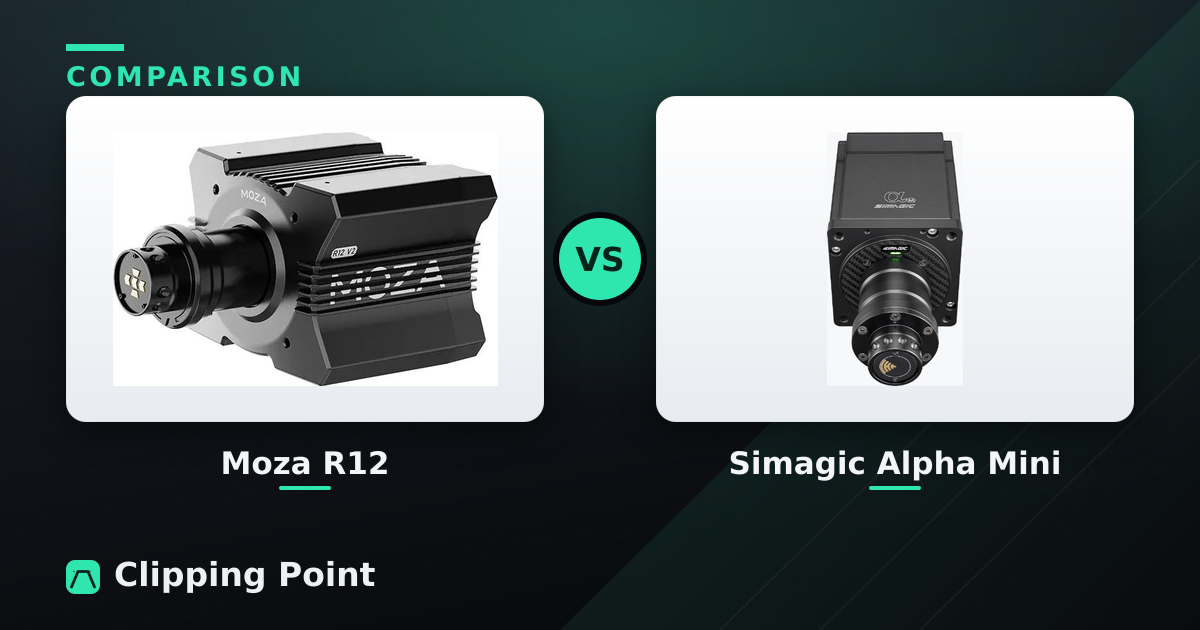
| Moza R12 | Simagic Alpha Mini | |
|---|---|---|
| Peak torque | 12 Nm | 10 Nm |
| Drive type | Direct drive | Direct drive |
| Platforms | PC · Xbox | PC |
| In the box | Base only | Base only |
| Best for | Strong FFB for GT and formula without going pro | Enthusiasts chasing detail over plug-and-play |
Specs from each manufacturer's current listings. Prices move constantly — hit the price buttons above for today's numbers.
Buy the Moza R12 unless you already know you are an FFB obsessive. That is the answer. It costs about the same as the Simagic Alpha Mini, gives you 12 Nm instead of 10, comes from a company whose software has gotten genuinely good, and plugs into a wheel lineup that covers everything from a $100 starter rim to a proper GT wheel with a dash. For the person searching this at 1 a.m. trying to decide where five-hundred-and-something dollars goes, that’s the safe call, and I mean safe in the boring, correct sense.
The complication, and the reason this article isn’t two paragraphs long, is that the Alpha Mini’s force feedback is a little bit nicer. Not stronger. Nicer. Simagic’s motor control has a fine-grained quality that Moza still doesn’t quite match, and if you spend most of your time in iRacing chasing tenths in cars where slip angle information matters, that difference is real and you will feel it. Whether it’s worth giving up torque, a slicker app, and easier warranty handling is the actual question. For most people it isn’t.
What you’re actually buying
Both of these are bare bases. No wheel, no pedals. Budget for that before you get attached to either number.
The R12 runs around $550 in the US. The Alpha Mini floats between about $450 and $550 depending on region, bundle, and which reseller you’re looking at, because Simagic sells through a patchwork of regional distributors rather than one storefront, and pricing drifts accordingly. On paper the Simagic can undercut the Moza. In practice, once you add a quick release adapter or a wheel, the totals land close enough that price shouldn’t decide this.
| Moza R12 | Simagic Alpha Mini | |
|---|---|---|
| Peak torque | 12 Nm | 10 Nm |
| Price (base only) | ~$550 | ~$450–550 |
| Software | Pit House | SimPro Manager |
| Quick release | Moza’s own QR | D1-spec QR |
| Cooling | Passive, no fan | Passive, no fan |
Neither has a fan, which matters more than reviewers admit. My old belt-drive Fanatec CSL made a faint whine I stopped noticing until it was gone. Both of these are silent apart from the motor itself doing its thing, and the Simagic makes a slightly more audible cogging click at low speed in menus. Harmless, but you’ll hear it once and then read a forum thread about it at midnight wondering if yours is broken. It isn’t.
On torque: 12 versus 10 Nm sounds like a rounding error and it is not. The useful difference isn’t peak strength, since almost nobody runs these things maxed for long sessions anyway. It’s headroom. Running the R12 at 8 Nm of output leaves the motor loafing, which keeps the feedback clean when the sim throws a big spike at you, kerb strikes especially. The Alpha Mini at 8 Nm is working closer to its ceiling. You feel that as a slightly compressed quality on the biggest hits. Subtle. Present.
How they actually feel to drive
I do most of my comparative testing in two places: the Porsche 992 GT3 R around Spa in ACC, because Eau Rouge and the Raidillon compression tell you everything about how a base handles sustained load stacking on top of detail, and the MX-5 at Lime Rock in iRacing, because a momentum car on a bumpy short track exposes whether small forces come through or get eaten.
In ACC the R12 is excellent and I have no notes worth money. The weight build through Eau Rouge is progressive, the wheel loads up hard at the bottom of the hill without the grainy edge cheaper bases get, and kerbs at the Bus Stop arrive as distinct impacts rather than a blur. I run Pit House at 100% with in-game gain at 68%, road sensitivity down at 2 or 3 (Moza ships it too high and it turns everything into gravel), and speed-dependent damping off. Leave the base’s own filters mostly alone. People stack interpolation and mechanical damper settings until the wheel feels like it’s turning through honey, then post that direct drive is overrated.
The iRacing MX-5 test is where the Simagic pulls ahead. The Alpha Mini transmits the front tires starting to push with a fidelity that’s hard to describe without sounding like a wine person, but here’s the concrete version: on the entry to Lime Rock’s Big Bend, carrying a little too much speed, the R12 tells you the front is sliding. The Alpha Mini tells you a beat earlier that it’s about to. There’s a texture to the transition, a fine vibration change as the contact patch gives up, that Simagic’s motor control preserves and Moza’s slightly smooths over. In iRacing I run the Alpha Mini with the in-sim force set via the auto button then dropped 5%, wheel force in SimPro at 100%, mechanical damper around 6%, friction and inertia at zero. Anything more than a whisper of damper on this base is a crime.
Le Mans Ultimate splits the difference. Its FFB is so good natively that both bases shine, and the hypercars’ power steering effect means torque headroom matters less. If LMU or rF2-derived sims are your main home, the gap between these two shrinks to nearly nothing.
Is the Simagic difference worth 2 Nm and everything in the next section? For maybe one buyer in five. You know if you’re that buyer. You’re the person who reads FFB settings threads for fun and can tell when a firmware update changed something before reading the changelog.
Software, or where Moza wins ugly
Pit House gets criticized for being bloated, and it is a bit much, with its telemetry dashboards and RGB nonsense nobody asked for. But the parts that matter work: per-game profiles that switch automatically, settings that stick, firmware updates that install without a ritual. Moza pushes updates frequently, which cuts both ways. Twice in the past year an update subtly changed the FFB character and the subreddit lit up about it, and Moza walked one of them back. Annoying. Also a sign of a company actually iterating.
SimPro Manager is the part of the Simagic experience that feels like it was translated twice. The layout buries common settings, some labels genuinely do not describe what the slider does, and profile switching is clunkier than it should be in 2026. It has improved. It started from a low place. Once you’ve dialed your settings you can ignore it for months, and plenty of Alpha Mini owners do exactly that, but the first week involves more Discord searching than it should. The Simagic Discord is actually one of the brand’s best assets; the answers are there, they’re just not in the manual.
Support is the same story with higher stakes. Moza has grown a real distribution and RMA presence in the US and EU. Simagic warranty service typically routes through whichever reseller you bought from, and the experience ranges from great to weeks of emails depending on the reseller. Nobody thinks about this before buying. Everybody thinks about it after the base starts doing something weird fourteen months in.
Mounting, and the desk-clamp fantasy
Both companies sell table clamps and both should stop.
At 10 to 12 Nm, an IKEA desk becomes part of your force feedback. Every strong counter-force flexes the desktop, the flex absorbs exactly the fine detail you paid direct-drive money for, and your monitor sways like it’s at a concert. I ran the R9 on a clamp for a month years ago before admitting the problem, and these bases are stronger. If a rig isn’t in the budget yet, a standalone wheel stand or an aluminum profile wheel deck bolted to something heavy gets you most of the way. Front-mount both if you can; the R12 supports it directly, and it’s stiffer than side bolts.
One real annoyance per base, since everything has one. The R12’s quick release is fine but proprietary, so you’re marrying Moza rims (the workaround adapters exist and add slop, defeating the point). Early units also shipped with a base-to-clamp bolt torque spec that let the base creep under hard use; check yours after the first week. The Alpha Mini’s D1-spec QR is more open, but its stock hub-to-wheel bolt pattern conversation on r/simracing is evergreen, and the base’s mounting holes on the underside are a slightly awkward pattern for some third-party decks. Measure before you order extrusion brackets.
The lineup question
Here Moza just runs away with it. The Moza ES wheel is a legitimately decent starter rim for around $100. The CS V2P at around $350 is the sweet-spot GT wheel most R12 buyers should get. There are formula rims, round rims, a dash, handbrakes, and the Moza CRP2 pedals if you want to stay one-brand with a proper load cell. Everything talks to Pit House. Everything ships from stock, usually.
Simagic’s wheels are good, in some cases better built than Moza’s equivalents. The GT Neo hub with your own 300mm rim is a genuinely great setup that Moza can’t quite match at the price. But the catalog is thinner, stock is inconsistent by region, and you’ll sometimes wait.
There’s also the elephant: Simagic launched the EVO line, and the Alpha Mini is now the older architecture. It’s still sold, still supported, and firmware still arrives. But if you’re buying Simagic in 2026, price the Alpha EVO before committing to the Mini, because the street-price gap is sometimes small enough to make the Mini the wrong Simagic. That’s a strange sentence to write in a Mini comparison and it’s true.
FAQ
Is the Moza R12 stronger than the Alpha Mini? Yes, 12 Nm versus 10 Nm, and the difference is noticeable, mostly as cleaner headroom on spikes rather than raw resistance. Both are far past the strength anyone needs for a desk-adjacent setup, and both will hurt your thumbs in a crash if you drive with them hooked through the spokes. Don’t.
Which has better force feedback? The Alpha Mini, by a small margin that shows up most in iRacing and rF2-based sims, as finer detail during grip transitions. In ACC and console-adjacent racing the gap narrows to the point where torque headroom and software matter more, and the R12 is the better overall package.
Do these work on PlayStation or Xbox? No. Both are PC bases. If Gran Turismo 7 is part of your life, neither belongs in your cart; you’re shopping Fanatec or Logitech’s console-licensed hardware instead, with all the shipping-and-support folklore that entails.
Before you order
Buy the Moza R12 if you want the strongest all-around package: more torque per dollar, the widest wheel selection, software your non-enthusiast brain can operate, and an RMA path that doesn’t depend on a reseller’s mood. That’s most readers.
Buy the Simagic Alpha Mini if iRacing is your primary sim, you care about the last few percent of FFB texture, and you’re comfortable doing your settings homework in a Discord instead of a manual. Also price the Alpha EVO first, seriously.
And before either order goes in: look at what the base will bolt to. If the answer is a desk clamp on a hollow-core desk, spend the difference on a wheel stand and buy the cheaper base, because a 9 Nm base on a rigid mount beats a 12 Nm base on a wobbly one every single time. Check your region’s actual warranty terms for Simagic resellers, confirm the R12 bundle you’re eyeing includes the QR wheel side, and count the true cost with a wheel and load-cell pedals included. That last number is the one that should make your decision, not the torque figure on the box.